Quarterly information security transformation roadmap template

Quarterly information security transformation roadmap template
Slide 1 of 2
Favourites Favourites

Try Before you Buy Download Free Sample Product

Audience Impress Your
Audience
Editable 100%
Editable
Time Save Hours
of Time
The Biggest Sale is ending soon in
0
0
:
0
0
:
0
0
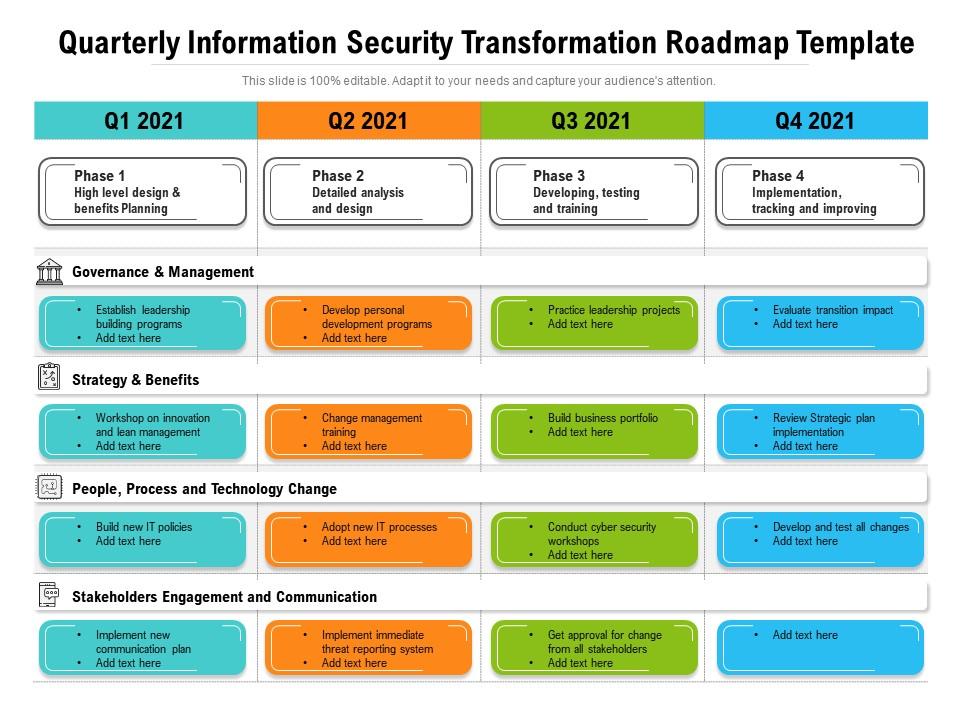
Presenting Quarterly Information Security Transformation Roadmap Template PowerPoint slide. This PPT presentation is Google Slides compatible hence it is easily accessible. This PPT theme is available in both 4,3 and 16,9 aspect ratios. This PowerPoint template is customizable so you can modify the font size, font type, color, and shapes as per your requirements. You can download and save this PowerPoint layout in different formats like PDF, PNG, and JPG.

FAQs for Quarterly information security

Key components of an effective information security roadmap include risk assessment frameworks, governance policies, incident response protocols, compliance requirements, and technology infrastructure planning. These elements work together by identifying vulnerabilities, establishing clear accountability structures, and enabling rapid threat mitigation, with many organizations finding that strategic integration ultimately delivers enhanced operational resilience and competitive advantage.

Organizational goals align with information security roadmaps by integrating business objectives, compliance requirements, risk tolerance levels, and operational priorities into comprehensive security strategies. Through strategic planning, companies ensure security investments support revenue growth, customer trust, and competitive positioning, while financial institutions and healthcare organizations find that aligned roadmaps deliver enhanced regulatory compliance and operational resilience.

Risk assessment serves as the foundational cornerstone for developing an information security roadmap, identifying vulnerabilities, threat landscapes, compliance requirements, and business-critical assets that need protection. This systematic evaluation enables organizations to prioritize security investments strategically, allocate resources efficiently, and build layered defenses, with many enterprises finding that comprehensive risk assessment ultimately delivers measurable ROI and competitive advantage.

Organizations should update their information security roadmap annually at minimum, with quarterly reviews recommended for rapidly evolving sectors like financial services, healthcare, and technology companies. These regular assessments enable businesses to adapt to emerging threats, regulatory changes, and technological advances, while ensuring security investments align with operational growth, ultimately delivering enhanced protection and competitive advantage in an increasingly complex digital landscape.

Effectiveness metrics include security incident reduction rates, mean time to detection and response, compliance audit scores, vulnerability remediation timelines, and security awareness training completion rates. These measurements enable organizations to track progress across financial services, healthcare, and manufacturing sectors, with many finding that regular metric reviews enhance resource allocation, demonstrate ROI to stakeholders, and ultimately strengthen their overall security posture.

Organizations can prioritize security initiatives by conducting comprehensive risk assessments, aligning security goals with business objectives, evaluating regulatory compliance requirements, and analyzing potential financial impact of threats. Through strategic risk scoring and stakeholder input, companies across sectors like healthcare, banking, and retail streamline resource allocation, ultimately delivering enhanced protection while maximizing operational efficiency and competitive advantage.

Common pitfalls include inadequate risk assessment, unrealistic timelines, insufficient stakeholder engagement, neglecting regulatory compliance requirements, and underestimating resource allocation needs. These challenges can derail implementation, with many organizations finding that overly ambitious scopes without proper phasing ultimately compromise security effectiveness, while lack of executive buy-in significantly hampers strategic progress and operational success.

Regulatory compliance significantly shapes information security roadmaps by mandating specific controls, audit requirements, and risk management frameworks like GDPR, HIPAA, or SOX. Organizations must align their security investments with compliance timelines, implementing required safeguards, monitoring systems, and reporting mechanisms, while these regulatory drivers often accelerate security modernization and ultimately strengthen overall cyber resilience.

Best practices for stakeholder engagement during roadmap development include regular cross-functional meetings, transparent communication channels, documented feedback loops, risk assessment workshops, and phased implementation reviews. These approaches streamline alignment by incorporating diverse perspectives, addressing security concerns early, and ensuring buy-in across departments, with many organizations finding that structured engagement ultimately delivers faster implementation and reduced resistance to security initiatives.

Technology advancements can be incorporated through regular assessment cycles, pilot programs for emerging solutions, strategic alignment with business objectives, and phased implementation approaches. Organizations increasingly integrate AI-powered threat detection, zero-trust architectures, and cloud-native security tools, with many finding that systematic evaluation and gradual adoption delivers enhanced protection while minimizing operational disruption.

Training programs should include phishing simulation exercises, security awareness workshops, incident response drills, data handling protocols, and role-specific cybersecurity training. These educational initiatives enhance employee vigilance, reduce human error risks, and strengthen organizational security culture, with many companies finding that regular training significantly decreases security incidents while improving compliance readiness.

Incident response plans should be integrated through strategic alignment with security architecture, regular testing schedules, stakeholder training programs, and continuous improvement processes. This integration enables organizations to minimize breach impact, reduce recovery time, and maintain business continuity, with many financial institutions and healthcare systems finding that coordinated response frameworks significantly enhance their overall security posture.

Strategic information security roadmaps focus on long-term organizational goals, enterprise-wide risk management, and aligning security investments with business objectives over 3-5 years. Tactical roadmaps address immediate operational needs, specific technical implementations, and short-term security gaps, with organizations like financial institutions finding that combining both approaches delivers comprehensive protection while maintaining strategic vision and operational efficiency.

Organizations ensure continuous improvement by implementing regular security assessments, threat landscape monitoring, incident response analysis, employee training updates, and technology refresh cycles. Through systematic quarterly reviews and stakeholder feedback loops, companies across sectors like healthcare, finance, and retail adapt their security frameworks to emerging threats, ultimately delivering enhanced protection, reduced vulnerabilities, and sustained competitive advantage.

Information security governance establishes strategic direction, policy frameworks, risk tolerance levels, and accountability structures that directly influence roadmap priorities and implementation approaches. Through executive oversight and cross-functional collaboration, governance bodies ensure security initiatives align with business objectives, regulatory requirements, and operational needs, while enabling organizations to balance security investments with growth opportunities and competitive positioning.

Ratings and Reviews

0% of 100
Review Form
Write a review
Most Relevant Reviews

No Reviews