


Five years information technology security roadmap template




Try Before you Buy Download Free Sample Product
 Impress Your
 Audience
 100%
100% Editable
 Save Hours
 of Time


The success rate of business plans is hugely dependent on the plan of action, and this editable Five Years Information Technology Security Roadmap Template rightly serves the purpose. Encapsulate all the information related to the project in a well structured manner to obtain maximum efficiency by incorporating our stunning PowerPoint theme. State the critical deliverable, steps involved, time frame, workforce allocation, and lots more in an easy to understand manner by utilizing this pre designed roadmap PowerPoint layout. You can also prioritize your tasks and discuss the problem areas with your colleagues by incorporating this tailor made PPT layout. Empower your work plan by employing this professionally designed PPT theme. Entrepreneurs can download Five Years Information Technology Security Roadmap Template as a beneficial communication tool that facilitates in collaborating with different tasks and achieve targets.
People who downloaded this PowerPoint presentation also viewed the following :
Content of this Powerpoint Presentation
Almost every facet of business has gone online over the last decade. The World Economic Forum estimates that digital transformation will generate $100 trillion in industrial value by 2025. Information technology has improved connection, trade, customer service, and many other aspects. However, due to this exponential increase, the protection of all digital assets and network equipment has become increasingly important.
It is imperative that your company follow this security procedure for safeguarding its IT assets, including digital devices, computer networks, and data. Companies also require a strong IT security framework to avoid data theft.
Download this quarterly plan for information technology security to create a vision for your cybersecurity needs.
The IT security roadmap is an effective toolkit for safeguarding computer assets from ransomware, malware, and viruses. Download this pre-made PowerPoint template from SlideTeam to create a five-year IT security roadmap that will shield your data and computer network from attacks. This slide helps with future implementation and control capability. Use this slide to carry out a well-thought-out effort by adhering to the roadmap's comprehensive action plan.
Planning a cyber security training? Don’t worry, take a look at this pre-designed PPT.
Template 1: Five Years Information Technology Security Roadmap Template
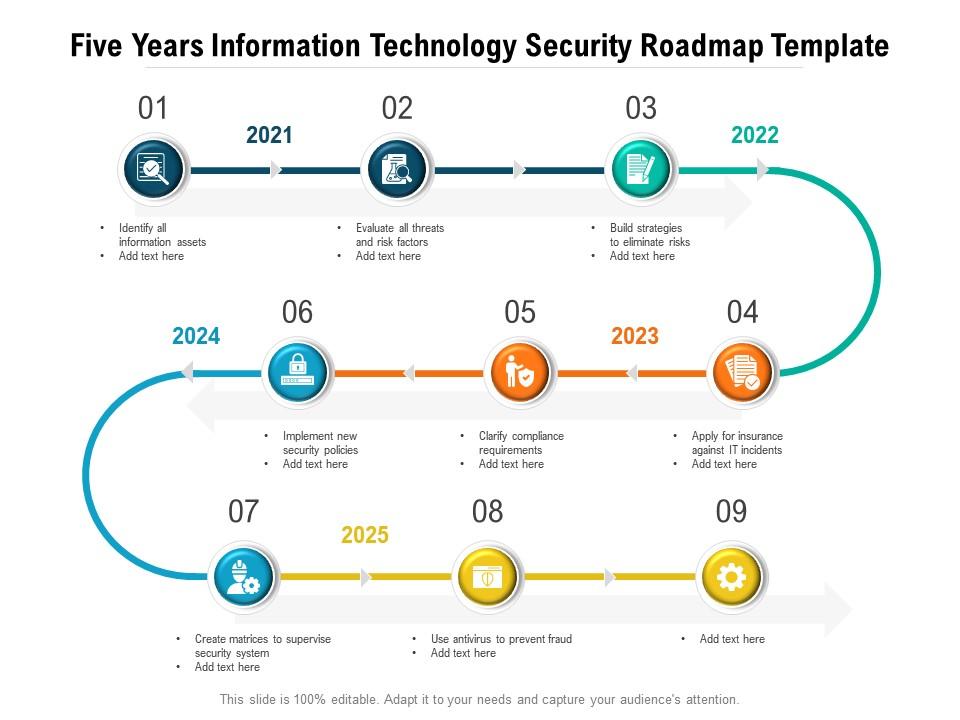
Use this PowerPoint Template to create a five-year IT security roadmap for your business. This action plan depicts the series of steps to be taken from 2021-2025 to ensure protection of your organization’s assets. Browse and download this slide as a crucial defense against cyberattacks, phishing attempts, data theft, and other threats.
Kickstart your IT security journey
SlideTeam’s pre-designed PPT Template offers you with a thorough plan for improving your IT security.
P.S. Browse and download this custom-made PPT to safeguard your digital data.
Five years information technology security roadmap template with all 2 slides:
Give your audience a fulfilling experience. They will find our Five Years Information Technology Security Roadmap Template elevating.
FAQs for Five years information technology
Honestly, you need five main things: figure out where you're at now, analyze your risks, set clear security goals, map out timing, and decide how you'll track progress. Most people totally skip that first audit step and kick themselves later - don't be that person. Once you know your biggest weak spots, set realistic deadlines for fixing them. I'd go with 12-18 months total, broken into quarterly chunks so you don't lose steam. Build in regular check-ins too since new threats pop up constantly. Oh, and make sure your milestones are actually measurable - vague goals are useless.
Start with a full security audit - basically figure out what you've actually got right now. Run some vulnerability scans and check your access controls. Review your policies too, though half the time those are outdated anyway. Don't skip the employee awareness piece - that's where most breaches happen, not some fancy zero-day exploit. Map your tech stack and document the gaps you find. Getting other teams involved helps since they'll catch stuff you missed. Once you know where you stand, prioritize the worst problems first.
Risk assessment is your starting point for figuring out what security stuff actually needs attention. Map out your biggest vulnerabilities first, then think about which threats could realistically mess with you. Rank everything by how badly it'd hurt the business. Honestly, I've watched teams get totally sidetracked by weird theoretical scenarios while their basic password policies are garbage. Your assessment results should drive your whole timeline and where you spend money. Just throw together a simple risk matrix to see your current gaps - you'll know exactly what to tackle first.
Honestly, just start with a risk assessment to figure out your biggest weak spots. What would absolutely wreck your business if it got hit? Customer data breach? Financial systems going down? That's where you focus first. I know it sounds cheesy, but actually think like a hacker would - it really does help you see the gaps. Your compliance stuff obviously can't wait, so those deadlines aren't flexible. Mix some quick security wins with your bigger long-term projects. Just don't plan anything you can't actually pull off with your current budget and team. Been there, learned that the hard way.
Track both tech and business stuff to prove your roadmap's working. Incident response times, vulnerability fix rates, and how fast you catch threats are solid starting points. Security training completion rates matter too - honestly, phishing sim results tell you everything about whether people actually get it. For the business side, measure downtime costs and compliance scores. Oh, and insurance premiums can shift based on your security posture, which executives love seeing. Pick maybe 5-6 metrics that your leadership actually cares about. Review monthly so you don't lose steam.
Quarterly is the bare minimum, but monthly is way better if you can manage it. Cyber threats move crazy fast now - waiting too long means you're already behind. Your business stuff changes more than you realize too, budgets and priorities and all that. Annual reviews? Forget it. That's useless. I always tell people to just block time on their calendar right now, otherwise you'll keep putting it off forever. Trust me on that one. The landscape shifts so much that even three months can feel like ancient history in security terms.
Honestly, get the executives on board first or you're screwed when budget season hits. Do a proper risk assessment upfront, then focus on what actually protects the business - not whatever sounds cool in presentations. Phase everything out gradually so you can test without nuking your systems. Your team needs training throughout because brilliant tech is useless if nobody knows how to run it. Write everything down as you go (seriously, future you will be grateful when someone inevitably asks "wait, why'd we choose this approach?"). Oh, and build in checkpoints to review progress. Sometimes you gotta change course.
Different groups need different angles - execs want ROI and risk stuff, tech teams need the nitty-gritty details. Make a visual roadmap first because honestly, dense security docs put everyone to sleep. Plain English beats jargon every time. Connect everything back to what they actually care about business-wise. Regular check-ins help you stay on track and pivot when needed. Oh, and be upfront about problems and what you'll need resource-wise. Way better than blindsiding people later when things get messy.
Honestly, just pick a project management tool that your team will actually use - Jira's solid if you're already using other security tools since everything connects nicely. Asana and Monday.com work great too. Set up milestones and timelines there first. If you need compliance tracking, ServiceNow or Resolver are worth looking at, though they can be overkill. Dashboard stuff like Tableau helps with executive reports but that's secondary. My advice? Don't overthink it. Start with one tool everyone will adopt instead of trying to implement five different platforms at once. We made that mistake before and it was a mess.
Don't treat training like some separate thing you tack on later. Build it right into whatever you're already rolling out. Figure out where people mess up most - usually phishing or terrible passwords. Then when you're deploying new MFA tools, that's when you train on MFA. Makes way more sense than those boring "cybersecurity awareness month" emails everyone deletes anyway. Train your incident response team before you actually need them to respond to incidents (seems obvious but you'd be surprised). Do quarterly check-ins and actually see if behavior's changing, not just completion rates.
Dude, the two killers I always see: going way too big right away, and forgetting to loop in leadership early on. So many gorgeous plans just... die because nobody got stakeholders involved from the start. Focus on your biggest risks first instead of trying to fix literally everything - that never works anyway. When you're talking to execs, ditch the tech speak completely. They don't care. Actually track real metrics too, not just "yeah we did the thing." Honestly? Start tiny, grab a few quick wins, then use that momentum to keep going.
Yeah, definitely start with compliance as your baseline - figure out what regulations hit your industry first (GDPR, HIPAA, whatever applies). Map those requirements out before anything else. Multi-jurisdiction stuff gets annoying but you can't avoid it. Build your timeline around their deadlines and audit schedules. Here's the thing though - don't just check boxes and call it done. That's pretty much the bare minimum. Use compliance as your foundation, then add security measures that actually make sense for your business risks. Some companies go overboard, but you want protections that fit your reality.
Think of incident response planning as your emergency playbook for when hackers actually get in. Map it out early because you don't want people scrambling around asking "who do I call?" while your systems are burning down. Your plan needs the response team roles, how to communicate, steps for containment, and recovery procedures. Honestly, the companies that wing it usually regret it big time. Test everything with practice runs so your team isn't learning their jobs during a real crisis. Those tabletop exercises might feel silly, but they're worth it when actual chaos hits.
So AI and ML basically automate all that threat detection stuff your team's probably drowning in right now. Your people won't have to dig through thousands of alerts anymore - the tech spots patterns and weird behavior way faster than we ever could. Zero-day attacks? Those sneaky persistent threats that slip past regular tools? Yeah, it catches those too. What's cool is it actually learns from each attack, gets better over time. Oh, and don't try to do everything at once - pick something like endpoint detection first, then build from there once everyone's used to it.
Honestly, you're dealing with three big headaches here. Budget constraints are brutal - you don't have enterprise-level money but face the same threats. Your IT folks are already juggling ten different things, and cybersecurity expertise isn't something you can just magically add to someone's skillset overnight. Business priorities constantly compete too. Like, do you invest in security or that new sales system? My take? Figure out what data/systems would actually kill your business if compromised. Focus your limited cash there first instead of trying to protect everything equally.
No Reviews