

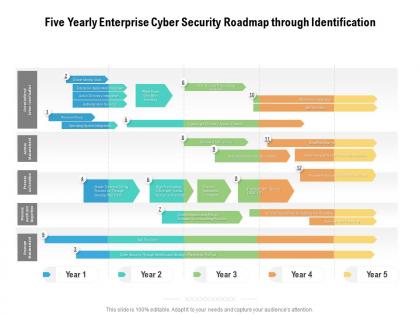
Five yearly enterprise cyber security roadmap through identification




Try Before you Buy Download Free Sample Product
 Impress Your
 Audience
 100%
100% Editable
 Save Hours
 of Time


A well thought out action plan makes execution easier and increases the possibility of success significantly. Ensure hitting all the milestones within the deadlines by introducing our fully customizable Five Yearly Enterprise Cyber Security Roadmap Through Identification. Streamline the work related information, budget, timeframe, key deliverable, landmarks, and major steps involved, all in one place to give an organized overview of the project by utilizing our PowerPoint theme. Minimize time lag and increase work efficiency by providing insight into the process with our comprehensively researched roadmap PowerPoint layout. Color coding helps in highlighting the process and grabs the attention of the audience. Download our handy Five Yearly Enterprise Cyber Security Roadmap Through Identification to identify the possible problem areas in a much shorter time and propose solutions. Have a productive brainstorming session with your workforce by utilizing our action plan visualization tool.
People who downloaded this PowerPoint presentation also viewed the following :
Five yearly enterprise cyber security roadmap through identification with all 2 slides:
Use our Five Yearly Enterprise Cyber Security Roadmap Through Identification to effectively help you save your valuable time. They are readymade to fit into any presentation structure.

FAQs for Five yearly enterprise cyber security
Start with figuring out where you're actually vulnerable - do a proper risk assessment first. Then work on your main security stuff: network protection, endpoint security, data safeguards. Training your people is massive though, since honestly they'll probably be the ones who accidentally let hackers in. Set up incident response plans and ongoing monitoring too. Oh and compliance stuff if your industry has those requirements (ugh). Don't try to do everything at once or you'll go crazy. Focus on your biggest risks first, then expand from there. Way more manageable that way.
First thing - get a proper security audit done. Vulnerability scans, pen testing, the works. Check your current setup against NIST or ISO 27001 too. But here's the thing that companies always miss - survey your people! Employees are honestly your weakest link most of the time, so figure out what they actually know about security. Map everything out: assets, how data moves around, who has access to what. Be real about the gaps you find. Then prioritize fixes based on actual risk instead of just buying whatever shiny new security tool is trending.
Honestly, you've gotta start with risk management - it's like the GPS for your whole cybersecurity plan. Figure out your biggest threats first, then see which ones would actually wreck your business. No point dropping serious cash on endpoint stuff if Karen in HR keeps falling for every phishing scam (and we both know there's always a Karen, right?). Once you know your real vulnerabilities, that's what drives your roadmap priorities. Makes way more sense than just buying random security tools and hoping for the best. Do the risk analysis upfront, then build everything around protecting what actually matters to your company.
Do a risk assessment first - figure out what would absolutely wreck your business if it got hit. Most companies I've seen try tackling everything and just spread themselves too thin, honestly. Get your basics locked down: patch your systems, train your people (they're usually the weakest link), and have solid backups for anything critical. You can worry about fancy zero-trust stuff later. Map your biggest threats against where you're actually vulnerable right now. Focus on quick wins that'll make a real difference before diving into the complex projects that eat up months.
Start with the obvious stuff - spotting phishing emails, decent passwords, recognizing when someone's trying to manipulate them. Physical security matters too, like not letting random people follow you through doors. Honestly, the hardest part is getting employees to report weird stuff without feeling stupid about it, so definitely cover that process. I'd run fake phishing tests regularly - keeps people on their toes. Make the training actually relate to their jobs though, not just boring generic examples. Quarterly sessions work well to start. Oh, and don't forget about new threats as they come up.
Track stuff like incident response times and how many attacks actually got through vs total attempts. Employee training completion rates matter too - plus how fast you're patching vulnerabilities. Pen testing is honestly where you'll find the most surprises, always shows you blind spots you didn't know existed. But don't just look at numbers - watch if people are actually following security protocols or just pretending to. Set up 3-5 baseline metrics first instead of trying to measure everything. Then you can see what's improving over time.
Honestly, the worst thing you can do is try tackling everything at once - your team will hate you and nothing gets done right. Get your leadership on board first or you're basically screwed from day one. Oh, and skip the risk assessment at your own peril. I watched one company blow three months building some elaborate system for threats that didn't even apply to them. Setting crazy deadlines when you don't have the people or skills? Recipe for disaster. Keep stakeholders in the loop or they'll start second-guessing everything. Focus on your biggest risks first and rack up some quick wins.
So compliance is basically your cybersecurity starting point - stuff like SOX, HIPAA, GDPR gives you the bare minimum you need to hit anyway. Don't treat it like the finish line though (even though half the teams I know totally do that). Map those regulatory requirements straight into your security controls. Super helpful for budget conversations with leadership too. The trick is building everything so compliance just happens naturally instead of being this separate pain-in-the-ass checklist. Figure out which regs actually apply to your industry first, then stack extra protections on top. Way easier than doing it backwards.
Honestly, start with zero-trust and cloud security - that's your foundation. SIEM/SOAR platforms handle the automation stuff, plus you need solid EDR solutions. Identity management is huge though, like seriously most breaches happen there so don't skip it. For remote teams, look into SASE frameworks. Oh and get some decent security training tech - people are still clicking weird links in 2024 somehow. The trick isn't buying random tools that don't talk to each other. Map out what you've got first, then fill gaps based on your actual risk profile. Build it in layers.
Don't treat incident response like some separate thing you'll deal with later - that's a mistake I've seen way too many times. Build it right into whatever security project you're already working on. Network upgrades? Plan your breach detection for those systems at the same time. Cloud migration? Same deal. We got burned on this once - had solid defenses but our response was a total mess when something actually happened. Look at your current IR gaps and just fold those fixes into your existing timelines. Test your playbooks regularly too, or they'll be useless when you need them.
Track both tech and business stuff to see what's actually working. Technical metrics - how fast you catch/fix incidents, vulnerabilities patched, training completion rates. Business side covers cost per incident, audit scores, downtime from attacks. Here's the thing though - "incidents prevented" is basically impossible to measure. Like, how do you prove something didn't happen? Focus on trends instead of raw numbers. Pick maybe 3-5 metrics that match your biggest headaches and check them monthly. Oh, and don't go crazy with too many at first.
Honestly? At least every quarter, but most teams I know are doing monthly check-ins now. The cyber world moves crazy fast. Big infrastructure changes or incidents mean you gotta update it right away though. I've watched so many roadmaps just collect dust for like a year - total waste. Monthly reviews work best, even if it's just 30 minutes of "okay what's broken here?" Treat it more like your grocery list that keeps changing, not some permanent document. Oh and actually put it in your calendar or you'll forget. Trust me on that one.
Honestly, the threat landscape is wild right now. AI-powered attacks are getting insanely sophisticated - we're talking deepfakes and automated phishing that's actually convincing. Zero-trust is basically mandatory at this point (trust nobody, verify everything). Everyone's rushing to cloud, so that's where attackers are focusing too. Supply chain hits like SolarWinds? Yeah, expect way more of those. Oh, and quantum computing is gonna break all our current encryption eventually, so post-quantum crypto is the next big thing. The talent shortage is brutal though - like, good luck hiring anyone decent. I'd start by figuring out where you stand on zero-trust implementation first.
Do a quick risk assessment first - figure out what actually matters most. Don't blow your whole budget day one. Employee training is huge (people really do click everything), plus basic endpoint protection and backups. Those three will cover like 80% of your problems honestly. Check out free tools from decent vendors before buying premium stuff. Your IT folks can probably handle way more than you're giving them credit for - saves tons on outside help. Roll it out over a year or so instead of trying to do everything at once. Way less painful that way.
So threat intel is like having a heads up on what hackers are actually doing right now - which exploits they're using, what industries they're hitting, that kind of stuff. You can use it to figure out where to spend your security budget instead of just guessing. Subscribe to some threat feeds for your industry first. Train your team on whatever attack methods are hot at the moment. Honestly, it beats flying blind and hoping for the best. Short version: you'll know what's coming so you can prep for it properly.
-
Enough space for editing and adding your own content.
-
Professional and unique presentations.
-
Design layout is very impressive.
-
Great quality product.