

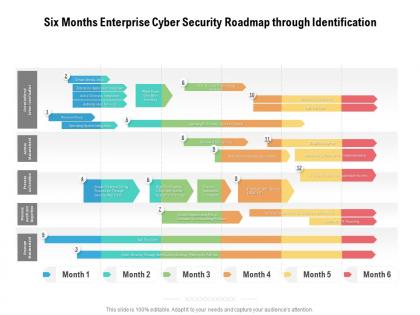
Six months enterprise cyber security roadmap through identification




Try Before you Buy Download Free Sample Product
 Impress Your
 Audience
 100%
100% Editable
 Save Hours
 of Time


Our Six Months Enterprise Cyber Security Roadmap Through Identification are topically designed to provide an attractive backdrop to any subject. Use them to look like a presentation pro.
People who downloaded this PowerPoint presentation also viewed the following :
Six months enterprise cyber security roadmap through identification with all 2 slides:
Use our Six Months Enterprise Cyber Security Roadmap Through Identification to effectively help you save your valuable time. They are readymade to fit into any presentation structure.
FAQs for Six months enterprise cyber security
Honestly, start by figuring out what data you absolutely can't afford to lose - that's your priority. Build four main areas: risk assessment, tech stuff like firewalls and monitoring, a solid incident response plan, and regular training for your team. Training's actually super critical because people clicking sketchy links causes way more problems than you'd think. Don't forget vulnerability assessments and whatever compliance your industry needs. Oh, and budget for both the tools AND people to run them - I've seen companies buy expensive software then have nobody who knows how to use it properly.
Start with figuring out where you actually stand right now - run some vulnerability scans and review whatever policies you've got. Map out all your digital stuff and where attacks might come from. Honestly, getting an outside pen test is worth it because they'll spot things you're blind to at this point. Talk to your key people about current processes and what's driving them crazy. Then compare everything against something like NIST or ISO 27001. This whole baseline becomes your foundation for building a roadmap that fixes real problems, not just checking boxes.
Honestly, training your people might be like 70% of your whole cybersecurity game. All the expensive tech won't help if Karen from accounting clicks that sketchy email link, you know? Don't do those boring once-a-year courses though - they're useless. Start with basic awareness stuff, then get more specific as you add new tools. Quarterly refreshers work way better. Oh, and make sure it actually connects to whatever security thing you're rolling out at the time. Can't just be random generic content.
Honestly, I'd look at it every quarter and do bigger updates once a year. New threats pop up constantly - like, remember that whole supply chain attack thing last month? Plus regulations keep changing and your business priorities shift too. Set quarterly check-ins in your calendar right now, trust me on this one. Also jump into an immediate review if you get hit with an incident or have major business changes. Don't just create it and let it collect dust somewhere. The whole point is keeping it current with what's actually happening out there.
Honestly, start with what'll hurt you most if it goes wrong - that's your risk assessment right there. Focus on the crown jewel stuff first, then work backwards. Quick wins are gold though, because leadership loves seeing fast results and it gets everyone on board. You've got to factor in compliance deadlines too, plus what resources you actually have. Dependencies between projects can really mess up your timeline if you don't think ahead. Oh, and definitely make a scoring system instead of just winging it - saves you from second-guessing everything later. It's all about balancing the "fire drill" stuff with longer-term strategy.
Look, risk assessments basically tell you what to fix first in your security setup. You find your biggest vulnerabilities and threats, then use that to build your roadmap. Makes way more sense than just randomly picking projects, you know? Like why spend months on fancy endpoint stuff if your real problem is servers that haven't been patched in forever? The risk scores give you a clear priority order - tackle the high-risk items first, then work down the list. Honestly, it's one of those things that seems obvious but so many teams skip this step and wonder why their security budget isn't doing much.
Honestly, start with the basics first - endpoint detection tools, identity management, and network monitoring. Those are your must-haves. Cloud security platforms too if you're running anything in AWS or whatever (which, let's be real, everyone is). After that? Look at security orchestration for automation, vulnerability scanners, and solid backup solutions. But here's the thing - don't just buy random stuff. Do a quick security assessment to figure out where you're actually vulnerable first. Then match the tech to those specific gaps based on what keeps you up at night risk-wise.
Don't just aim for compliance - that's your starting point, not the finish line. Map out what regulations actually require vs. what risks you're facing. You'll probably find some weird gaps where you're technically compliant but still vulnerable (happens more than you'd think). The smart move? Find controls that kill two birds - access management, monitoring, incident response stuff that keeps auditors happy AND actually protects you. Most companies screw this up by treating them as totally separate things. Document as you go since that evidence helps with reporting later and makes your security better over time.
Look, you gotta track both the techy stuff and business impact. Response times, patch rates, how many threats you're actually catching - that's your bread and butter. But don't sleep on the business side either. Compliance results, training completion, whether your CEO is constantly panicking about security (spoiler: less panic = you're winning). Cost per incident matters too. Honestly though? Pick like 5-7 metrics tops and check them monthly. I've seen teams drown in spreadsheets they never actually use to make real decisions.
Honestly, new threats mess up your whole security plan. You'll be constantly reacting instead of sticking to what you mapped out. AI phishing and zero-days targeting your specific setup? Yeah, that means dropping everything and scrambling. It's annoying but you gotta roll with it. Build some wiggle room into your roadmap upfront - like blocks of time just for emergency responses. Keep some budget aside too for when you suddenly need new tools. Oh, and definitely stay on top of threat intel feeds. Better to catch trends early than get blindsided later.
Honestly, breaking down those silos between IT, security, and business teams is huge - most places totally suck at this. Get cross-functional incident response teams going and start sharing threat intel with industry peers and government agencies regularly. Your vendors need to be part of this too, so work with them on security requirements and run joint tabletop exercises. Monthly cross-team meetings will keep everyone aligned. The whole point is making security everyone's job, not just dumping it all on IT (which never works anyway). Make it collaborative from the start.
Look, your cybersecurity plan can't just live in its own bubble - it has to actually support what the business cares about. Figure out their real priorities first: protecting revenue, keeping customers happy, staying compliant, whatever digital stuff they're pushing. Map your security spending to those things. Expanding overseas? Focus on data privacy rules for those markets. Here's the thing though - you gotta speak their language when you present this. Show them ROI and risk reduction, not just tech specs. I've seen too many security teams get sidelined because they position themselves as a cost instead of something that actually helps the business grow.
Don't try to solve everything at once - that's where most people crash and burn. Get your executives on board first, but translate the tech stuff into business speak they actually care about. Those NIST frameworks look tempting but honestly? They're useless if you just slap them on without thinking about what your company actually needs. Loop in other departments early so your timeline isn't completely delusional. Oh, and build in checkpoints to pivot when things change (because they always do). Start small, show some wins, then scale up from there.
Dude, you've gotta speak to each group differently. Executives want ROI numbers and risk stuff. Your IT folks? They need the technical nitty-gritty and realistic timelines. Create a visual timeline with major milestones - honestly, those text-heavy roadmaps are the worst and nobody actually reads them. Use business language for leadership, tech specs for your security team. Quarterly check-ins are crucial since everything changes constantly. New threats pop up, budgets shift, priorities get reshuffled. Oh, and throw in some quick wins early on so people see progress right away.
So incident response planning is like having a fire extinguisher - you hope you'll never need it, but when shit hits the fan, you're glad it's there. Set it up after your basic security stuff is running but don't wait until you're doing fancy threat hunting. Start simple and build it up over time as you get better at this whole security thing. Here's the kicker though - actually practice using your plan! I've seen so many companies with these beautiful incident response docs that fall apart the second there's a real emergency. Test it, break it, fix it. Otherwise you're just playing security theater.
-
Much better than the original! Thanks for the quick turnaround.
-
Easy to edit slides with easy to understand instructions.
-
The Designed Graphic are very professional and classic.
-
Best Representation of topics, really appreciable.
-
Great designs, really helpful.
-
Easily Understandable slides.