


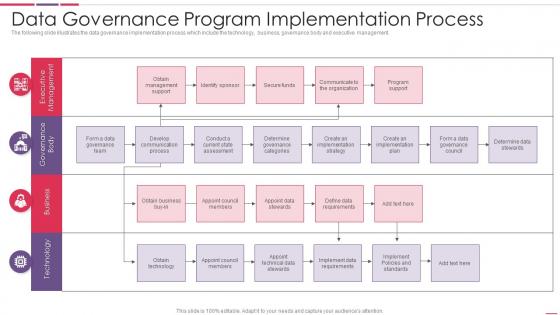
Data Governance Program Implementation Process




Try Before you Buy Download Free Sample Product
 Impress Your
 Audience
 100%
100% Editable
 Save Hours
 of Time


The following slide illustrates the data governance implementation process which include the technology, business, governance body and executive management.
People who downloaded this PowerPoint presentation also viewed the following :
Data Governance Program Implementation Process with all 6 slides:
Use our Data Governance Program Implementation Process to effectively help you save your valuable time. They are readymade to fit into any presentation structure.





FAQs for Data Governance
Honestly, you need five things to make data governance actually stick. First, get clear data owners - someone's gotta be responsible or nothing happens. Then build policies around how data gets handled, set up access controls so people can get what they need, and create processes to keep your data quality decent. Oh, and documentation - this is where everyone screws up but it's super important. I'd start with finding your data owners first since everything else builds from there. Without that, you're just creating rules nobody will follow anyway.
You know how your data turns into a complete disaster without any rules? That's where data governance comes in. It's like setting up house rules but for your company's information. Someone owns each piece of data, you've got standard processes everyone follows, and there are quality checks built in. Without it, nobody knows what anything means and you can't trust any of your reports. The trick is actually sticking to whatever policies you set up - I've seen too many companies just ignore them after a few months. Short answer: it keeps your data clean and reliable so people don't waste time arguing over which numbers are right.
So data stewards are like your front-line people keeping data quality in check day-to-day. Pick folks who already know the business inside and out - subject matter experts from different teams, experienced analysts, that kind of thing. Business knowledge matters way more than being super technical, honestly. They'll handle stuff like setting data definitions, fixing quality problems, making sure everyone follows the standards you set up. Oh and they need to actually work with the data regularly so they can catch issues early. Trust me, you want people who can spot a mess before it spirals into chaos.
Track the obvious stuff first - data quality scores, compliance rates, how fast you fix problems. Numbers tell the story. But here's what most people miss: ask your teams if they actually trust the data they're using. Survey them about whether they can find what they need without wanting to scream. I'd also measure policy adherence rates and track if incidents are going down over time. Oh, and document your data lineage coverage - sounds boring but it's clutch. Don't go crazy though. Pick 3-5 metrics, get your baseline, then stick with it. Measuring everything just creates noise.
Honestly, the technical stuff isn't what'll kill you - it's all the politics and drama. Every department thinks they're special snowflakes with unique data needs (they're not). Nobody wants to own anything when it breaks, but suddenly everyone's an expert when things work. People hate change, especially if they've been hoarding spreadsheets for years. My advice? Don't try to boil the ocean right away. Pick one team that actually wants help and nail that first. Once you've got something working, the rest will slowly come around. Or at least stop actively sabotaging you.
Yeah so GDPR and CCPA basically mean you can't just slap compliance on later - privacy has to be built into everything from the start. Data collection, storage, processing, deletion... all of it. You need clear tracking of where data goes, proper consent systems, and quick response for when people want their stuff deleted. It's honestly such a hassle but your data gets way cleaner. Oh and definitely map out what personal data you actually have first. I was shocked when I did this at my last job - data was everywhere we didn't expect.
So data governance is basically the "what and why" - you're setting up policies for how data gets handled company-wide. Management is more the "how" part - the actual daily grind of storing, processing, and keeping that data running smoothly. Compliance? That's your "must-do" regulatory checklist for stuff like GDPR. Honestly, they blur together sometimes which makes it super confusing. But think of it this way: governance = strategic decisions, management = the operational work, compliance = legal requirements you can't ignore. Just figure out which angle you're dealing with first.
Data catalogs automatically find and sort your stuff, which is huge. Governance platforms enforce rules and track where everything flows without you babysitting it. Real-time compliance monitoring catches violations instantly - beats the hell out of Excel tracking! Access requests get handled through automated workflows too, so you're not stuck approving everything manually. Pick tools that play nice with what you already have though. Otherwise you'll just end up with more disconnected systems to juggle, and honestly nobody needs that headache.
First things first - get a C-level exec on board or this whole thing dies in committee hell. Pull in people from IT, legal, compliance, plus your main business units. You want both the tech nerds and the people who actually understand what customers need. Keep your core team tiny though - like 5-7 max. Any bigger and you'll spend half your time just scheduling meetings (trust me on this one). Set up separate working groups for specific projects. Define who makes what decisions upfront. Turf wars are momentum killers. Start with problems you can actually solve quickly rather than writing policies nobody reads.
Dude, cross-departmental collaboration is totally make-or-break for data governance. You can't just let IT decide everything for the whole company - that's a recipe for disaster. Marketing handles data completely different than finance, so you need everyone's input upfront. Each department has their own weird workflows and headaches that you won't know about otherwise. Honestly, I've seen too many governance policies fail because they looked great on paper but nobody could actually use them. Find someone from each team who really gets their data challenges and loop them in early. Trust me, it'll save you so much pain later.
Start with the basics - completeness, accuracy, consistency across your main datasets. Don't overthink it with like 20 different KPIs or you'll go crazy. Check how well teams actually follow your data policies (spoiler: probably not great at first). User adoption of your governance tools is huge - if nobody's using them, what's the point? Track incident response times when things break. Oh, and data lineage coverage helps you find blind spots. I'd do a simple monthly dashboard with maybe 5-7 key metrics. Review trends with stakeholders so you can see what's working versus what needs fixing.
Honestly, it's all about how much complexity you can handle right now. Small companies should focus on the basics - who owns what data, simple quality checks, basic security stuff. Don't get caught up in fancy enterprise tools that'll just bog you down. Bigger organizations? They need the full setup with dedicated teams, formal processes, automated monitoring. Way more moving parts when you're dealing with tons of data sources and departments that don't always play nice together. My take: start simple and build up as you grow. No point overengineering from day one.
Think of data governance as the cleanup crew that makes your BI worth a damn. Your analysts won't waste half their day hunting down what fields actually mean or fixing the same crappy datasets repeatedly. Clean, standardized data means your dashboards show what's really happening instead of hot garbage. It speeds up projects too - no more second-guessing if those numbers are legit. Honestly, if your team spends more time prepping data than analyzing it, that's your red flag right there. Good governance fixes that mess upfront.
Get your people involved in actually making the policies instead of just following them. Pull in reps from different departments for your governance committee - they'll feel heard and can sell it back to their teams. Training has to connect to what they do every day, not some boring generic compliance stuff. Quick wins work great too, like showing how cleaner data made someone's monthly reports way less painful. Oh and definitely tie this to their performance reviews somehow. People respond to incentives, right? Start with pilot programs first - rolling out everything at once usually backfires. Recognize the champions early.
Honestly, automation is where it's at right now - these AI tools can actually classify and track your data without someone manually doing it all day. Privacy laws are making companies get ahead of compliance instead of scrambling after the fact. Business units are getting more control over their own governance, but within set boundaries. It's like giving your team freedom with training wheels still on. Cloud-native approaches are pretty much required now since everyone's migrating workloads anyway. You should probably look into automated discovery tools if you haven't yet - they'll map out your data landscape way faster than doing it manually.
-
I was confident and well prepared for my presentation for the first time ever. With SlideTeam’s templates, I could deliver one of my best presentations. Will be coming back for more!
-
Based on my personal experience, I would recommend other people to subscribe to SlideTeam. No one can be disappointed here!