


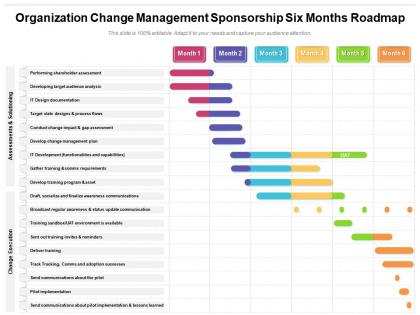
Organization change management sponsorship six months roadmap




Try Before you Buy Download Free Sample Product
 Impress Your
 Audience
 100%
100% Editable
 Save Hours
 of Time


A well thought out action plan makes execution easier and increases the possibility of success significantly. Ensure hitting all the milestones within the deadlines by introducing our fully customizable Organization Change Management Sponsorship Six Months Roadmap. Streamline the work related information, budget, timeframe, key deliverable, landmarks, and major steps involved, all in one place to give an organized overview of the project by utilizing our PowerPoint theme. Minimize time lag and increase work efficiency by providing insight into the process with our comprehensively researched roadmap PowerPoint layout. Color coding helps in highlighting the process and grabs the attention of the audience. Download our handy Organization Change Management Sponsorship Six Months Roadmap to identify the possible problem areas in a much shorter time and propose solutions. Have a productive brainstorming session with your workforce by utilizing our action plan visualization tool.
People who downloaded this PowerPoint presentation also viewed the following :
Organization change management sponsorship six months roadmap with all 2 slides:
Use our Organization Change Management Sponsorship Six Months Roadmap to effectively help you save your valuable time. They are readymade to fit into any presentation structure.

FAQs for Organization change management sponsorship
Honestly, the biggest thing is getting your leadership team to actually walk the walk - people can smell fake buy-in from a mile away. Communication has to be super clear about the "why" behind everything. Don't expect zero pushback though, resistance is just part of the deal. Get employees involved early instead of springing changes on them last minute. Oh and find your office cheerleaders first - those naturally enthusiastic people who'll help spread good vibes about the changes. Think of it more like a marathon than a sprint. You can't just announce something big and expect everyone to adapt overnight.
Don't just dump the change on them - explain WHY it's happening first. Share real examples or data they'll actually connect with. I've watched so many managers skip this step and then act shocked when everyone pushes back, which honestly drives me nuts. Be upfront about the tough parts AND the good stuff coming. Make it a conversation, not some announcement from corporate. Ask what they're worried about before you even finish explaining. People need to feel like they have a voice in this, not just something happening TO them. Short version: context first, then listen.
Honestly, it's everything. I've watched amazing plans crash and burn just because nobody cared about them. Get your people excited first - like, really excited about WHY you're changing things - and they'll actually help you instead of fighting every step. They adapt faster, give better feedback, help their teammates through rough patches. Skip that step though? You're screwed. People will drag their feet, spread negativity, do that annoying thing where they smile and nod but don't actually do anything different. Seriously, spend way more time on the "why" before you even think about logistics.
Watch for the obvious stuff - people skipping meetings, complaining in the hallway, or suddenly clamming up when the topic comes up. Don't ignore it hoping it'll just fade away (trust me, it won't). Listen to what's actually bothering them first, then explain the benefits without being preachy about it. Getting resisters involved in planning helps too. Find your enthusiastic supporters early - they're worth their weight in gold for convincing doubters. Way more effective than some corporate email from the C-suite. People just want to feel heard, honestly.
Honestly, you've gotta show flexibility first - your team picks up on everything you do. Make it safe for people to actually speak up about changes without getting their heads bitten off. Those retrospectives are gold because they get everyone used to the idea that tweaking stuff is just normal. Here's what works for me: call things "experiments" instead of rollouts or whatever. Way less intimidating. Cross-training helps too since people aren't freaking out when they need to jump into something new. Oh, and definitely make a big deal when someone handles change well - even tiny stuff. People need to see that adaptability gets noticed.
So change management gets way less painful when you bring tech into it. Slack or Teams keeps everyone updated without the endless email chains (thank god). Project management tools help you actually see what's working and what isn't - plus the data side is pretty cool because you can spot resistance patterns instead of flying blind. Survey platforms are clutch for getting real feedback too. My advice? Don't go crazy with a bunch of tools at once. Just grab one thing that fixes your worst headache first, whether that's communication being a mess or not knowing if people are actually adopting changes.
Track the obvious stuff first - adoption rates, how fast people learn the new system, productivity numbers. But honestly? The soft metrics matter way more than most people think. Run quick sentiment surveys to see if your team's actually bought in or just pretending to play along. Measure resistance levels and engagement too. Training completion rates are solid indicators. Communication effectiveness is huge but gets overlooked. Set up maybe 6 key metrics on a simple dashboard and check weekly. The engagement numbers usually predict whether you're gonna succeed before the technical metrics do.
Dude, training during change is make-or-break stuff. People get anxious when you throw new processes at them without proper support - then resistance goes through the roof. I've watched so many initiatives crash because leadership thought employees would just "wing it" somehow. Short sentences don't work here, but comprehensive upfront training with ongoing support? That's your golden ticket. Don't skimp on this part. The adoption rates will thank you later, trust me.
Microsoft's a great example - Nadella flipped their whole vibe from "know-it-all" to "learn-it-all" by actually walking the talk. Toyota crushed it with lean manufacturing because they trained people properly AND let workers help design the changes. That's huge. Netflix saw the writing on the wall with DVDs (remember those?) and got their team on board by being brutally honest about where the market was headed. The pattern? Don't just tell people what's changing - explain why it matters and get them involved in figuring out how to make it work.
Look, change management frameworks are lifesavers when you're not sure where to start. ADKAR breaks it down person by person - Awareness, Desire, Knowledge, Ability, Reinforcement. Pretty straightforward stuff. Kotter's approach is more big picture, like getting leadership fired up first and building momentum across the whole org. Both help you avoid rookie mistakes. You know, like forgetting to loop people in early or - this one gets me - implementing everything perfectly then never acknowledging the wins. My take? Don't get too hung up on following every step exactly. Just use whichever framework clicks with your team's vibe.
Honestly, it all comes down to how your company is set up. Those old-school hierarchies are the worst - everything crawls through endless approval chains. Flatter orgs move way faster since you don't have as many people saying "let me check with my boss first." Matrix structures are just chaos with everyone pulling in different directions. Here's what actually works: figure out who really calls the shots (hint: it's not always the person with the fancy title). Find your change champions early and give them what they need to spread the word. Oh, and don't ignore the informal networks - sometimes the person everyone actually listens to is just some random team lead.
Honestly, most resistance comes from fear, not people being difficult. Pay attention to who looks stressed or zoned out - deal with those emotions first before jumping into the technical stuff. I learned this the hard way watching perfectly good plans crash and burn. Listen to what's really bothering them, then be super transparent about what's happening and why. Yeah, change sucks and it's totally fine to say that out loud. When you stay calm during the chaos, your team picks up on that energy. Sometimes acknowledging "this is messy" does more than pretending everything's smooth sailing.
Dude, the worst thing you can do is skip getting your leadership team excited about it first. I've seen so many changes crash and burn because nobody bothered to explain the "why" to employees - they just wake up one day and everything's different. People hate that. Communication has to happen early, not after you've already decided everything. Don't rush the timeline either, even though your boss probably wants it done yesterday. Set up ways for people to actually give feedback throughout the process. Trust me, things will go sideways and you'll need to pivot.
People actually remember stories way better than random stats - it's wild how our brains work. When you're trying to get buy-in for changes, don't just throw data at people. Paint them a picture instead. Show what things look like now vs. what they could be. Use real customer examples or walk through an employee's day before and after your changes. The emotional stuff hits different than pure logic. I've seen teams completely flip once they could actually picture themselves in the story. Make it personal and they'll get why the change matters.
Honestly, it depends on what you're dealing with. Complex stuff or missing expertise? Yeah, get a consultant. They see things differently and aren't stuck in your office drama. Your team might actually listen to an outsider saying the exact same thing you've been telling them for months - kind of annoying but whatever. You can totally handle it internally though if your leadership's on board and you've got decent project management chops. Just be real about whether your team can actually pull it off given how big the change is.
-
Designs have enough space to add content.
-
I discovered this website through a google search, the services matched my needs perfectly and the pricing was very reasonable. I was thrilled with the product and the customer service. I will definitely use their slides again for my presentations and recommend them to other colleagues.
-
Easily Editable.
-
Great quality slides in rapid time.