


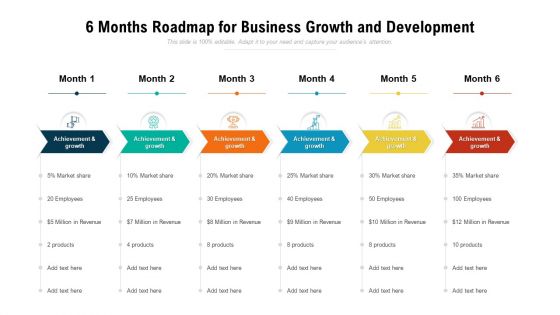
6 months roadmap for business growth and development




Try Before you Buy Download Free Sample Product
 Impress Your
 Audience
 100%
100% Editable
 Save Hours
 of Time


A well thought out action plan makes execution easier and increases the possibility of success significantly. Ensure hitting all the milestones within the deadlines by introducing our fully customizable 6 Months Roadmap For Business Growth And Development. Streamline the work related information, budget, timeframe, key deliverable, landmarks, and major steps involved, all in one place to give an organized overview of the project by utilizing our PowerPoint theme. Minimize time lag and increase work efficiency by providing insight into the process with our comprehensively researched roadmap PowerPoint layout. Color coding helps in highlighting the process and grabs the attention of the audience. Download our handy 6 Months Roadmap For Business Growth And Development to identify the possible problem areas in a much shorter time and propose solutions. Have a productive brainstorming session with your workforce by utilizing our action plan visualization tool.
People who downloaded this PowerPoint presentation also viewed the following :
6 months roadmap for business growth and development with all 2 slides:
Give your audience a fulfilling experience. They will find our 6 Months Roadmap For Business Growth And Development elevating.
FAQs for 6 months roadmap for business
Okay so basically you need four things: revenue targets with actual dates, your main growth channels figured out (sales, marketing, whatever), the team/resources to make it happen, and ways to measure if it's working. Most people mess this up by being way too optimistic or super vague. Pick one main thing to focus on first - seriously, don't try to do everything at once. Build around that before you add more stuff. Also watch out for obvious problems early on. Cash flow issues, hiring headaches, that kind of thing. I've seen too many roadmaps that look great on paper but completely ignore the fact that you can't hire 5 engineers in a month.
Start with a solid competitive analysis - what are your competitors totally bombing at? Check out their customer complaints and weak spots. Then honestly assess what you're actually good at versus what you think you're good at (there's usually a gap lol). Don't spread yourself too thin trying to dominate everything. Pick 2-3 specific goals where you can realistically kick ass. The magic happens when market demand meets something you can deliver way better than the other guys. That's your goldmine right there.
Look, market research is like having a GPS for your growth strategy - shows you actual opportunities instead of just guessing. Skip it and you'll end up chasing random ideas that go nowhere (learned this the hard way). Start by surveying your current customers about what they actually need. That'll reveal expansion opportunities you hadn't thought of. Research also helps you understand competitors and find market gaps before dumping money into the wrong things. When you're pitching ideas to your team or investors, having real data makes everything way easier. Don't overthink it though - just figure out which growth moves to make first.
Tech can really speed up your growth by handling the boring stuff automatically and giving you better customer data. Start with whatever's slowing you down most right now - maybe a CRM to actually track your leads properly, or automation for your marketing (honestly, doing that manually is painful). Cloud solutions are great for scaling without hiring tons of people. AI stuff helps predict what customers want and nail your pricing. The trick is picking one thing first instead of trying to upgrade everything - I've seen teams crash and burn doing that. Once you get comfortable with one system, then add more.
Track the stuff that actually matters - revenue growth, CAC, LTV, and monthly recurring if you've got subscriptions. Conversion rates at each funnel stage too. Honestly? Most teams get caught up in vanity metrics that look pretty but don't mean anything. Pick maybe 5-7 things max that directly connect to your bottom line. I learned this the hard way when I was drowning in data that didn't help us make better decisions. Set up a simple dashboard you can glance at weekly. If you can't quickly explain why a metric matters to revenue, ditch it and find something useful instead.
Dude, get your systems locked down *before* you try to grow. Write down how you do everything - like, literally everything. Quality checklists, training docs, the works. I made the mistake of winging it early on and it was a disaster. Automate the boring stuff first, then build solid feedback loops so customers tell you when things suck. Oh, and don't scale everything at once - that's insane. Pick one thing, perfect those systems, then move on. Start by documenting exactly how you do your best work, then teach your team to copy it step by step.
Look, don't go crazy ambitious right off the bat - you'll just crush your team's morale when things inevitably fall behind. Research first! So many people build roadmaps on pure guesswork instead of actual data (learned this the hard way). You need measurable goals for each milestone too, otherwise you're basically just hoping for the best. Keep some flexibility though - markets shift constantly. Oh, and honestly? Start small. Pick maybe 2-3 realistic things for next quarter and build from there. Way better than some massive plan that'll collect dust.
Don't build your roadmap in a vacuum - get your team involved from the start. I've watched companies create these gorgeous plans alone, then act shocked when nobody cares. Ask what growth opportunities actually excite your people first. Their input shapes a strategy that fits how they work and what matters to them. Regular check-ins matter since culture shifts over time (honestly, more than most leaders realize). When your team helps build the roadmap, they're way more likely to champion it. Makes sense, right?
Referral programs are insane - existing customers convert 4x better, so lean into that hard. Content marketing and social ads work great too, just hit people where they already scroll. Retention's where most companies totally blow it though. Your onboarding needs to be smooth, then stay in touch regularly. Loyalty programs help, but honestly? Just listening to feedback and actually doing something about it beats most fancy tactics. Oh, and map out your customer journey first - you'll probably find some obvious holes you didn't notice before.
Dude, you absolutely need a financial plan - it's like your GPS for money decisions. Too many businesses crash because they run out of cash right when they're growing (classic mistake). Map out your expected revenue and expenses for the next 12 months. Don't forget to budget for growth stuff like hiring people or buying equipment. This helps you figure out if you'll need a loan and when. Honestly, even a basic spreadsheet is better than winging it. I've seen companies fail simply because they didn't track their cash flow properly.
Dude, partnerships are seriously where it's at for growing your business. You can reach new customers and split costs on bigger projects instead of doing everything solo. Plus you get to work with companies that are strong where you're weak - it's like filling in your gaps. I swear I've watched businesses basically double their audience overnight with the right collab. Just don't partner with direct competitors, obviously. Map out what you need vs what you bring to the table first. Then hit up potential partners with actual ideas, not just "hey let's work together" nonsense.
Just bake it right into your regular growth targets, honestly. Pick like 2-3 things you can actually measure - maybe cut your carbon footprint by 15% while you're scaling up, or hit specific diversity numbers when hiring. Don't treat this stuff as a side project though, that's where most companies mess up. Make them real KPIs that you track in quarterly reviews alongside revenue. Investors are way more interested in this now than they used to be. Budget for it, track it religiously, and tie it to your core business goals. Start small but be consistent about it.
Look, if you're running a startup, you've gotta move fast and break things - test ideas cheap, pivot when something's not working, and honestly? Growth matters more than profit right now. Big companies can't do that even if they wanted to (have you seen how slow corporate decisions are?). But here's the thing - they've got cash for R&D and acquisitions that would make any startup founder weep. The real difference is risk. You can bet your whole company on one crazy idea. They can't without protecting what already makes money. Pick your strategy based on what you actually are, not what sounds cooler.
Don't treat your roadmap like it's carved in stone - that's how companies die honestly. Check market signals and customer feedback every month because waiting longer is just asking for trouble. Most teams I've seen are way too slow on this. Quarterly reviews are clutch for reallocating resources when reality hits. Build flexibility into your process from day one so pivoting doesn't feel like you're scrambling. Sometimes you'll need to kill projects that made perfect sense six months ago. It sucks but that's business. The companies that survive are the ones that can change direction without losing their minds about it.
Miro and Lucidchart are solid for visual stuff - flowcharts, timelines, that kind of thing. Google Analytics or Mixpanel will show you what's actually working right now. Asana keeps everything organized, though honestly? A spreadsheet works fine too if you're not trying to impress anyone. I'd grab one visual tool and one analytics platform first. You can always add more later. North Star Framework is pretty good for structuring your approach - way better than just winging it. Don't overcomplicate the tech stack early on. Figure out what you're missing as you go.
No Reviews