


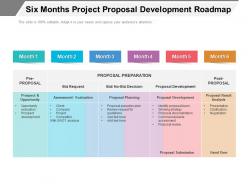
Six months project proposal development roadmap





Try Before you Buy Download Free Sample Product
 Impress Your
 Audience
 100%
100% Editable
 Save Hours
 of Time


A cohesive work plan is essential for achieving the desired target. Communicate your vision and lay a firm ground in front of your audience with our PowerPoint layout. Align your project milestones, budgets, deliverables, deadlines, and all the requisite information for a dynamic presentation by employing this amazingly designed Six Months Project Proposal Development Roadmap. Maximize team efficiency and streamline a work plan efficiently by introducing our ready made roadmap PowerPoint theme. You can quickly establish coordination between different activities across the organization and present an insight to your colleagues by utilizing this useful business tool. Color code specific tasks, prioritize, and keep a close eye on the deadlines with the help of our eye catchy PowerPoint template. Download our Six Months Project Proposal Development Roadmap for excelling at productive management.
People who downloaded this PowerPoint presentation also viewed the following :
Six months project proposal development roadmap with all 2 slides:
Use our Six Months Project Proposal Development Roadmap to effectively help you save your valuable time. They are readymade to fit into any presentation structure.
FAQs for Six months project
So for your project roadmap, you'll need the obvious stuff first - clear objectives, timeline with milestones, budget breakdown. Resource requirements too. But honestly, the thing that kills most projects is communication gaps. Everyone thinks someone else is sending updates and then everything falls apart. Risk assessment is huge - basically "what could go wrong" planning. Define your success metrics upfront or you'll be arguing about what "done" looks like later. Oh, and stakeholder roles need to be crystal clear. Start with a basic template and just tweak it for whatever you're working on. Way easier than building from scratch.
Dude, visual roadmaps are a game changer. People actually look at timelines and charts instead of skipping over boring text blocks. Gantt charts work great, but honestly even basic flowcharts get the job done - anything's better than paragraph hell. You can spot problems way faster when everything's laid out visually. Dependencies become obvious, milestones pop out. I always use different colors for each team or phase. Makes those review meetings so much smoother. Your stakeholders will thank you because they can finally see how all the pieces connect without squinting at bullet points for twenty minutes.
Skip the vague stuff and get specific with your milestones - like "prototype tested with 50 users" not just "do user testing." Space them 2-4 weeks apart so you're not cramming everything together (seriously, nobody wants to look at a messy Gantt chart). Each one should be a real checkpoint where people can actually see what you've accomplished and decide next steps. Oh, and tie them to your budget phases since that's usually when funding gets released anyway. Always pad some extra time in there because let's be honest - when does anything ever go perfectly according to plan? Make sure stakeholders can evaluate real progress at each milestone.
Honestly, stakeholder needs are what make or break your roadmap. First thing - figure out who actually matters (execs, users, compliance people, whoever). Then dig into what's keeping them up at night and how they measure success. The fun part? They'll all want different things that totally contradict each other. I swear it's like herding cats sometimes. But you've got to balance those competing priorities somehow while keeping everyone focused on the main goal. Do interviews upfront and check back regularly because - surprise - their needs will definitely shift as you go.
Dude, risk assessment is basically your safety net for getting approval. Think of it this way - you identify what might blow up, figure out how likely it is, then show you've got backup plans. Honestly, stakeholders eat this stuff up because it proves you're not just winging it. Most people skip this part and wonder why their proposals get shot down. Don't just throw together a list though - actually walk them through how you'd deal with each problem. It's kinda like showing your work in math class, but way more important for your budget.
Honestly, I'd dig up your company's strategic goals first - they're probably buried in some boring annual report somewhere. Then just check each project milestone against those priorities. Like, does this thing actually move us closer to what leadership wants? If not, cut it or change it. Simple as that. The trick is getting stakeholders on board early by showing them how your roadmap connects to stuff the executives actually care about. Next time you write a proposal, lead with something like "This project directly hits [whatever goal]..." Trust me, it works way better than hoping they'll figure out the connection themselves.
For project roadmaps, you'll want timeline templates that actually make sense - Gantt charts or those horizontal layouts work great. Clean designs beat those awful rainbow PowerPoint templates every time (seriously, who thought neon green was professional?). Swim lanes help when you've got multiple teams working. Milestone markers are clutch for showing key deadlines and deliverables. Your stakeholders need to grasp the what and when without zooming in on microscopic text. Miro's pretty solid if you want something interactive, or just stick with Lucidchart for basic timelines.
Honestly, skip the boring bullet-point dates and go with visual timelines instead. Gantt charts work great, or those roadmap bar things. Color-code different parts of the project so people can actually follow what's happening. I learned this the hard way after watching executives' eyes glaze over during presentations lol. Build in some buffer time because things always take longer than you think. Make your big deliverables stand out visually, and don't bury the timeline in paragraphs of text. If someone can't get it in 30 seconds, you've lost them.
Ugh, don't be vague with your timelines - that's where everything falls apart. Also, seriously overestimating what your team can handle is a death trap. Stakeholders will push for crazy deadlines but you can't just cave to that pressure. I learned that one the hard way! Dependencies between tasks? Don't skip mapping those out. You need buffer time too because stuff always goes sideways. Oh, and define your deliverables upfront or you'll be arguing about what "done" means later. Make milestones super specific, not wishy-washy. Get someone else to review your draft - they'll catch what you missed.
Definitely tailor your roadmap based on who you're presenting to. Executives want the big picture stuff - milestones, budget impact, ROI timelines. Don't bore them with sprint details. Technical people? They need the meaty stuff like dependencies and resource planning. I've literally watched C-suite eyes glaze over when someone dove into implementation weeds - it was brutal. Project teams need the actual tasks they'll be doing. Here's what works: create different views of the same roadmap instead of totally separate docs. Figure out what each group considers a win first, then adjust your pitch. Way easier than starting from scratch each time.
Mix quantitative stuff with qualitative - like on-time deliverables, staying on budget, and stakeholder satisfaction scores. Don't forget KPIs that actually matter for your specific project (user adoption, efficiency gains, whatever). I always track "lessons learned" because honestly, the failures teach you more than the wins sometimes. Keep your metrics measurable with clear deadlines. Oh, and stick to maybe 5-7 key ones max - I learned this the hard way when I tried tracking everything and spent more time on spreadsheets than actual work.
Don't wait until the end to get feedback - that's a disaster waiting to happen. Build review points right into your timeline instead. After research, after your first draft, before you submit. I made this mistake once and basically had to start over lol. Get different people looking at it too - tech people, budget folks, whoever will actually use this thing. The key is timing these reviews early enough that you can actually fix stuff. Oh, and give people a simple template so they know what feedback you actually need. Trust me on this one.
Honestly, you're gonna need three main things to make this work. People with the right skills for each phase - and build in some extra bandwidth because someone's always getting dragged into random urgent stuff. Budget's next: tools, contractors, infrastructure, all that. Time is where most people completely screw themselves over though. Like seriously, whatever timeline you're thinking, add 30% more. Oh and don't underestimate needing executive support - when stuff goes sideways (and it will), you'll want someone with actual power in your corner. Map out where your resources depend on each other so you can catch bottlenecks early.
Honestly, just pick one good platform and force everyone to stick with it. Google Workspace or Notion work great - your whole team can edit docs together, drop comments, track changes instantly. Way better than those nightmare email threads where nobody knows which version is current. Asana's pretty solid for dividing up tasks and deadlines too. Video calls are obvious but still necessary for the big brainstorming stuff. The tricky part isn't finding tools though - it's actually getting people to use the same system consistently. Otherwise you're back to having info scattered everywhere, which defeats the whole point.
Okay so agile proposal development is massive right now - teams are doing shorter sprint cycles instead of those brutal months-long timelines. You can pivot way faster when clients give feedback. Also, everyone's obsessed with visual storytelling now. Interactive dashboards, video pitches, anything but boring PDFs. Speaking of tech, AI tools are pretty standard for research and drafts (saves so much time). Oh and collaborative platforms where clients can mess around with your content in real-time? That's the direction everything's heading. I'd pick one thing and test it out - maybe start with the visual stuff since that's easiest.
No Reviews