

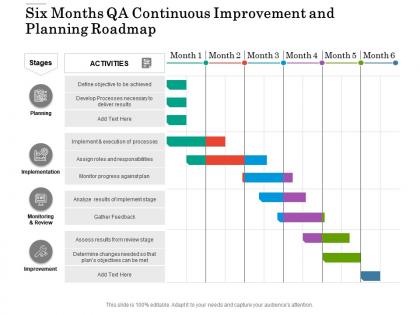
Six months qa continuous improvement and planning roadmap




Try Before you Buy Download Free Sample Product
 Impress Your
 Audience
 100%
100% Editable
 Save Hours
 of Time


A well thought out action plan makes execution easier and increases the possibility of success significantly. Ensure hitting all the milestones within the deadlines by introducing our fully customizable Six Months QA Continuous Improvement And Planning Roadmap. Streamline the work related information, budget, timeframe, key deliverable, landmarks, and major steps involved, all in one place to give an organized overview of the project by utilizing our PowerPoint theme. Minimize time lag and increase work efficiency by providing insight into the process with our comprehensively researched roadmap PowerPoint layout. Color coding helps in highlighting the process and grabs the attention of the audience. Download our handy Six Months QA Continuous Improvement And Planning Roadmap to identify the possible problem areas in a much shorter time and propose solutions. Have a productive brainstorming session with your workforce by utilizing our action plan visualization tool.
People who downloaded this PowerPoint presentation also viewed the following :
Six months qa continuous improvement and planning roadmap with all 2 slides:
Use our Six Months QA Continuous Improvement And Planning Roadmap to effectively help you save your valuable time. They are readymade to fit into any presentation structure.
FAQs for Six months qa continuous improvement
A robust QA Continuous Improvement Roadmap includes metrics-driven assessment frameworks, automated testing integration, defect root cause analysis, stakeholder feedback loops, and regular process optimization cycles. These components work together by establishing baseline quality measurements, identifying improvement opportunities through data analysis, and implementing iterative enhancements, with many organizations finding that systematic roadmaps reduce defect rates significantly while accelerating delivery timelines.
Organizations measure QA Continuous Improvement success through key metrics including defect detection rates, cycle time reduction, test automation coverage, customer satisfaction scores, and cost per defect. Through strategic tracking systems, companies in manufacturing, software development, and healthcare streamline quality processes, enhance operational efficiency, and deliver measurable ROI, ultimately achieving faster time-to-market and competitive advantage.
Stakeholder engagement ensures QA Continuous Improvement Roadmaps align with business objectives, user requirements, and operational realities through collaborative input gathering, priority setting, and resource allocation. This strategic involvement enables organizations to identify critical quality gaps, secure necessary funding, and maintain cross-functional support, ultimately delivering sustainable improvements and enhanced customer satisfaction.
Technology enhances QA Continuous Improvement through automated testing frameworks, AI-powered defect prediction, real-time analytics dashboards, cloud-based collaboration platforms, and machine learning algorithms for pattern recognition. These solutions streamline quality workflows by reducing manual testing cycles, accelerating feedback loops, and enabling data-driven decision making, with many organizations finding significantly faster release cycles and improved product reliability.
Common pitfalls include neglecting stakeholder buy-in, implementing changes without proper testing, lacking clear metrics for success, and attempting too many improvements simultaneously without prioritization. Organizations should avoid rushing implementation timelines, overlooking training requirements, and failing to establish feedback loops, with many finding that gradual, measured approaches deliver sustainable quality improvements and stronger organizational adoption.
A QA Continuous Improvement Roadmap should be reviewed quarterly and updated annually, with major milestone assessments occurring every six months to ensure alignment with evolving business objectives. This strategic cadence enables organizations to adapt to changing technologies, market demands, and quality standards, while maintaining momentum toward long-term operational excellence and competitive advantage.
**INPUT**: What metrics are most effective for tracking QA performance improvements over time? **OUTPUT**: Effective QA performance metrics include defect detection rates, test coverage percentages, mean time to resolution, escaped defects, and automation coverage ratios. These metrics enable organizations to streamline quality processes by identifying bottlenecks, enhancing test efficiency, and reducing production issues, with many software teams finding that combined tracking ultimately delivers faster release cycles and improved customer satisfaction. [Word count: 58 words]
Cross-functional collaboration enhances QA continuous improvement by integrating diverse perspectives, breaking down silos, and aligning quality objectives across development, operations, and business teams. Through shared knowledge sessions and collaborative testing approaches, organizations streamline feedback loops, accelerate defect resolution, and ultimately deliver higher-quality products, with many teams finding that collective ownership significantly improves overall software reliability.
Best practices for training QA teams include establishing clear improvement metrics, implementing regular retrospectives, providing hands-on workshops with real project scenarios, creating cross-functional collaboration opportunities, and fostering a culture that celebrates learning from failures. These approaches streamline adoption by encouraging experimentation, building analytical thinking skills, and demonstrating tangible value through incremental wins, with many organizations finding that teams become more proactive and innovative when continuous improvement becomes part of their daily workflow.
Customer feedback informs QA Continuous Improvement Roadmaps by identifying pain points, revealing functionality gaps, prioritizing enhancement areas, and validating testing scenarios. Through systematic feedback analysis, organizations streamline their testing processes, enhance user experience validation, and align quality initiatives with actual user needs, ultimately delivering more reliable products while reducing development cycles and improving customer satisfaction rates.
Industry standards and regulations significantly influence QA Continuous Improvement strategies by establishing baseline requirements, compliance frameworks, and quality benchmarks that organizations must integrate into their processes. These guidelines enable companies to streamline audit preparations, enhance risk management, and maintain consistent quality levels, while many organizations finding that regulatory alignment ultimately delivers competitive advantage and operational efficiency.
QA improvement techniques include process mapping, root cause analysis, metrics tracking, stakeholder feedback collection, and benchmarking against industry standards. These approaches streamline quality assurance by revealing bottlenecks, identifying recurring defects, and measuring performance gaps, with many organizations finding that systematic assessment ultimately delivers faster release cycles, reduced costs, and enhanced product reliability.
Organizations ensure QA Continuous Improvement alignment with business objectives by establishing clear KPIs tied to revenue goals, customer satisfaction metrics, and operational efficiency targets. Through strategic stakeholder engagement, regular cross-functional reviews, and data-driven decision making, companies streamline quality processes while delivering measurable business value, ultimately enhancing competitive advantage and customer experiences.
Automation significantly enhances QA continuous improvement by enabling faster feedback cycles, reducing manual testing bottlenecks, and providing consistent data collection for process optimization. Through automated testing frameworks and analytics, organizations streamline defect detection, accelerate release cycles, and maintain higher quality standards, with many software development teams finding that automation delivers measurable improvements in efficiency and reliability.
Organizations can celebrate small wins by recognizing individual contributions through team meetings, implementing peer nomination systems, sharing success stories across departments, and creating visible progress tracking dashboards. These practices enhance team morale, increase engagement levels, and build momentum for larger initiatives, with many QA teams finding that consistent recognition of incremental improvements ultimately delivers stronger collaboration and sustained performance gains.
No Reviews