


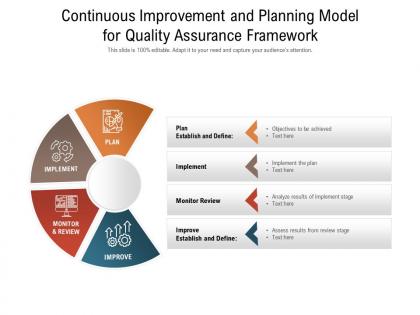
Continuous improvement and planning model for quality assurance framework




Try Before you Buy Download Free Sample Product
 Impress Your
 Audience
 100%
100% Editable
 Save Hours
 of Time


Our Continuous Improvement And Planning Model For Quality Assurance Framework are topically designed to provide an attractive backdrop to any subject. Use them to look like a presentation pro.
People who downloaded this PowerPoint presentation also viewed the following :
Continuous improvement and planning model for quality assurance framework with all 2 slides:
Use our Continuous Improvement And Planning Model For Quality Assurance Framework to effectively help you save your valuable time. They are readymade to fit into any presentation structure.
FAQs for Continuous improvement and planning model for
Honestly, it starts with leaders who don't just talk about improvement but actually do it themselves. People need to feel safe calling out problems without getting their heads bitten off. Quick feedback loops are huge - you want to catch issues fast, not months later. Here's the thing though: good ideas come from everywhere, not just the C-suite. I've watched companies waste brilliant suggestions because some manager thought they knew better. Celebrate the small wins just as much as learning from screwups. Oh, and build reflection time into your regular schedule instead of cramming it into those painful annual planning marathons nobody enjoys.
Start small and get everyone involved - management can't do this alone. Weekly 30-minute team sessions work way better than those massive once-a-year events that nobody remembers. Pick one specific problem, brainstorm together, then actually let people test their ideas (this is where most companies mess up). Quick wins build momentum before you tackle the big stuff. Oh, and celebrate those small improvements - people need to feel like their input matters or they'll just stop contributing. Regular beats perfect every time with Kaizen.
Your team sees stuff you don't - they're in the weeds every day dealing with whatever's not working. Those bottlenecks and annoying processes? They know exactly where they are. But here's the thing - you can't just wait around hoping people will speak up. Most won't unless you ask directly. I'd set up regular check-ins or quick surveys to actually gather their thoughts. Then do something with what they tell you! Nothing kills morale faster than asking for input and then ignoring it. People get way more excited about changes when they helped create them anyway.
Think of metrics as your GPS for getting better at whatever you're doing. Pick 3-5 that actually matter to your goals - don't go overboard here. Look at trends over weeks/months instead of obsessing over daily swings (seriously, that'll make you nuts). Use the data to figure out your biggest problems first, then see if your fixes actually work. Oh, and definitely sit down with your team regularly to go through the numbers together. That's usually when the best ideas happen. Focus on which metrics tell you where you're crushing it versus where things are falling apart.
Honestly? It's keeping people interested once the daily chaos kicks in. Teams start pumped, then boom - deadlines hit and improvement stuff gets shoved aside for "later." Spoiler: later never happens. Plus you'll get pushback from the "don't fix what ain't broken" crowd who think suggesting changes means admitting they screwed up before. Leadership rarely gives you actual time for this - they just expect it to magically happen. My take? Start tiny with some easy wins first. Build momentum, then literally schedule time for improvements so it becomes normal routine instead of wishful thinking.
Honestly, tech is like having a turbo button for getting better at stuff. Real-time data shows you what's actually working instead of just guessing. Automation handles the boring repetitive tasks - which is amazing because who wants to do that manually? You can spot trends way faster and focus on changes that actually matter. Though I swear sometimes the tools themselves break and become another project to fix lol. The trick is finding tech that solves your actual problems, not just grabbing whatever's trendy right now.
Make improvement feel safe, not terrifying. Celebrate small wins AND failures equally - your team needs to know they won't get torched for trying something that flops. When stuff goes wrong (and it will), ask "what'd we learn?" instead of hunting for someone to blame. Most leaders totally blow this part, honestly. Give people actual time for improvement projects, not just leftover scraps. Share lessons learned in meetings regularly. Oh, and model it yourself by talking about your own screw-ups and what you figured out. People watch what you do way more than what you say.
Don't wait until the end of projects to do retrospectives - build them in throughout. Quick feedback loops are everything. Have your team call out what's broken as it happens, then actually fix it instead of just talking about it. Most teams I've worked with do retros just because they're supposed to, which is honestly a waste of everyone's time. Better to make tiny tweaks while you're in the thick of things. Maybe try this: grab 15 minutes during weekly standups to test one small process change. Way more effective than those marathon post-project sessions where half the team has already moved on.
Get a baseline first - that's crucial. Track maybe 3-5 metrics that actually connect to what you're trying to fix, not everything under the sun. Process stuff like cycle time and defect rates are solid picks. Financial ones too - cost savings, ROI, the usual suspects. Honestly though? Employee engagement is make-or-break here. If your people aren't feeling it, good luck getting anything to stick long-term. Customer satisfaction and delivery metrics round it out since they show you what's happening on the outside. Don't overthink it - pick what matters most to your specific goals and stick with those.
Yeah, every industry tweaks continuous improvement to fit their priorities. Manufacturing is all about lean principles - Toyota basically wrote the playbook on this stuff. Healthcare obsesses over patient safety and tracking outcomes. Tech moves fast with agile sprints and constant A/B testing, while retail focuses on customer experience and managing inventory better. Honestly, the fundamentals don't change much between industries. You should definitely check out what others in your field are doing. But some of the best ideas come from totally random places you wouldn't expect.
Don't try changing everything at once - your team will just get overwhelmed and nothing sticks. People need to know WHY you're doing new stuff, not just what they need to do differently. Honestly, I've watched so many good ideas crash because managers thought everyone would magically be excited about change. Also track your wins! Even tiny ones matter. Pick one thing first, get everyone actually bought in (not just nodding along), then see what's actually working before you move on. Oh and celebrate the small stuff - people forget that part.
You know how problems love to hide until they become disasters? Visual tools fix that completely. Dashboards, kanban boards, whatever - they make issues impossible to miss. Your team spots bottlenecks right away instead of discovering them weeks later in some boring report. There's honestly something psychological about seeing a big red warning that just makes people jump into action. Feedback happens faster. Everyone knows what's broken and needs fixing. Oh, and don't overthink it - just pick one metric that actually matters to your team and start there.
Honestly, continuous improvement is a game-changer for keeping customers happy. You're basically fixing all the stuff that annoys them before it becomes a real problem. When people see you actually listening to their complaints and doing something about it? That builds serious loyalty. The trick is focusing on what they actually care about - not just whatever looks good on your internal dashboards. I'd start by straight-up asking customers what drives them crazy about your service, then tackle those issues first. It's way better than guessing what needs fixing.
So here's the thing - your team can't fix what they don't know how to measure. Training teaches them the actual tools: data analysis, process mapping, those problem-solving frameworks that actually work. But honestly? The bigger win is changing how people think. Instead of "that's just how we do it," they start seeing broken stuff as chances to make things better. Don't do those one-and-done workshops though - they're pretty useless. Figure out what skills your people are missing first, then build ongoing learning around those gaps.
Honestly, the payoff is massive in the long run. Your company becomes way more adaptable - like, people actually start fixing annoying stuff before it becomes a real headache. Teams get better at innovation too. What I love about it is how much more engaged employees become when they can actually change things that drive them crazy (instead of just venting about broken processes all the time). Better profit margins, quicker responses when the market shifts, happier customers - all that good stuff follows. Oh, and pick one specific area to start with where small tweaks could snowball. That's where you'll see results first.
-
Enough space for editing and adding your own content.