


Continuous Improvement Plan For Construction Company




Try Before you Buy Download Free Sample Product
 Impress Your
 Audience
 100%
100% Editable
 Save Hours
 of Time


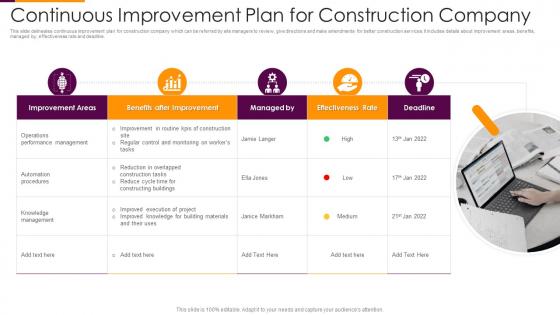
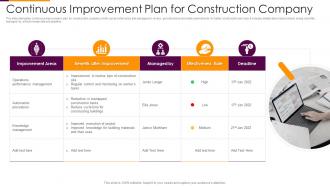
This slide delineates continuous improvement plan for construction company which can be referred by site managers to review, give directions and make amendments for better construction services. It includes details about improvement areas, benefits, managed by, effectiveness rate and deadline.
People who downloaded this PowerPoint presentation also viewed the following :
Continuous Improvement Plan For Construction Company with all 6 slides:
Use our Continuous Improvement Plan For Construction Company to effectively help you save your valuable time. They are readymade to fit into any presentation structure.





FAQs for Continuous Improvement Plan
You'll need four main things: good metrics (not just vanity numbers that look pretty), regular check-ins to spot problems fast, some kind of structured way to solve issues - PDCA works, so does root cause analysis - and actual people plus budget to make changes happen. Honestly, most people mess up the metrics part by tracking stuff that doesn't really matter. Set up data reviews and get employee feedback too. Oh, and this is huge - assign specific folks to own the improvements. I've seen so many plans just sit there doing nothing because nobody was actually responsible for executing them.
Honestly? Leadership has to buy in first - if they're not actually listening to feedback, nobody else will bother trying. Set up real safe spaces where people can pitch ideas without getting shut down (I've watched so many useless suggestion boxes lol). Build improvement into job descriptions instead of treating it like extra credit. Quick wins matter too - celebrate when someone tries something new, even if it flops. Oh, and give people actual time and budget to test their ideas. Nothing's more frustrating than having your suggestions ignored after you put thought into them.
Pick 3-5 metrics that actually connect to what you're trying to fix - cycle time, defect rates, customer satisfaction, cost savings, whatever matters for YOUR process. Don't just grab pretty numbers for dashboards (though executives do love those charts). Mix it up with some leading indicators like training completion and lagging ones like quality improvements. Honestly, the biggest mistake people make is not measuring the "before" state. How else will you prove it worked? Start by figuring out what success looks like, then find metrics that'll show you're headed there.
Dude, you absolutely need employee feedback - it's like having spies throughout your company. Your team sees the day-to-day mess that you'd never catch from the top. Bottlenecks, weird inefficiencies, all that stuff. When people feel heard, they'll actually support changes instead of fighting you on everything (which saves your sanity). Set up different ways for them to speak up - surveys work, team meetings, even old-school suggestion boxes if that's your vibe. But here's the thing - if you ask for feedback and then ignore it? You're done. People will clam up and you'll lose all that insider knowledge.
First thing - map out exactly what you're doing now, step by step. Then hunt for where stuff gets stuck or slows down. Your frontline people are honestly your best resource here since they see the actual problems daily (managers miss this constantly). Check your data for patterns - how long things take, error rates, complaints. Oh and definitely compare yourself to competitors to see where you're behind. Regular team check-ins help catch issues early too. Most companies skip talking to employees but that's usually where the real answers are hiding.
Honestly, just bake it into stuff you're already doing - weekly retrospectives, monthly check-ins, whatever. Don't make it this big separate thing. Make sure you celebrate the small wins out loud because people get discouraged if they can't see any progress happening. Oh, and definitely rotate who's running these improvement things. I've seen the same person get stuck with it forever and they just burn out (been there myself). Let teams mess around with their own processes instead of telling them exactly what to do. Next meeting, just ask "what's one thing we could improve this week?" Works better than you'd think.
Honestly, the best thing about using tech for process improvement is it handles all the tedious tracking stuff automatically. Real-time dashboards show you what's actually happening, and you'll get alerts when something goes wrong - way better than digging through endless spreadsheets. Analytics tools catch patterns you'd totally miss otherwise. Your team can collaborate without those annoying email threads about who's responsible for what. Just don't pick something super complicated that nobody wants to use. I've seen teams waste months trying to force fancy systems that don't match how they actually work.
Honestly, the biggest mistake is jumping in without getting your boss/leadership on board first. Don't try changing everything at once either - that's a recipe for disaster. Keep it simple! I've watched teams build these crazy complicated systems that just collect dust. Start with one clear goal and get a quick win to show it works. Oh, and actually track if it's working or not (sounds obvious but people skip this). Communication is huge too - everyone needs to know why you're doing this whole thing and what they get out of it. Build momentum with small stuff first, then go bigger.
Honestly, bringing different departments together is huge for fixing processes. You'll catch problems you'd never see otherwise because everyone's got their own angle on things. Like, accounting might know a shortcut that could save your team hours. The best part? People start understanding how their changes mess with (or help) other teams. Map out who actually touches your process first - you might be surprised. Then just invite them to your next brainstorming thing. I've seen teams solve months-old headaches in one meeting this way. Different perspectives really do make all the difference.
So your team needs three main things to make CI actually work. First, basic problem-solving methods - think Lean or Six Sigma fundamentals. Second, they've got to learn data analysis so they can catch trends and track progress. The third one's huge but everyone forgets it: facilitation skills for leading improvement meetings. Seriously, I've seen too many good initiatives die because nobody knew how to run a decent workshop. Get them some tracking software too, plus regular coaching from people who've done this before. Oh, and start with just one problem-solving workshop - don't overwhelm them right off the bat.
Ask your team what they'd want to improve first - that's honestly the best starting point. Then get specific with real examples of how continuous improvement actually fixed problems they deal with daily. You know, like eliminating those workflow bottlenecks that make everyone want to scream. Don't just tell them what the plan is, explain why it matters to them personally. Will it reduce frustrating rework? Help with career growth? Be upfront about current challenges too. People appreciate honesty over corporate speak. Connect everything back to what they actually care about - less daily headaches and goals they'll genuinely feel proud achieving.
Oh man, Toyota basically made this whole thing famous with their "kaizen" approach - every single worker could pitch ideas for improvements. Amazon does it too, constantly tweaking warehouse stuff and delivery routes. There's this medical center, Virginia Mason I think, that cut patient wait times by like 85% doing the same thing. What's cool is none of them just did random fixes. They made it systematic. Honestly, just pick one process that drives your team crazy every day and start running small experiments to make it better.
So continuous improvement is basically like having your business constantly fine-tune itself to hit your big goals. You're systematically cutting waste and making everything run smoother. Small daily fixes from your team actually add up to real progress on the stuff that matters - whether that's revenue, customer happiness, whatever you're tracking. The cool part is people start connecting their little optimizations to the bigger picture. I'd honestly just start by looking at your top 3 priorities and see how your current improvement projects line up with those. It's kind of like GPS recalculating, but for your whole operation instead of just driving directions.
Honestly, I'd start with basic KPI dashboards - Tableau's great but even Excel works if you're consistent about it. PDCA cycles are clutch because they actually make you stop and review what's working (vs just collecting data forever). Kanban boards help track your improvement projects too. Oh, and pulse surveys - people forget how useful those are for reading the room with your team. Here's the thing though: pick like 2-3 tools max and stick with them. I've seen too many people get overwhelmed trying every shiny new platform out there.
Look, you gotta run two tracks at once here. Put about 70% of your resources toward the stuff that needs fixing now. The other 30%? That's for projects that won't show results for like 6-12 months, but trust me - guard that 30% with your life because everyone will try to steal it when things get crazy. Honestly, different metrics work better for each track. Daily stuff gets daily check-ins, long-term projects get quarterly reviews. Oh, and try to find improvements that actually help both timelines if you can swing it.
-
The team is highly dedicated and professional. They deliver their work on time and with perfection.
-
One-stop solution for all presentation needs. Great products with easy customization.