


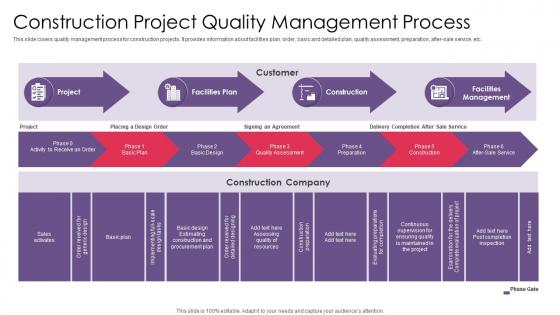
Construction Project Quality Management Process




Try Before you Buy Download Free Sample Product
 Impress Your
 Audience
 100%
100% Editable
 Save Hours
 of Time


This slide covers quality management process for construction projects. It provides information about facilities plan, order, basic and detailed plan, quality assessment, preparation, after sale service, etc.
People who downloaded this PowerPoint presentation also viewed the following :
Construction Project Quality Management Process with all 6 slides:
Use our Construction Project Quality Management Process to effectively help you save your valuable time. They are readymade to fit into any presentation structure.





FAQs for Construction Project
So the big four are customer focus, continuous improvement, getting employees involved, and thinking in terms of processes. You're basically centering everything around what customers actually want while always hunting for better ways to do stuff. Your team has to be bought in too - honestly, if it's just management pushing it down, the whole thing crumbles fast. Process mapping is where I'd start, figure out where things typically go wrong. When you nail these principles, you'll cut waste, speed up delivery, and people are way happier at work. Plus fewer headaches from defects and complaints.
Get leadership on board first - seriously, without that you're dead in the water. Map what processes you actually have (be brutally honest here), spot the gaps, then create quality goals that tie to real business results. Everyone needs training, not just the suits. Documentation should be systematic but don't overcomplicate it or people won't use it. Internal audits catch problems before they explode. Oh, and this is a culture thing - you can't just roll it out once and call it done.
Look, customer feedback is your reality check on whether quality efforts actually work. Perfect internal processes mean nothing if customers aren't happy - you're clearly missing something. Their complaints show you exactly where the gaps are. It's probably the most honest input you'll ever get, which can sting but whatever. Use it to figure out which processes need fixing first. Oh, and always circle back to customers about what you changed based on their suggestions. They love knowing they were heard.
So basically ISO standards are like having a universal recipe book for quality management. Companies can use them no matter what industry they're in. Take ISO 9001 - it gives you tried-and-true processes for documentation, improvement, and customer focus. Works for car manufacturers or tech companies, doesn't matter. Pretty smart how they designed it to be flexible like that. You get structured ways to measure performance and manage risks across all your operations. Honestly, the consistency part is huge. If you're considering certification, I'd start by comparing what you're doing now to their requirements - that'll show you where you need to fill gaps.
Oh man, there's actually a bunch of stuff that works pretty well for this. Root cause analysis is clutch - fishbone diagrams help you trace problems back to their source. Process control charts track trends over time, which is honestly way more useful than people think. Plan-Do-Check-Act cycles give you a systematic way to test improvements. Pareto charts are gold because they show you the 20% of problems causing 80% of your pain. You can also map out your processes to catch bottlenecks you didn't even know existed. Six Sigma's there if you want the full structured approach, but honestly? Just pick whatever doesn't feel overwhelming and start there.
So here's the thing - data analytics flips quality management from always playing catch-up to actually getting ahead of problems. You'll spot patterns in production data and customer complaints before stuff goes sideways. Honestly, the benchmarking part is where it gets interesting - you can compare teams or time periods to figure out what actually moves the needle. I know companies that cut defect rates by 30-40% just by digging into data they already had sitting around. My advice? Start simple. Pick one quality metric you're already tracking and really dig into what's behind those numbers.
Honestly, combining all three systems is a game-changer for efficiency. No more managing overlapping processes or doing separate audits for everything. Your documentation gets way cleaner too - I can't tell you how much paperwork headache that saves. Risk management becomes actually useful when you're seeing the whole picture instead of just bits and pieces. The systems end up reinforcing each other naturally, which is pretty cool. Training gets simpler since you're not teaching the same concepts three different ways. Best place to start? Map out where your current processes already overlap - that's your low-hanging fruit right there.
Training your team is huge for quality work. People need to actually know what they're doing, right? When they get why quality matters and see how their piece fits the whole puzzle, they start catching problems before they blow up. Nobody wants to feel clueless at work - that just leads to more screw-ups. You'll also get everyone on the same page with standards and expectations. Oh, and here's what I'd do: figure out where your biggest quality issues are happening first, then hit those areas hard with training. Way more effective than trying to fix everything at once.
Honestly, the biggest pain points are always people just hating change - even when their current process is a total mess. Leadership not backing you up makes everything 10x harder too. Most places either don't train people properly or try to overhaul everything at once, which just stresses everyone out. Oh, and money's always tight for this stuff upfront. Start with just one small process though. Get a quick win under your belt first, then people actually start believing it works. Don't go big until your leadership is genuinely on board and showing it.
Track your defect rates and customer satisfaction scores first - those are your bread and butter metrics. First-pass yield and cost of quality matter too, but honestly? Don't sleep on the soft stuff like customer complaints and what your team's telling you. They'll catch problems your numbers miss. Process cycle times show if improvements are actually working. Set up a simple dashboard with maybe 5-6 metrics tops (I've seen people go overboard with like 15 and it's useless). Mix leading indicators like training completion with lagging ones like returns. Review monthly and you're golden.
Think of continuous improvement as the thing that keeps quality management from going stale. You're constantly hunting down problems and fixing them instead of just accepting "eh, that's fine." Pick one process and ask how you could make it 10% better - that's honestly where most people should start. The whole point is measuring what works and what doesn't. Short bursts work better than trying to overhaul everything at once (learned that the hard way). Without this mindset, you'll miss chances to cut defects and actually make customers happy. Quality can't just sit there collecting dust.
Honestly, leadership buy-in is everything for quality management. Without it, you're basically screwed. I've seen it happen - when leaders just talk about quality but don't actually show up, employees know it's BS immediately. The trick is getting your leadership team to actually participate in the messy stuff. Have them join audits and improvement projects instead of just telling everyone else to do it. When they allocate real resources and model the behavior themselves, that's when quality initiatives actually stick. Otherwise it's just another corporate checkbox thing that nobody takes seriously.
So quality and risk management? They're super connected - when you nail quality processes, you're already cutting down on operational risks like defects and angry customers. Poor quality literally creates risk, and if you don't manage risks well, your quality goes to hell. Good quality controls are just risk mitigation wearing a different hat. Your QM systems spot where things might fail, risk frameworks help you figure out which quality issues could actually tank your business. Honestly, most companies don't realize how much these overlap. Try mapping your quality processes against your risk register - you'll see what I mean.
Don't even think about adding compliance later - seriously, I've watched companies try this and it's pure chaos. Start by mapping every regulation that hits your industry, then bake those requirements right into your processes from day one. Build in regular internal audits and keep your team trained on any regulatory updates. Honestly, the daily grind should naturally hit compliance marks without you sweating bullets before inspections. Focus on your biggest 3 regulatory risks first and create solid controls around those. Way easier than scrambling to retrofit everything later.
So AI predictive analytics is huge right now, plus all those IoT sensors giving you real-time monitoring. Digital twins are pretty cool - they catch quality problems before they even happen. Customer feedback loops are instant now instead of waiting months for survey results. Machine learning spots stuff we'd totally miss, while automation handles the boring inspection work. Oh, and remote audits became normal after COVID and honestly they're staying that way. Supply chain transparency is way better too. My advice? Don't try revolutionizing everything - just pick one area to digitize first and build from there.
-
Commendable slides with attractive designs. Extremely pleased with the fact that they are easy to modify. Great work!
-
Illustrative design with editable content. Exceptional value for money. Highly pleased with the product.