Quality Management System Implementation Work Plan
Try Before you Buy Download Free Sample Product
Audience
Editable
of Time
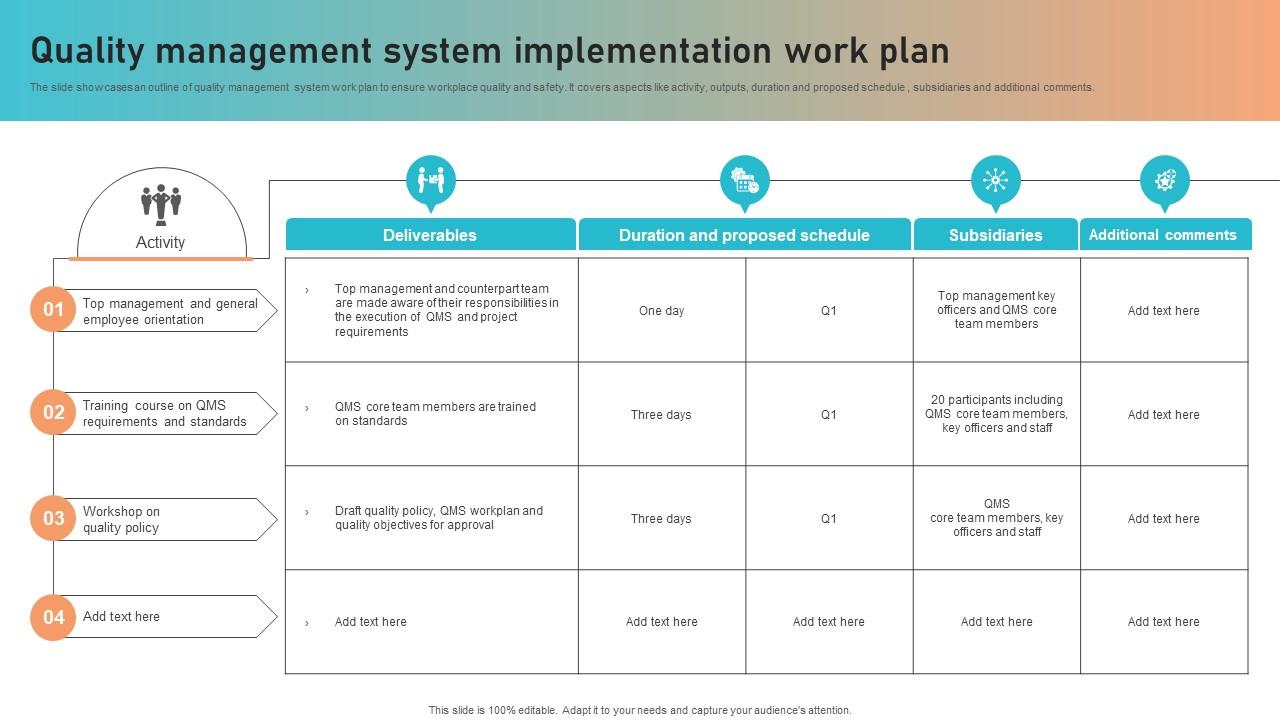
The slide showcases an outline of quality management system work plan to ensure workplace quality and safety. It covers aspects like activity, outputs, duration and proposed schedule, subsidiaries and additional comments.
People who downloaded this PowerPoint presentation also viewed the following :
Quality Management System Implementation Work Plan with all 6 slides:
Use our Quality Management System Implementation Work Plan to effectively help you save your valuable time. They are readymade to fit into any presentation structure.
FAQs for Quality Management System
So you'll need process documentation, clear roles, and regular monitoring/audits. Customer feedback loops are huge too - plus corrective action procedures and management reviews. Training programs and risk management should be in there as well. Documentation is honestly such a drag but you can't skip it if you want consistency. Oh, and everything needs to connect - your processes should flow into monitoring, which then drives improvements. I'd start by mapping what you're already doing, then figure out where you need better controls. Risk management sounds fancy but it's basically just thinking ahead about what could go wrong.
Hey! So first thing - get your leadership on board or you're basically screwed from the start. Do a gap analysis to see where you stand against ISO requirements. Document your processes (yeah, I know it's boring but necessary). Build everything around Plan-Do-Check-Act cycles. Internal audits are honestly where the magic happens - way more useful than the actual certification audit since they catch problems early. Train everyone on procedures and keep solid records. Oh, and don't treat it like some box-checking exercise. Make quality part of how you actually work day-to-day, otherwise it'll just become this annoying thing nobody cares about.
Honestly, training is make-or-break for your QMS. People need to get the "why" behind quality stuff, not just follow steps blindly. When folks understand how their job connects to the bigger picture, you'll see way fewer mistakes and less of that "not my problem" attitude. Auditors always check training records first too - learned that the hard way at my last job. Don't just focus on technical skills either. The mindset piece matters just as much. Keep everything current when processes shift, otherwise you're asking for trouble.
Look, data analytics basically lets you stop guessing and start making decisions based on actual evidence in your QMS. You'll spot defect trends way faster and catch quality issues before they blow up into bigger headaches. Once you see those patterns emerge - and trust me, you will - it becomes addictive in the best way. No more scrambling to put out fires after the fact. Pick one quality metric you're already watching (probably something obvious) and just dive deeper into what it's telling you. I guarantee there's stuff buried in there you haven't noticed yet.
Ugh, the resistance you'll get is insane - people will act like you're asking them to learn hieroglyphics when really it's just better processes. Leadership might give you lip service but then wonder why you need actual budget and time. Documentation is a nightmare if nobody's written down how things actually work (vs how they're supposed to work, you know?). Plus everyone gets excited during kickoff meetings but then three months later it's crickets. Honestly though? Pick one small area to pilot first. Get some quick wins so people stop rolling their eyes when you mention QMS.
Here's the thing - QMS catches problems before your customers see them, which is honestly half the battle. You get consistent processes, regular checks, and when something does go sideways, there's actually a system for handling complaints (customers notice this stuff). The documentation side might seem boring but it really helps. What I love about it is the continuous improvement part - you're always tweaking things to get better. Happy customers stick around and tell their friends. I'd start by looking at where quality matters most in what you do and focus there first.
Look, start with the basics - map out what you're doing now, then spot where things get messy. PDCA cycles work great (Plan-Do-Check-Act if you haven't heard of it). Your employees are honestly your best resource here since they see the problems firsthand. Track your data and watch for patterns over time. When stuff breaks, dig into why it actually happened instead of just slapping a band-aid on it. Regular audits help too, though they're kinda boring. Oh, and don't try to fix everything at once - pick one small process as your guinea pig first. Way less overwhelming that way.
Honestly, the biggest game-changer is automated compliance reporting - no more scrambling around last-minute trying to pull everything together manually. You can digitize document control, get real-time dashboards that actually make sense, and set up workflows so approvals happen automatically. Your team can work from anywhere with cloud platforms, and everything gets tracked without you thinking about it. No more digging through filing cabinets for the right revision (thank god). Electronic signatures speed things up too. My advice? Pick whatever manual process drives you the most crazy and start there.
So there's a bunch of ways to track if your QMS is actually working. Customer satisfaction scores are huge - honestly that's probably the most important one since happy customers = success. Then you've got your usual suspects like defect rates, how fast you're delivering stuff, complaint resolution times. Internal audit findings tell you a lot too. Non-conformance rates are another big one. Oh, and definitely track how quickly you're closing out corrective actions - that shows if your team is actually fixing problems or just letting them pile up. The trick is setting baselines first, then watching trends instead of just random data points. Maybe throw together a simple dashboard? Review it monthly with your team so everyone stays on the same page.
So QA is all the upfront stuff - processes and systems that stop problems from happening in the first place. QC happens after. That's your testing and inspections to catch defects once something's already made. I always think of it like... QA builds the fence at the top of the cliff, QC is the ambulance at the bottom. Kinda dramatic but whatever, it sticks. You definitely need both in your QMS though. Most companies I've seen are way too heavy on one side. Try mapping out what QA processes you actually have versus your QC activities - probably gonna be eye-opening.
Your QMS is basically an early warning system for catching problems before they explode. All that documentation and monitoring? It's like having little sensors everywhere tracking what's going wrong. You get way better visibility into issues, plus standardized ways to handle them when stuff hits the fan. Regular audits help spot blind spots too - honestly, I've seen companies miss obvious risks because they weren't looking systematically. The escalation paths are clutch when things get messy. Map out where your current risks connect to your QMS processes. That'll show you exactly where to tighten things up.
Leaders totally make or break quality culture. If they're cutting corners when things get crazy but preaching about standards, everyone sees right through that BS. Your boss needs to actually walk the walk - celebrating quality wins, backing initiatives with real resources, not just lip service. The psychological safety thing is huge too. People won't speak up about problems if they think they'll get blamed. Honestly, just watch what leadership actually rewards day-to-day versus what they claim matters in meetings. That'll tell you everything about where quality really stands in your company.
Different industries basically bend QMS to match their world. Healthcare goes all-in on patient safety and compliance stuff. Manufacturing cares more about stopping defects and controlling processes. Software teams - they've gotten pretty clever adapting it for agile cycles, honestly. Financial companies obsess over risk management and keeping audit trails. Food industry? They're paranoid about contamination, which makes sense I guess. You can't just copy ISO standards though. Figure out what "quality failure" actually looks like for your business first. Then build your system around preventing exactly those disasters.
So the huge win is cutting out all that duplicate paperwork and processes. Instead of managing three separate systems that basically do the same stuff anyway, you get one smooth operation. Audits become so much easier - auditors can check everything in one go rather than bouncing around. Your team won't be scratching their heads about which procedure to use either. Plus you'll catch quality problems that tie back to safety or environmental issues way quicker. Honestly, the overlap between these systems is insane once you really look at it. Start by figuring out where your current processes already cross over.
Don't treat customer feedback like it's some separate thing - weave it right into your QMS processes. Multiple channels work best: surveys, complaints, regular check-ins, whatever fits your business. Here's where companies totally blow it though - they collect feedback but never close the loop. You've got to actually analyze patterns, find root causes, then update your processes. Most important part? Tell customers what you changed because of their input. People love knowing they were heard. Start by looking at where you're already getting feedback and figure out what gaps you're missing. Documentation helps track everything over time.
-
“I required a slide for a board meeting and was so satisfied with the final result !! So much went into designing the slide and the communication was amazing! Can’t wait to have my next slide!”
-
Mesmerized with the fantastic collection! Super sleek, relevant infographics.