


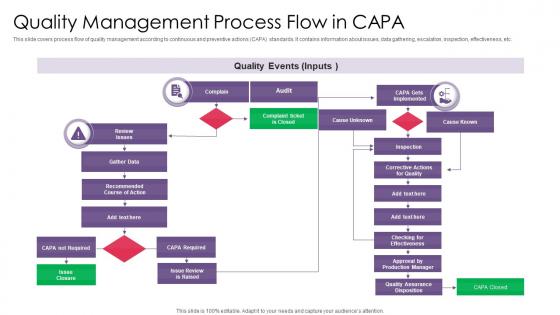
Quality Management Process Flow In Capa




Try Before you Buy Download Free Sample Product
 Impress Your
 Audience
 100%
100% Editable
 Save Hours
 of Time


This slide covers process flow of quality management according to continuous and preventive actions CAPA standards. It contains information about issues, data gathering, escalation, inspection, effectiveness, etc.
People who downloaded this PowerPoint presentation also viewed the following :
Quality Management Process Flow In Capa with all 6 slides:
Use our Quality Management Process Flow In Capa to effectively help you save your valuable time. They are readymade to fit into any presentation structure.





FAQs for Quality Management Process
So you need four main things: figure out what's wrong, dig into why it happened, fix the current mess, then prevent it from happening again. Documentation is huge too - auditors are basically obsessed with paperwork, it's wild. Risk assessment should be part of it, plus timelines and checking if your fixes actually worked. The whole idea is building a system that stops problems before they start instead of just scrambling to react. I'd start by looking at what you're already doing and seeing what gaps you have. Way more effective than band-aid solutions.
So CAPA management basically helps you stay one step ahead of regulators. When the FDA shows up for inspections, they'll dig straight into your CAPA system first thing - I swear it's like they have a checklist. You want to show them you're finding problems and fixing them before they blow up into bigger issues. Root cause investigations are huge here. Document everything obsessively and track whether your fixes actually work. That's what really gets their attention in a good way. It proves you're not just putting out fires but actually improving your processes over time.
Honestly, the worst thing you can do is treat CAPA like paperwork instead of actual fixing. Most teams do garbage root cause analysis - they just blame "human error" and move on. Drives me crazy! Your corrective actions need to be specific too, not some wishy-washy statement nobody can measure. Train your people on proper root cause methods first, that's huge. And for the love of god, actually follow up later to see if it worked. I've seen so many places just file the report and forget about it. Total waste of time.
Honestly, automating your CAPA workflows is probably the smartest move you can make right now. You'll get automated reminders, real-time tracking, and everything stored digitally instead of drowning in paperwork. The analytics part is clutch - spots patterns before they blow up into major headaches. My advice? Don't try to do everything at once though. Start by going digital with what you've got, then add the fancy automation stuff once everyone's used to it. Integration with your current quality systems makes the whole thing way smoother too.
Honestly, you can't skip the root cause analysis part - that's where most teams mess up. They see a problem and immediately jump to fixing it without figuring out WHY it happened. Big mistake. The whole point of CAPA is digging deeper than surface symptoms. I've watched so many corrective actions fail because people didn't do their homework first. Once you actually understand what caused the issue, then you'll know what actions might work. Otherwise you're just slapping temporary fixes on things that'll break again next month. Trust me, spend the time upfront on good RCA.
Honestly, just focus on the basics first - closure rates, how long fixes take, and whether the same crap keeps happening again. That last one's your best indicator by far. Track if your root cause analysis is actually working by watching for repeat issues. Implementation success across departments matters too, but here's the thing - the real proof is six months later when you're not dealing with similar problems anymore. I'd set up something simple to check quarterly (nothing fancy), and definitely get input from whoever's actually doing the fixes. They'll tell you what's really working.
So basically, corrective actions fix stuff that already went wrong. Preventive actions catch problems before they even happen. Like if you find a defective product - corrective action means digging into what caused it and fixing that. But preventive? That's looking at trends or doing risk assessments to spot potential issues early. It's kinda like patching a hole in your roof vs. checking for loose shingles before the next storm hits. Honestly, the timeline thing trips people up the most. When you're writing up your CAPAs, be super clear about which type you're dealing with because the whole investigation process is different for each one.
Honestly, CAPA works so much better when people actually want to help fix things. Your team will report problems way earlier if they're not worried about getting blamed - I've seen this happen too many times. They'll also dig into real root causes instead of slapping quick fixes on everything. Leadership has to show they're cool with mistakes and celebrate people who speak up. Change how you run those CAPA meetings too. Don't ask "who screwed this up?" Ask "what can we figure out from this?" Makes a huge difference in how people respond.
Honestly, start with the obvious stuff - how long CAPAs take to close and what percentage finish on time. Recurrence rates are huge though, that's my go-to metric. If the same issues keep popping up, your root cause analysis is probably too shallow. Track reopened CAPAs too since that's usually a dead giveaway something's wrong. I'd throw overdue counts in there and maybe break it down by department. Monthly dashboards work well, then do quarterly reviews to catch trends. The recurrence thing really tells the whole story - I've seen companies think they're crushing it until they realize they're just playing whack-a-mole with symptoms.
Yeah, CAPA processes totally change depending on your industry. Manufacturing usually follows ISO standards - you're mostly fixing product defects and tweaking processes. Healthcare though? That's a whole different beast. FDA makes everything way more complicated with tons of documentation and risk analysis. Plus patient safety committees get involved which honestly slows everything down. Food safety sits in the middle - HACCP drives most of their corrective actions around contamination stuff. The basic investigate-fix-prevent approach doesn't change, but timelines and paperwork requirements are completely different. I'd start by figuring out which regulations actually apply to your specific sector first.
Start with root cause analysis training - that's honestly the most critical piece. Your team needs to get comfortable with 5 Whys, fishbone diagrams, failure mode analysis, all that stuff. Problem-solving and data analysis skills are massive too since they'll need to actually figure out what went sideways. Communication training is super underrated here because documenting everything clearly is half the battle. Plus they'll be presenting to different people constantly. Oh, and whatever regulatory stuff applies to you - FDA, ISO standards, etc. I'd map out who has what gaps first, then build your training plan around that.
Don't treat CAPA like some separate thing - weave it into your regular QMS stuff. Connect it to audits, complaints, nonconformances, all that. I've watched companies totally waste time keeping CAPA isolated and honestly, it becomes pointless. Your procedures should reference each other. Get data flowing between systems automatically if you can swing it. Train people so they actually understand how everything connects - way too many teams miss this bigger picture. The whole point is making CAPA part of what you're already doing daily, not some afterthought you scramble to handle later.
Look, bad CAPA management is like a broken record - same problems keep coming back to bite you. Your product quality tanks, customers lose faith, and you're stuck playing whack-a-mole with defects instead of actually solving anything. I've seen teams burn through so much time and money because they keep patching symptoms rather than digging into what's really broken. The worst part? Customers notice when you can't deliver consistent quality, and they start shopping around. Short sentences hit different sometimes. Bottom line - fix your CAPA process to tackle root causes, or you'll keep dealing with the same headaches over and over.
Once a year is the bare minimum, but honestly? I'd go with every 6 months if you're in pharma or med device - those industries change fast. Your procedures get stale quick when new regs drop or you learn something from an actual investigation. Here's the thing though - if you keep seeing the same root causes over and over, don't wait for your scheduled review. That's your system telling you something's broken. I always tell people to just set a reminder and treat it like any other QA review. Way better than scrambling when an auditor asks about it.
Use structured templates for CAPA docs - cover root cause analysis, corrective actions, and preventive stuff. Fishbone diagrams work great, or just do 5-why analysis. Risk matrices help you figure out what to tackle first. Keep it simple though - I've watched teams way overthink this and bog everything down. Set up tracking with CAPA logs or quality software to watch timelines and see if things actually work. Oh, and stay consistent with your format so auditors don't get confused trying to follow your thinking.
-
Amazing product with appealing content and design.
-
Design layout is very impressive.