


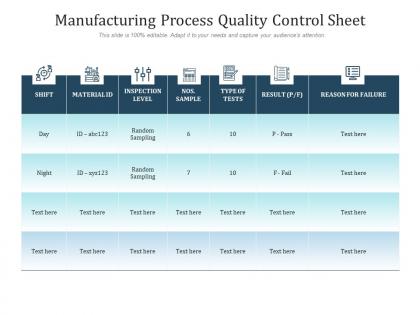
Manufacturing process quality control sheet




Try Before you Buy Download Free Sample Product
 Impress Your
 Audience
 100%
100% Editable
 Save Hours
 of Time


Our Manufacturing Process Quality Control Sheet are topically designed to provide an attractive backdrop to any subject. Use them to look like a presentation pro.
People who downloaded this PowerPoint presentation also viewed the following :
Manufacturing process quality control sheet with all 2 slides:
Use our Manufacturing Process Quality Control Sheet to effectively help you save your valuable time. They are readymade to fit into any presentation structure.
FAQs for Manufacturing process
So basically you want to catch problems before they happen instead of fixing them after. Way cheaper that way. Measure everything obsessively - all that data helps you tweak your processes over time. Your team's gotta understand what quality looks like and feel comfortable shutting things down when something seems wrong. Customer focus is everything too, obviously. Oh and map out where you're checking quality now - you'll probably find some weird gaps you didn't notice before. The whole point is getting consistent results that don't disappoint people.
Look, QC is basically what makes or breaks customer happiness. People want what they ordered, and when they get it consistently, they'll stick with you. Honestly, I've seen too many businesses skip this step and then wonder why they're drowning in returns and nasty reviews. You catch problems before shipping = happy customers who tell their friends about you. Don't catch them? You're dealing with complaints and refunds, which costs way more than just fixing stuff during production. Trust me on this one - good quality control pays for itself pretty quickly.
Think of SPC as catching problems before they blow up in your face. Control charts let you watch your processes happen and spot weird patterns or drift right away. Way smarter than just checking stuff at the end - honestly, who has time for that headache? You can actually fix things while they're happening instead of dealing with angry customers later. The data tells you exactly when to tweak things. Pick whatever process stresses you out most and throw some basic control charts at it first.
Honestly, you've gotta track your defect rates and customer complaints religiously - that's where the real data is. Set up monthly reviews to spot trends, and get your team involved since they see problems way before management does. That PDCA thing (Plan-Do-Check-Act) actually works, even though it sounds super corporate. Here's the thing though - people won't speak up about issues if they're gonna get blamed for it. Create a safe space for reporting problems. Oh, and don't try to fix everything at once. Pick one small improvement per quarter. Way less overwhelming that way.
For QC data analysis, I'd go with R or Python if you want the full statistical toolkit - control charts, hypothesis testing, all that good stuff. Minitab's solid too but costs more. Honestly though, Excel handles most basic QC work fine, and let's be real - everyone already knows how to use it. You'll want some kind of SPC software for real-time monitoring, like QI Macros. Tableau or Power BI are clutch for dashboards since visual alerts often catch problems faster than running complex stats. My advice? Start simple with tools your team actually uses, then get fancy later.
Healthcare QC is absolutely brutal - we're talking FDA approvals, endless validation rounds, mountains of documentation. People die if you mess up. Manufacturing's way more chill about it, though they still do their statistical sampling and defect tracking stuff. I mean, nobody's thrilled about a broken widget, but it won't land you in court for malpractice, right? The whole thing comes down to consequences. Medical device fails? That's someone's life. Your QC process should match whatever nightmare scenario you're trying to avoid in your industry.
Okay so basically QA prevents problems, QC finds them after. QA is all the upfront stuff - your processes, training, standards - so things don't go wrong to begin with. Then QC comes in later with testing and inspections to catch whatever still slipped through. It's like... QA builds a solid fence, QC checks if anything jumped over anyway. Both matter but honestly? Get your QA dialed in first because fixing stuff later is such a pain. Way more expensive too. Once that's solid, add your QC checkpoints on top.
So regulatory standards are basically the minimum you have to hit for quality control, but it gets crazy different depending on your industry. Pharma is absolutely nuts - FDA wants you documenting everything like three times over. Manufacturing usually goes with ISO 9001, food has HACCP for safety stuff. Healthcare's obviously the most intense since people's lives are literally at risk. The tighter the regs, the more you'll be drowning in testing and paperwork. Honestly, I'd start by figuring out exactly which standards hit your sector first, then work backwards from there to build your processes.
Honestly, hands-on training with real examples from your production line works best - people need to see the actual defects they'll deal with. Cover both what each quality standard is AND why it matters, since understanding the reasoning helps with judgment calls later. Role-playing scenarios sounds dumb but actually works really well. Document everything as simple checklists for reference. You'll need regular refresher sessions too because details get forgotten. Oh, and this is huge - create an environment where they can ask questions and report problems without getting blamed for stuff.
Honestly, AI can be a game-changer for quality control. Computer vision catches stuff human eyes miss, especially when people are tired from long shifts. The machine learning side gets better over time too - it learns your production quirks and starts predicting problems before they hit. Real-time data is huge because you can tweak things immediately instead of finding out about issues later. My advice? Don't go crazy right away. Pick your most important product line and test an automated inspection system there first. See how it goes, then expand from there.
Oh man, where do I start? Inconsistent processes are the worst - nobody's doing things the same way. Communication between teams is usually terrible too. You never get enough time or budget, which sucks but that's just reality. Half the time people don't even know what good quality looks like because training is nonexistent. Most companies just catch problems after they happen instead of preventing them. Honestly, documenting your standards clearly is probably the best first step. Make sure everyone actually gets it though - otherwise you're just wasting paper.
So basically, supplier quality management is about getting your vendors to do the quality work upfront instead of you scrambling to fix things later. Way smarter than inspecting everything that shows up at your door - that's just expensive damage control. You want to set standards with suppliers, audit how they do things, maybe require some certifications. Train them to be your quality watchdogs, you know? It's honestly one of those things that saves you so much headache down the road. Start by figuring out which suppliers actually matter for your quality - map out the critical ones first and go from there.
Quality control is actually huge for the environment - mostly in a good way. Catching defects early stops bad products from hitting landfills. You're also not wasting all the energy and materials that went into making them. It's like finding a typo before printing 10,000 flyers, right? Better QC makes your whole process more efficient too, which cuts down energy use and material waste. The trick is building quality checks right into production instead of just testing at the end. That way you can fix things before you've already burned through everything. Honestly, it just makes sense.
Get shared dashboards up first - everyone needs to see the same real-time metrics without digging around. Weekly meetings help but honestly, keep them short or people just check out. Charts and that red/yellow/green color thing work way better than just throwing numbers at people. Here's the thing though - sales cares about totally different stuff than engineering does, so you'll need to translate. I'd start with maybe two metrics that everyone actually agrees matter, then build from there once it's working.
Honestly, don't make quality just the QC team's problem. Train everyone on your standards first - show them how their piece affects the whole thing. When someone catches an error or has a good idea, celebrate it big time. That positive reinforcement actually works. Let people stop the line if they see issues, and make reporting problems feel safe, not like they're tattling. Oh, and do regular check-ins about how things are going. The whole point is shifting from "who screwed up" to everyone taking pride in good work. It's way more effective than the blame game.
No Reviews