


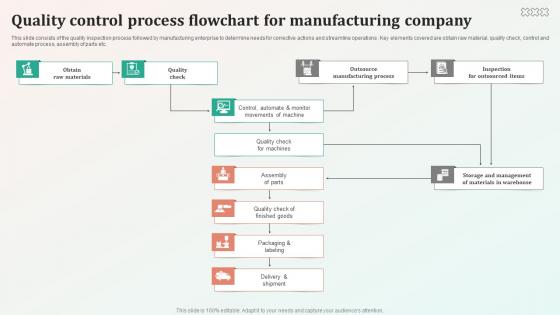
Quality Control Process Flowchart For Manufacturing Company




Try Before you Buy Download Free Sample Product
 Impress Your
 Audience
 100%
100% Editable
 Save Hours
 of Time


This slide consists of the quality inspection process followed by manufacturing enterprise to determine needs for corrective actions and streamline operations . Key elements covered are obtain raw material, quality check, control and automate process, assembly of parts etc.
People who downloaded this PowerPoint presentation also viewed the following :
Quality Control Process Flowchart For Manufacturing Company with all 6 slides:
Use our Quality Control Process Flowchart For Manufacturing Company to effectively help you save your valuable time. They are readymade to fit into any presentation structure.





FAQs for Quality Control Process Flowchart
Honestly, start with solid quality standards and build in checkpoints as you go - don't try to do everything at once. Documentation is boring but it'll save you when stuff hits the fan later (learned that the hard way). Train your people well because great systems are useless if nobody knows how to actually use them. Oh, and collect metrics that matter, then actually look at the data regularly instead of just letting it pile up. Regular inspections throughout production catch problems early. Quick feedback loops help you fix issues before they snowball into bigger headaches.
Basically it comes down to timing - product QC happens before customers see anything, but with services you're doing quality control while actually delivering the service. Products are way easier honestly, since you can test everything in advance and fix problems before shipping. Services though? You're performing quality checks in real-time with actual humans involved, which gets messy fast. Can't exactly recall a waiter mid-conversation to "fix" them. So service companies focus more on training their people really well and having good feedback systems. The trick is building those quality checks right into how you deliver the service instead of crossing your fingers afterward.
Honestly, data analysis is like having a crystal ball for quality control. You'll spot patterns way faster and predict failures before they bite you. Track your key metrics consistently first - that's the foundation. Then hunt for correlations you probably missed (trust me, the obvious culprits usually aren't the real problem). Statistical tools help you set smarter control limits too. But here's where it gets cool: predictive analytics lets you catch problems upstream instead of scrambling after everything's already broken. Way less stressful than playing defense all the time.
Look at what's eating up the most time first - those boring repetitive checks that drive everyone crazy. Cameras on conveyor belts spotting defects, sensors measuring parts, stuff like that. Hook them into your current setup so they can catch problems instantly and kick out the bad ones automatically. Yeah, the initial investment will make your accountant nervous, but most places see payback in 12-24 months. I'd say pick one line to test it out. Let your crew get used to it before going nuts with the whole operation. Way less headaches that way.
So for food QC, HACCP is your foundation - it's basically systematic hazard analysis that gives you the whole framework. Then you layer on statistical process control to catch variations, plus visual inspections at key points. Most places do regular micro testing for nasties like pathogens, monitor pH and temps constantly. Metal detectors are surprisingly hardcore - way more sensitive than TSA ones, which is kinda wild. Lot tracking systems let you trace problems back to specific batches when things go sideways. Start with HACCP first, then add whatever testing makes sense for your specific products.
Look, good quality control = happy customers who actually come back. Nobody wants to deal with broken stuff or products that suck - those "ugh why did I waste my money" moments kill trust fast. You know how you probably grab the same brands without thinking? That's because they don't disappoint you. Honestly, the trick is catching problems before customers do instead of scrambling after complaints roll in. Fix issues early and people will keep buying from you. It's pretty straightforward - consistent quality builds the kind of loyalty where customers don't even shop around anymore.
Honestly, the worst part is dealing with inconsistent processes - every team does things slightly different and it drives me crazy. Staff turnover is brutal too because you're constantly retraining people. Budget constraints are always an issue when you're trying to maintain quality standards. Equipment calibration becomes this ongoing nightmare if you let it slide. Even your best people will have off days or interpret things differently than you expect. Don't get me started on regulatory changes... feels like they're always shifting the rules on you. My advice? Document everything and make idiot-proof checklists. Sounds tedious but it'll save your sanity later.
Training your people is everything for quality control, seriously. Without it, you're basically throwing money away on fake processes that don't work. Your team needs to get the reasoning behind stuff, not just follow steps blindly. That way they spot problems early and know what to do when weird situations come up. Confidence matters too - trained employees actually speak up when something looks wrong instead of staying quiet. I'd definitely do regular refreshers and use real examples from your actual work, not boring textbook scenarios that nobody relates to.
So ISO 9001 is basically proof you've got your quality stuff figured out. It's this international certification that shows you follow consistent standards - like documenting everything, doing regular audits, all that fun stuff. Honestly, some clients won't even talk to you without it. But beyond just having the fancy certificate, you actually get better processes and fewer screw-ups. Your customers end up happier too. My advice? Map out what you're already doing first before diving in. Makes the whole thing way less overwhelming.
So lean manufacturing flips quality control on its head - instead of checking everything at the end, you build quality into each step. Workers can actually stop the line when they catch problems, which seems scary but works way better. The whole idea is preventing defects rather than finding them later through error-proofing and continuous improvement stuff. Honestly, it makes quality everyone's job instead of dumping it all on QC. Visual tools and standardized procedures help issues pop up right away. I'd start by figuring out where your biggest defect problems are happening and hit those areas first.
Honestly, there's a bunch of solid options depending on what you're dealing with. Minitab and JMP are great for statistical stuff - though JMP can be pricey. For documentation headaches, check out MasterControl or TrackWise. Machine vision tools are getting really good now too, and some places are throwing IoT sensors everywhere for real-time monitoring. But look, if you're just starting out? Even Excel control charts or simple checklist apps can save you tons of headache. I'd figure out what's driving you most crazy right now and tackle that first.
Just track your QC spending against what you save from catching problems early. Look at hard numbers first - less waste, fewer returns, warranty claims dropping. The soft stuff like brand reputation is real but harder to measure, so start simple. Pick 2-3 metrics and track them for six months straight. Most companies I've seen hit 3-5x ROI when they actually bother measuring it properly. Compare your total QC costs (people, tools, whatever) to the money you're not losing on defects and rework. Start small though - don't overcomplicate it right out of the gate.
Look, skipping quality control is basically asking for trouble. Defective stuff reaches customers, your brand takes a hit, and you're stuck with expensive recalls. The worst part? You can't even track where problems started, so fixing them becomes this nightmare guessing game. Your suppliers get defensive when things go wrong too - nobody wants to take the blame. I learned this the hard way at my old job. Bottom line: dealing with quality disasters after they happen costs way more than just preventing them upfront. Trust me on this one.
Look, pharma QC is basically ruled by regulations - they're not optional. cGMP guidelines control everything from test method validation to documenting every tiny detail. FDA and EMA set the testing protocols and batch release criteria you can't mess with. Your whole QC setup - how you sample, train people, structure the department - comes from these rules. Yeah, the paperwork is insane (seriously, so much paperwork), but patients depend on it. Oh, and definitely check out ICH guidelines first - they'll show you what's expected globally.
Real-time monitoring with IoT sensors is where it's at - you get constant data instead of just checking stuff randomly. AI predictive analytics can actually catch defects before they mess things up, which honestly saves so much headache. Digital twins are wild too, basically you can test changes on a virtual copy without breaking your actual process. Machine learning is making statistical process control way smarter since it adapts to your specific patterns over time. Oh, and everything connects now which is pretty cool. I'd probably start by figuring out where you can swap predictive stuff for the reactive checks you're doing now.
-
The quality of PowerPoint templates I found here is unique and unbeatable. Keep up the good work and continue providing us with the best slides!
-
Great product with effective design. Helped a lot in our corporate presentations. Easy to edit and stunning visuals.