


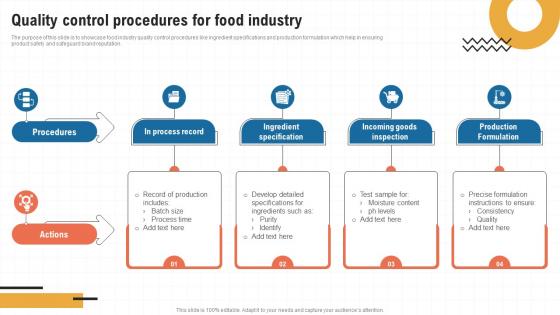
Quality Control Procedures For Food Industry




Try Before you Buy Download Free Sample Product
 Impress Your
 Audience
 100%
100% Editable
 Save Hours
 of Time


The purpose of this slide is to showcase food industry quality control procedures like ingredient specifications and production formulation which help in ensuring product safety and safeguard brand reputation.
People who downloaded this PowerPoint presentation also viewed the following :
Quality Control Procedures For Food Industry with all 9 slides:
Use our Quality Control Procedures For Food Industry to effectively help you save your valuable time. They are readymade to fit into any presentation structure.








FAQs for Quality Control Procedures
So basically you want to prevent problems instead of just catching them after the fact. Way more effective. Your front-line people are gold for this - they see issues before anyone else does. Statistical process control sounds fancy but it's just using real-time data to watch your processes. Honestly, the biggest game-changer is getting everyone to own quality, not dumping it all on QC. Continuous improvement and keeping customers happy are the other big pieces. I'd start by mapping where you're getting defects now - that'll show you the quick wins right away.
So TQM shifts everything - quality becomes everyone's job, not just some department's headache. Defects drop, costs go down, customers actually get happy. The culture change is wild honestly. People start thinking "how can we do this better?" instead of just phoning it in. Your teams get way more engaged too since they can actually fix problems they spot. Oh and start small though - pick one department first, see how it goes, then roll it out wider once you've got proof it works.
So SPC is like having a heads-up system for quality problems. You track important metrics over time and watch for weird patterns that mean your process is going off the rails. Way better than just checking finished products - you catch issues while you can still do something about them. It's kind of like monitoring your car's dashboard instead of waiting for smoke to start pouring out (maybe a bad analogy but whatever). The cool part? You fix things before they turn into expensive headaches instead of playing catch-up later.
Honestly, you can't rely on just one thing to figure out if customers are happy. Short surveys work great after someone buys something - but seriously keep them short because people bail if there's too many questions. I'd also track your Net Promoter Score every few months and keep an eye on what people are saying in online reviews or social media. Oh, and throw a simple feedback box on your website. The real trick is being consistent with measuring so you can actually see patterns instead of just random complaints here and there. If you're starting from scratch, surveys and NPS are your best bet.
Honestly, most places rely on the big three - SPC, Six Sigma, and lean manufacturing. But here's the thing: basic tools like check sheets and control charts handle probably 80% of quality headaches if you're consistent with them. Pareto analysis is solid too. Root cause stuff like fishbone diagrams gets used a ton, plus failure mode analysis when things get complicated. My advice though? Pick maybe 2-3 tools your team will actually use instead of going crazy with everything. I'd start with control charts and check sheets - they're dead simple but crazy good at catching problems early.
Honestly, it depends on your industry and how bad things get if you mess up. Healthcare? That's life-or-death stuff, so FDA protocols are insane - like, document everything twice. Car companies dump tons into safety testing because recalls will bankrupt you. Food's somewhere in the middle but still serious - nobody wants to be the guy who gave half of Ohio food poisoning, you know? Figure out what regulations hit your industry first. Then see what happens when competitors screw up. That'll tell you how tight your quality control needs to be.
First thing - figure out what "good" actually means for your product. Identify where things usually go sideways and set up checkpoints there. I know it sounds like a lot, but honestly just tackle the biggest risks first. Document your testing methods (boring but necessary) and get everyone trained on the process. Oh, and definitely have a plan for when stuff inevitably doesn't meet standards - trust me on this one. Keep it simple to start. You can always add more complexity later once you've got the basics down and see what's actually working.
Honestly, try the DMAIC thing from Six Sigma - it's actually pretty useful. Define what's broken first, then measure it with real numbers (not just gut feelings). The analyze part is where you'll find the actual root causes, which is kinda the whole point. From there you can improve stuff and put controls in place so it doesn't just fall apart again. I always think people jump straight to solutions without understanding the problem first, which is backwards. Maybe pick one small process to test this on? Data beats guessing every time.
Training is seriously the foundation of good quality control. Your team will catch problems way earlier when they actually understand why procedures matter, not just what to do. I've watched companies skimp on training and their quality tanks every time. Good training turns employees into your best defense against defects - they'll spot issues before they blow up. Honestly, most places do this backwards though. Figure out where your biggest quality problems are happening first. Then build training around fixing those specific weak spots instead of generic stuff nobody remembers.
ISO certs make you document literally everything - all your quality processes, procedures, the works. Yeah, it's a paperwork nightmare at first, not gonna lie. But once you get through it? Your quality control becomes way more consistent. Audits happen regularly, and there's this whole continuous improvement thing baked in. When problems come up (and they will), you'll actually be able to trace them back properly. Your team gets clearer direction too. Honestly, I'd map out what you're already doing first - that way you can spot the gaps without starting from scratch.
Dude, the AI stuff is crazy right now - real-time defect detection that's actually accurate, plus it predicts problems before they even happen. IoT sensors are everywhere too, constantly monitoring instead of those random quality checks we used to do. Computer vision is honestly getting a little creepy with how well it spots defects humans totally miss. Sometimes I feel like the tech moves faster than anyone can keep up with (myself included lol). But here's what I'd do - just start small. Pick one AI inspection tool for your most important process and test it against whatever you're doing now.
Start with quality management systems that match your industry regs - ISO, FDA, whatever fits. Regular internal audits are huge, plus train your people properly. They can't follow rules they don't get, right? Document like crazy and build processes where compliance just happens automatically. Oh, and definitely pick someone to be your compliance person who keeps up with all the changing rules - trust me on this one. Do quarterly check-ins to spot problems early. Way cheaper than dealing with violations later.
Honestly, cost is gonna be your biggest headache. Plus people absolutely hate when you mess with their routine - I've seen teams revolt over way smaller changes lol. You'll need dedicated staff and training, which gets expensive fast. Different shifts doing things totally differently is another nightmare. And don't get me started on trying to keep up with industry standards that change every five minutes. Resource constraints are brutal too since quality control isn't cheap. Start with a small pilot program first though - prove it works before you go all-in company-wide.
Think of feedback loops as your way to catch stuff before it blows up. Pick one process and create a simple cycle: check how it's going, figure out what's broken, fix it, then repeat. Weekly check-ins work way better than waiting months - honestly, most teams I know who do quarterly reviews are just letting problems fester. The trick is making it actually cyclical so each fix builds on the last one instead of just random patches. Start small though. Track a few basic metrics and adjust as you go. You'll spot the expensive headaches coming from miles away.
Start with defect rates, customer complaints, and first-pass yield - those three will tell you if stuff's actually getting caught before it hits customers. Cost of quality is huge too, honestly most people don't realize how much they're spending on prevention versus fixing screwups later. You'll want to track how long corrective actions take and whether people are actually finishing their training. I learned this the hard way at my last job. Once you get those basics down, then you can add whatever weird industry-specific stuff applies to you.
-
Attractive design and informative presentation.
-
I am extremely pleased with these PPT slides that we used for our event. They were easy to modify and came out great in all aspects!