


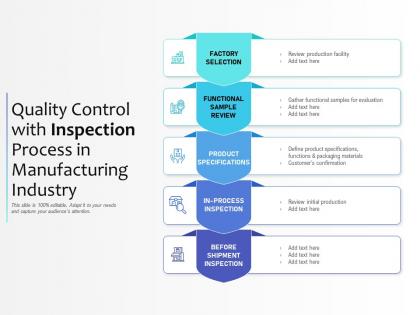
Quality control with inspection process in manufacturing industry




Try Before you Buy Download Free Sample Product
 Impress Your
 Audience
 100%
100% Editable
 Save Hours
 of Time


Our Quality Control With Inspection Process In Manufacturing Industry are topically designed to provide an attractive backdrop to any subject. Use them to look like a presentation pro.
People who downloaded this PowerPoint presentation also viewed the following :
Quality control with inspection process in manufacturing industry with all 2 slides:
Use our Quality Control With Inspection Process In Manufacturing Industry to effectively help you save your valuable time. They are readymade to fit into any presentation structure.
FAQs for Quality control with inspection process
Look, the whole thing really comes down to catching problems early instead of scrambling to fix them later. Build quality checks right into each step - way better than just testing the final product and finding out you screwed up. Get your team trained properly and actually write down your processes (yeah, even the basic stuff people think they remember). Use data to spot weird patterns before they blow up. Oh, and base everything on what customers actually need, not what's easier for you internally. Honestly, prevention beats detection every single time.
First thing - map out your current processes and find where defects usually pop up. Set clear standards at each stage (yeah, it's boring but whatever). Train your team on what to look for and actually let them stop production when something's wrong. That part's huge because most places don't give workers that power. Track data regularly so you can catch patterns early. Don't dump it all on QC either - make quality everyone's job. Honestly, just pick one process to start with and expand from there once you get the hang of it.
Okay so statistical process control is like having a radar system for quality problems. You monitor your key metrics and set boundaries - when things start going wonky outside those limits, boom, you know something's up. Way better than waiting for customers to complain about defective stuff, right? It's honestly pretty smart - you can spot trends early and fix things before they spiral. I'd start simple though, just pick your most critical measurements and throw them on some basic control charts. Track everything continuously and you'll catch issues while they're still manageable.
Look, good quality control basically means your customers won't get burned by crappy products. They'll trust you more and keep coming back. Catching problems before stuff ships saves you from angry emails and returns - trust me on this one. Companies mess this up all the time even though it seems pretty straightforward. Here's the thing though: fixing quality issues after customers find them costs way more than just preventing them upfront. So yeah, invest in solid QC processes now.
For QC, start with control charts and inspection checklists - honestly, those two alone will solve most of your headaches right away. Statistical process control charts track variations over time, which is clutch. Pareto charts are my personal favorite though - they show you which problems are actually worth fixing instead of wasting time on random small stuff. You'll also need sampling plans, flowcharts for mapping your processes, and fishbone diagrams when you're trying to figure out what went wrong. Oh, and histograms help with data distribution. Most people throw in some automated testing tools too. Don't overcomplicate it at first.
So QC is basically damage control - you're catching defects after stuff's already made. QA's the opposite - it's setting up systems beforehand so problems don't happen. Picture QC as cramming for finals while QA is actually doing the homework all semester (terrible analogy but whatever). Most companies do QC at different production checkpoints. QA starts from day one with your processes, training, all that foundational stuff. Honestly, if you nail the QA side early on, you won't be putting out fires with QC constantly later.
Honestly, the worst part is everyone doing things their own way despite having procedures written down. People rush and mess up - it happens. Equipment goes out of calibration, suppliers send inconsistent stuff, and there's always pressure to go faster or cheaper (which means skipping quality steps, obviously). Oh, and good luck getting anyone to actually fill out paperwork properly - that's like pulling teeth. I'd focus on nailing down your most critical processes first and do regular training sessions so people don't drift back to their old habits.
Honestly, automation can be a game-changer for QC. Real-time sensors and AI defect detection will catch problems way faster than manual checks ever could. Machines don't get tired or have bad days, so you get way more consistent results. They can run around the clock too, which is pretty sweet. The data they collect helps you spot trends you'd probably miss otherwise. Your team gets to focus on actually solving problems instead of doing the same inspections over and over. I'd start by looking at whatever manual tasks eat up the most time - those are usually the best candidates for automation. Makes the whole process so much smoother.
Track defect rates and first-pass yield - that's your bread and butter right there. Customer complaints are obvious but honestly the most telling metric since they catch what you missed. Cost of quality is huge too, covering prevention, appraisal, and failure costs so you see the whole financial mess. Oh, and don't forget cycle time for fixes - catching problems is only half the battle. First-pass yield shows what percentage goes through clean without rework. Personally think that one's underrated. These five will give you a solid view of where things stand quality-wise.
So regulatory standards are basically your non-negotiable minimums - FDA stuff for pharma, ISO for manufacturing, that kind of thing. They'll tell you exactly what documentation you need, how to test things, what to do when stuff goes wrong. Can be annoying honestly, but at least you get a clear roadmap. Map out what you're already doing against whatever standards apply to your industry. Then fix the gaps before some auditor shows up and finds them for you - trust me on that one. Way less stressful than scrambling last minute.
Honestly, lean manufacturing and quality control go hand in hand perfectly. Instead of just checking for problems at the very end, you're building quality right into each step. Think of it like fixing typos as you write rather than waiting to proofread everything later (though let's face it, we still mess up sometimes). Continuous improvement becomes the name of the game. Everyone takes ownership of quality, not just the QC team. Map out your current processes first - see where defects usually pop up. That gives you a clear starting point for making things better.
Training your people is probably the biggest game-changer for quality control. When employees actually know what to look for, they catch problems way before they blow up. It's pretty simple - teach them the standards and procedures, and suddenly you've got eyes everywhere spotting defects. People also give a damn more when they understand how their job connects to the bigger picture. My old manager used to say trained workers are like quality detectors, but honestly that's kind of true. They'll follow protocols better and even suggest fixes based on what they see daily. Focus your training on your worst problem areas first.
So Toyota's lean manufacturing thing completely changed how cars get made - their whole continuous improvement deal is legendary. Motorola saved actual billions with Six Sigma while cutting defects way down. Southwest Airlines is interesting because they're not even manufacturing, but they built their whole brand on super consistent service through quality processes. That Southwest example is pretty cool since it proves this stuff works beyond just factories. If you want to try something similar, I'd look at what specific numbers each company tracked and how they actually got their people on board with it.
So it really depends on your industry's specific risks, you know? Pharma companies have to deal with FDA stuff and batch testing since people's lives are at stake. Manufacturing focuses more on statistical controls and defect rates. Food industry is obsessed with HACCP protocols - makes sense since nobody wants to cause food poisoning! Tech companies usually go heavy on automated testing. Here's the thing though: you've got to figure out what failure actually costs you first. Is it expensive rework? Safety issues? Regulatory headaches? Once you know that, your whole QC approach becomes way clearer.
Think of feedback loops as your quality system actually learning from its mistakes. You collect data from inspections, complaints, production issues - whatever. Then you actually do something with it instead of letting it sit in a spreadsheet somewhere (which happens way too often, honestly). Ask yourself what's going wrong and genuinely listen to the answer. The magic happens when you close that loop - make real changes based on what you're finding. Set up regular times to review trends and adjust processes. Short version: collect, analyze, act, repeat. Don't just hoard data.
-
Unique and attractive product design.
-
Much better than the original! Thanks for the quick turnaround.