


Five P S Of Good Manufacturing Practices In Food Quality And Safety Management Guide




Try Before you Buy Download Free Sample Product
 Impress Your
 Audience
 100%
100% Editable
 Save Hours
 of Time


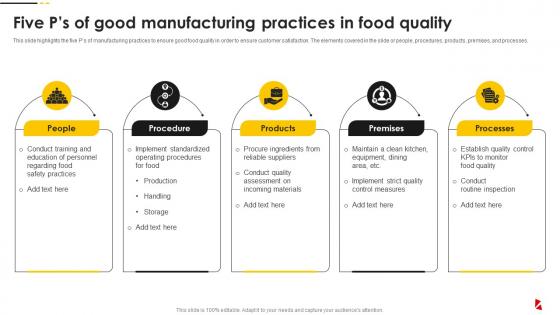
This slide highlights the five Ps of manufacturing practices to ensure good food quality in order to ensure customer satisfaction. The elements covered in the slide or people, procedures, products, premises, and processes.
People who downloaded this PowerPoint presentation also viewed the following :
Five P S Of Good Manufacturing Practices In Food Quality And Safety Management Guide with all 9 slides:
Use our Five P S Of Good Manufacturing Practices In Food Quality And Safety Management Guide to effectively help you save your valuable time. They are readymade to fit into any presentation structure.








FAQs for Five P S Of Good Manufacturing Practices In Food Quality And
So the Five P's are Purpose, Preparation, Practice, Presence, and Passion. Think of it as your anti-disaster toolkit. First figure out WHY you're even presenting - seriously, if you can't explain it in one sentence, you're already screwed. Then do your homework and get organized (Preparation). Practice until it doesn't feel weird coming out of your mouth. Presence is that whole "own the room" thing - way easier said than done, but you'll get there. Passion just means don't be boring about it. Actually care. I know it sounds like corporate BS, but these really do keep you from spiraling during the actual presentation.
The Five P's all work differently to make your presentations better. **Preparation** builds confidence and helps you think ahead about questions. **Practice** is honestly the biggest game-changer - it smooths out those awkward transitions and stops you from rambling (guilty as charged). Good **posture** makes people actually pay attention to you, and **projection** means they'll hear your important points instead of straining to listen. **Pace** keeps things interesting by mixing up your rhythm. Don't try tackling all five at once though. Pick one per presentation until it feels natural, then add another.
Honestly, the Five P's totally changed how I do presentations. Your Purpose and People help you figure out what'll actually matter to your audience instead of just rambling about whatever. Process keeps things flowing so people don't zone out - we've all sat through those painful ones that go nowhere, right? Having a clear Payoff gives everyone something to stick around for. Map them all out beforehand and you'll see people actually paying attention because they get why they should care. Makes such a difference when your audience can follow where you're headed.
The Five P's work great no matter how you present. Storytelling? Focus hard on Purpose to build your narrative. Data presentations need super clear Points with good visuals. I've learned interactive workshops require flexible Preparation - discussions always go off track lol. Pitches demand solid Practice and tight timing. Honestly, the trick is figuring out which P matters most for your audience and style. Match your strongest P to what you're trying to accomplish. Sometimes I'll spend way more time on one P than the others depending on the situation.
Honestly, the Five P's just stop you from doing all the stuff that makes presentations painful to sit through. You know - rambling forever, putting everyone to sleep, or talking about things nobody cares about. Getting clear on Purpose, People, Place, Preparation, and Performance means you won't be that person who obviously has no clue why they're presenting. We've all seen it happen (maybe been there ourselves, let's be real). Master these basics and your presentations will actually make sense and keep people awake. Oh, and figure out your purpose first - before you even think about slides.
Dude, preparation is literally everything with the Five P's. It's what makes the other four actually work - you'll nail your purpose, connect with your audience, and not look like a deer in headlights up there. Good prep means you've thought through the tough questions and smoothed out the awkward parts. Plus you're not panicking about what slide comes next. We've all sat through those cringe presentations where someone obviously threw it together last minute, right? Block out actual time for this stuff early on. Don't be that person cramming at 2am the night before - trust me on this one.
So technically it's the "Promotion" P, but personal branding actually bleeds into everything else too. Your brand becomes how you position yourself as the product - what makes you different from everyone else out there. Stronger brands can charge more, obviously. Plus it shapes which platforms you should even be on and how you show up there. I'd honestly think of it more like the connecting thread running through all five P's rather than just one box to check. Oh, and definitely nail down your core message first - then just keep that consistent no matter which P you're working on.
Honestly, the best approach is mapping each visual to one of your Ps. Charts should directly back up your main Purpose - don't just throw random graphs in there. Know your Audience too. Millennials eat up infographics, but execs? They want clean data, period. Your slides need smooth transitions (jarring jumps kill momentum). When showing your Product, focus on benefits over boring specs - people don't care about features if they can't see what's in it for them. Make sure your Positioning shines through everything. Pro tip: look at each slide and ask "which P am I hitting?" Can't answer? Delete it.
Start with stakeholder mapping - figure out your key People and Partners first because this'll save you so much headache later. Don't do the 4 P's one by one though. Run them in parallel: have someone scope Product requirements while you're nailing down the Process. Honestly, I always underestimate how long planning takes! For Place, just use distribution channels that already exist instead of building new ones from scratch. Make a simple checklist and assign owners to each P. Trust me, during crunch time you'll forget something otherwise and it sucks when that happens.
So corporate presentations are all about driving decisions - you need ROI, timelines, business impact right up front. Academic ones? Way more theoretical, honestly sometimes painfully so lol. Corporate audiences want the "so what" immediately, while academics don't mind if you build up to your point slowly. Your prep changes too - corporate needs hard data and clear recommendations, academic focuses on methodology and lit reviews. Oh and corporate folks hate jargon unless it's their own business speak. Just match your examples to whoever's in the room and you'll be fine.
Honestly, the Five P's thing actually works really well for group presentations. You divide up Purpose, People, Process, Product, and Performance between everyone so there's no confusion about who's handling what. No more scrambling last minute because someone forgot their part - been there! Each person can focus on their strengths too. Like if Sarah's great with audience research, she takes People. If Mike knows the content inside out, he handles Product. The planning meeting is where the magic happens though. Try giving each team member one or two P's to own next time.
So the Five P's thing actually works because you get way more specific feedback than usual. Like instead of someone just saying "nice presentation," they'll tell you if your purpose made sense, whether you seemed prepared, stuff like that. Each P is basically a different area to focus on - Purpose, Preparation, Practice, Performance, and Post-analysis. Way better than guessing what you messed up, honestly. You can actually pinpoint what needs fixing instead of just hoping for the best next time. Try asking for feedback using those categories after your next one - it's a game changer.
Honestly, Steve Jobs nailing the iPhone launch is the perfect example here. Clear purpose (revolutionize phones), he knew his audience, built crazy suspense with that "one more thing" moment, delivered an epic payoff ("today, Apple reinvents the phone"), and you could feel his passion radiating through the screen. Brené Brown's vulnerability TED Talk is another killer example - she hit all five elements flawlessly. I'd definitely watch some iconic product launches or top TED Talks and try spotting each P. It's like a masterclass in presentation skills, but way more entertaining than actual classes.
So storytelling hits all the P's, but Purpose and People are where it really shines. Share customer wins to show your "why" - that stuff resonates way more than mission statements. For your team, stories build actual connection and culture. Marketing loves narratives too, obviously. Process gets helped by case studies that show what works. Performance is weird but true - wrap your metrics in stories instead of just dumping spreadsheets on people. Honestly makes such a difference. I'd start with finding that one story that captures why your team exists. Everything else flows from there.
Honestly, start with what you've got - your phone works great for recording practice runs and timing yourself. Canva's super easy for slides, or just grab a PowerPoint template. Mind mapping? MindMeister's cool but sticky notes on the wall hit different sometimes, you know? For the actual presenting, Teleprompter apps help if you're nervous about forgetting stuff. There's this app called Orai that'll analyze how you talk - kinda weird but useful. Oh, and Mentimeter or Kahoot are clutch for getting people involved with polls and questions. Don't overthink the tech side though. Half the battle is just practicing enough times that you're not stumbling over words.
-
The designs by SlideTeam are honestly the best I have seen so far. Will be definitely coming back for more.
-
Crisp and neat slides. Makes it fun and easier to curate presentations.