

Food Quality And Safety Management Guide Powerpoint Presentation Slides




Try Before you Buy Download Free Sample Product
 Impress Your
 Audience
 100%
100% Editable
 Save Hours
 of Time


Introducing our comprehensive Food Quality and Safety Management Guide PowerPoint presentation your essential tool for ensuring top-notch food safety and quality control in the culinary industry. This meticulously crafted guide covers every facet of food safety management, enabling you to implement a robust Food Safety Management System FSMS with confidence. Additionally, this Food Quality Control presentation dives into topics such as Food Hygiene and Hazard Analysis, essential for identifying and mitigating potential risks. It also explores effective strategies for Food Quality Control, guaranteeing that your products consistently meet the highest standards. Furthermore, this System of Food Quality and Safety Assurance module helps to maintain the integrity of your operations elevating your knowledge, and streamlining your processes with this indispensable resource. Lastly, this Food Safety Management System deck makes informed decisions, safeguards your reputation, and prioritizes consumer well-being. Get access now.
People who downloaded this PowerPoint presentation also viewed the following :
Content of this Powerpoint Presentation
Slide 1: This slide introduces Food Quality and Safety Management Guide. State Your Company Name and begin.
Slide 2: This slide is an Agenda slide. State your agendas here.
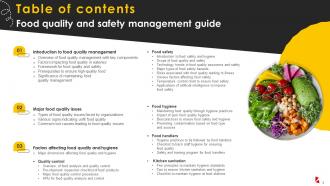
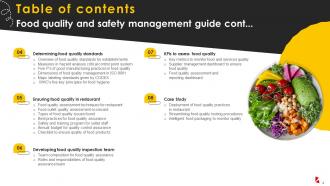
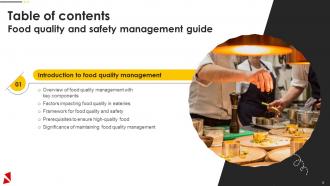
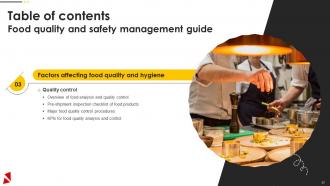
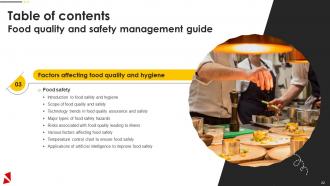
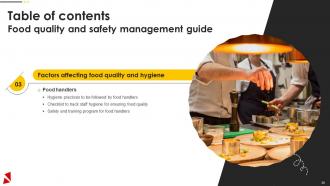
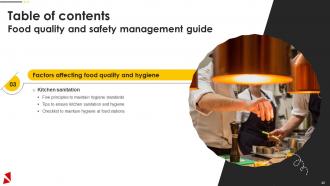
Slide 3: This slide shows a Table of Contents for the presentation.
Slide 4: This slide is in continuation with the previous slide.
Slide 5: This slide is an introductory slide.
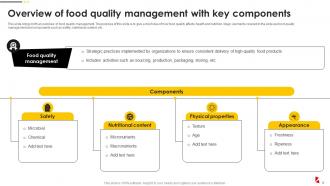
Slide 6: This slide brings forth an overview of food quality management.
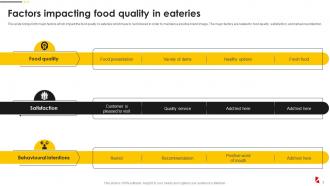
Slide 7: This slide highlights forth major factors which impact the food quality in eateries.
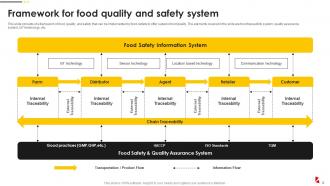
Slide 8: This slide consists of a framework of food, quality, and safety that can be implemented by food outlets to offer superior food quality.
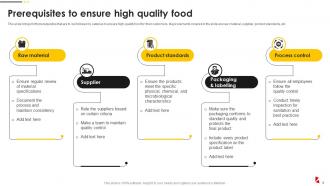
Slide 9: This slide mentions forth prerequisites that are to be followed by eateries to ensure high-quality food for their customers.
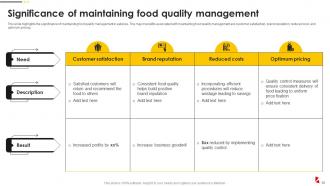
Slide 10: This slide highlights the significance of maintaining food quality management in eateries.
Slide 11: This slide is an introductory slide.
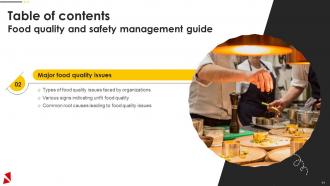
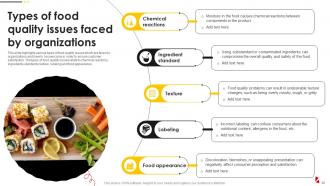
Slide 12: This slide illustrates various types of food quality issues which are faced by organizations.
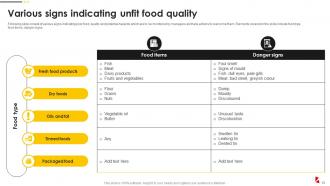
Slide 13: This slide consist of various signs indicating poor food, quality and potential hazards which are to be monitored by managers.
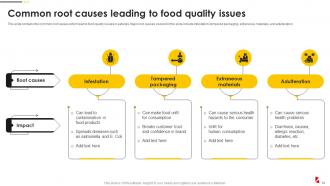
Slide 14: This slide contains the common root causes which lead to food quality issues in eateries.
Slide 15: This slide is an introductory slide.
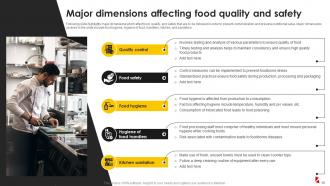
Slide 16: This slide caters to the major dimensions which affect food, quality, and safety that are to be followed in order to prevent contamination and preserve nutritional value.
Slide 17: This slide is an introductory slide.
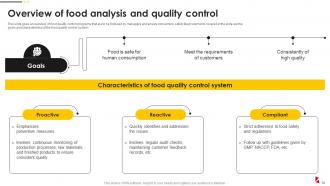
Slide 18: This slide gives an overview of food quality control programs that are to be followed by managers and ensure consumers’ safety.
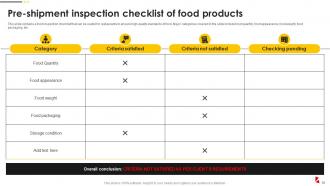
Slide 19: This slide encompasses a food inspection checklist that can be useful for restaurants to ensure high-quality standards of food.
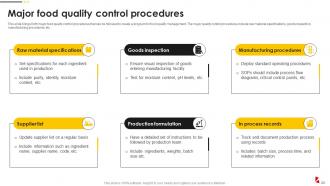
Slide 20: This slide illustrates forth major food quality control procedures that can be followed to create a program for food quality management.
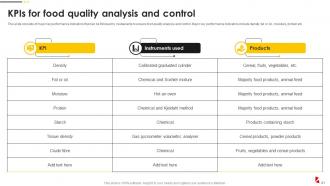
Slide 21: This slide consists of major key performance indicators that can be followed by restaurants to ensure food quality analysis and control.
Slide 22: This slide is an introductory slide.
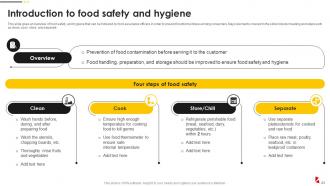
Slide 23: This slide gives an overview of food safety, and hygiene that can be followed by food assurance officers.
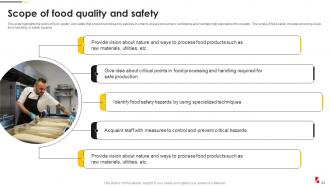
Slide 24: This slide highlights the score of food, quality, and safety that should be followed by eateries.
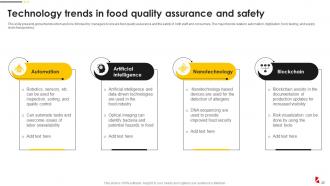
Slide 25: This slide presents global trends which are to be followed by managers to ensure food quality assurance and the safety of both staff and consumers.
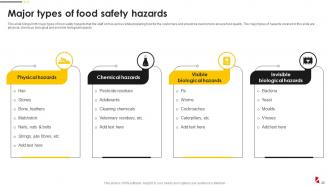
Slide 26: This slide brings forth major types of food safety hazards that the staff comes across while preparing food for the customers and should be overcome to ensure food quality.
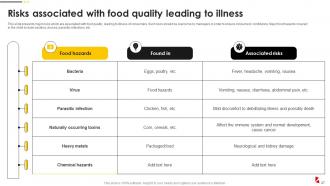
Slide 27: This slide represents major risks which are associated with food quality, leading to illness of consumers.
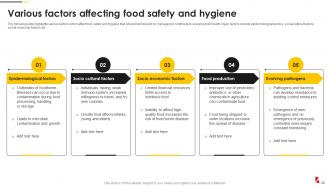
Slide 28: This slide depicts various factors which affect food safety and hygiene that should be followed by managers to contribute to overall public health.
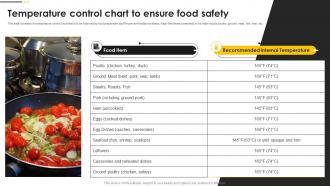
Slide 29: This slide consists of a temperature control chart that is to be followed by food preparation staff to prevent foodborne illness.
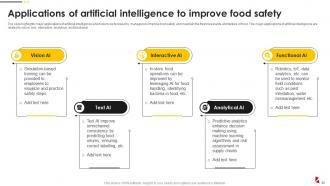
Slide 30: The slide enhances major applications of artificial intelligence.
Slide 31: This slide is an introductory slide.
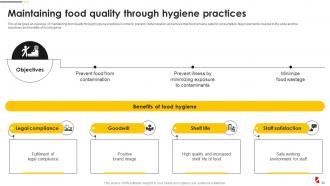
Slide 32: This slide gives an overview of maintaining food quality through hygiene practices.
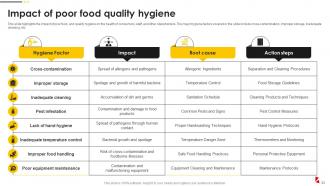
Slide 33: This slide entails the impact of poor food, and quality hygiene on the health of consumers, staff, and other stakeholders.
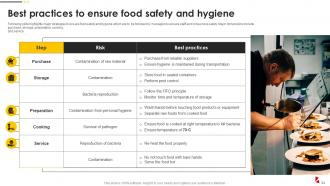
Slide 34: This slide describes major strategies to ensure food safety and hygiene which are to be followed by managers to ensure staff and consumers safety.
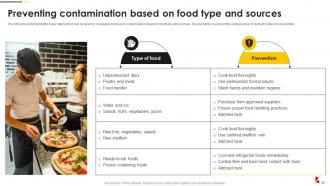
Slide 35: This slide highlights major steps which can be taken by managers to prevent contamination based on food type and sources.
Slide 36: This slide is an introductory slide.
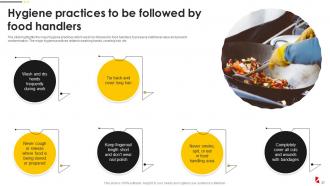
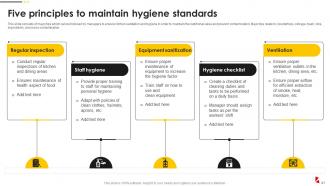
Slide 37: The slide portrays the major hygiene practices which are to be followed by food handlers to preserve nutritional value and prevent contamination.
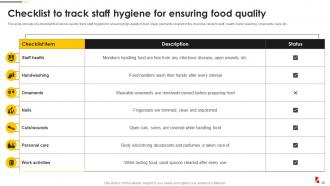
Slide 38: This slide consists of a checklist that can be used to track staff hygiene for ensuring high-quality of food.
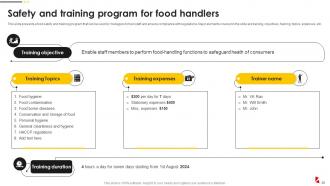
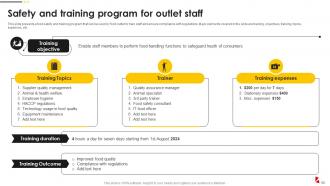
Slide 39: This slide presents a food safety and training program that can be used by managers to train staff and ensure compliance with regulations.
Slide 40: This slide is an introductory slide.
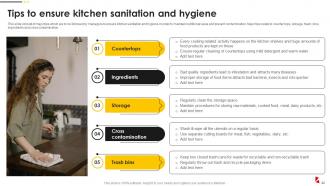
Slide 41: This slide consists of major tips which can be followed by managers to ensure kitchen sanitation and hygiene.
Slide 42: This slide overviews the major tips which are to be followed by managers to ensure kitchen sanitation and hygiene.
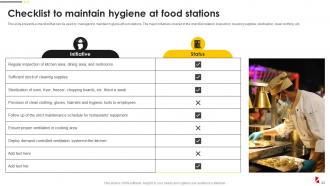
Slide 43: This slide presents a checklist that can be used by managers to maintain hygiene at food stations.
Slide 44: This slide is an introductory slide.
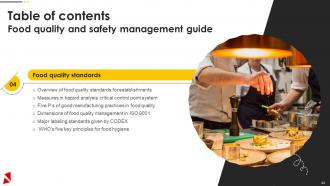
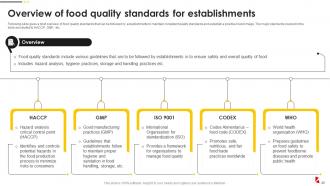
Slide 45: This slide gives a brief overview of food quality standards that can be followed by establishments to maintain consistent quality standards.
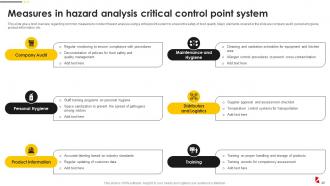
Slide 46: This slide entails brief overview regarding common measures to conduct Hazard analysis using a critical point system to ensure the safety of food quality.
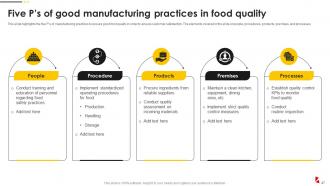
Slide 47: This slide highlights the five P’s of manufacturing practices to ensure good food quality in order to ensure customer satisfaction.
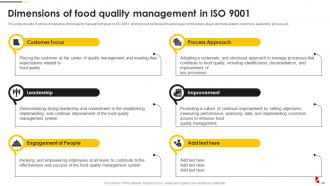
Slide 48: This slide consists of various dimensions of food quality management given by ISO 9001, which should be followed to avoid legal complications.
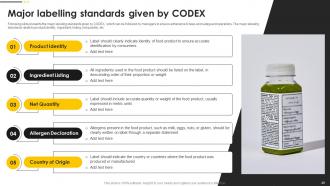
Slide 49: This slide presents the major labeling standards given by CODEX, which can be followed by managers to ensure adherence to laws and safeguard operations.
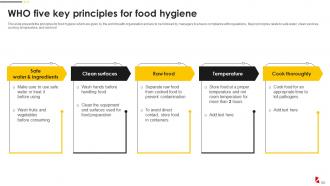
Slide 50: This slide represents the principles for food hygiene which are given by the world health organization and are to be followed by managers to ensure compliance with regulations.
Slide 51: This slide is an introductory slide.
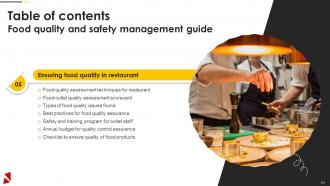
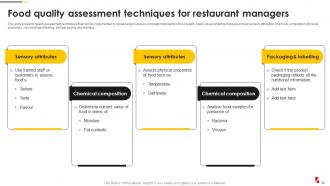
Slide 52: This slide mentions quality assessment techniques that can be implemented by restaurants to ensure consistent standards of food quality.
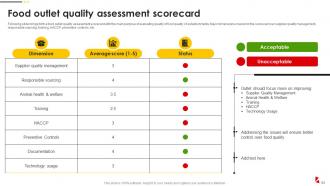
Slide 53: This slide brings forth a food outlet quality assessment scorecard with the main purpose of evaluating quality of food quality of establishments.
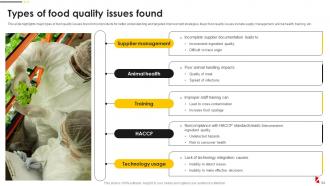
Slide 54: This slide puts major types of food quality issues found in food products for better understanding and targeted improvement strategies.
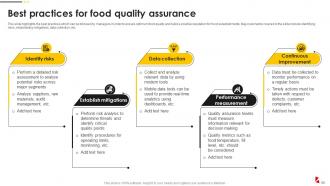
Slide 55: This slide caters to the best practices which can be followed by managers.
Slide 56: This slide presents a food safety and training program that can be used by food outlet to train staff and ensure compliance with regulations.
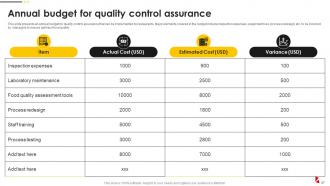
Slide 57: This slide represents an annual budget for quality control assurance that can be implemented by restaurants.
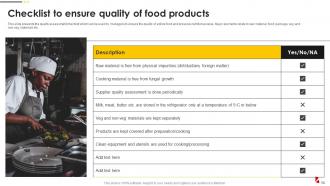
Slide 58: This slide mentions the quality assessment checklist which can be used by managers to ensure the quality of edible food and preserve nutritional value.
Slide 59: This slide is an introductory slide.
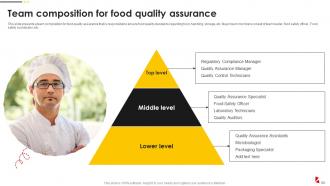
Slide 60: This slide illustrates a team composition for food quality assurance that is responsible to ensure food quality standards.
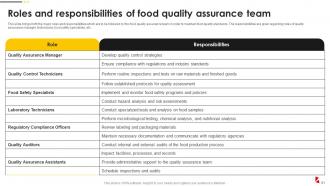
Slide 61: This slide brings forth the major roles and responsibilities which are to be followed by the food quality assurance team.
Slide 62: This slide is an introductory slide.
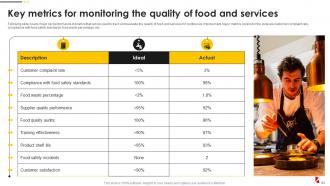
Slide 63: This slide covers major key performance indicators that can be used to track and evaluate the quality of food and services for continuous improvement.
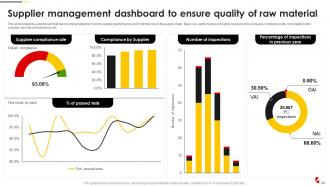
Slide 64: This slide presents a dashboard that can be implemented to monitor supplier performance and minimize risk in the supply chain.
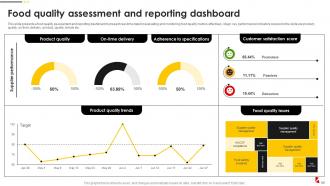
Slide 65: This slide represents a food quality assessment and reporting dashboard to present real-time data for evaluating and monitoring food quality.
Slide 66: This slide is an introductory slide.
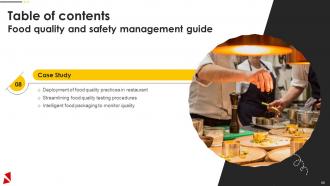
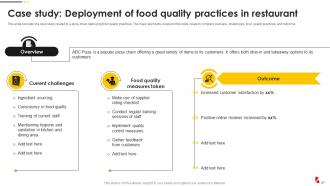
Slide 67: This slide caters to the case study related to a pizza chain deploying food quality practices.
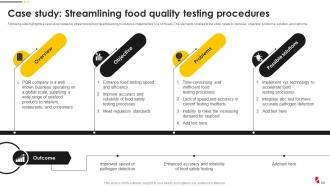
Slide 68: This slide highlights a case study related to streamlining food quality testing procedures implemented by a company.
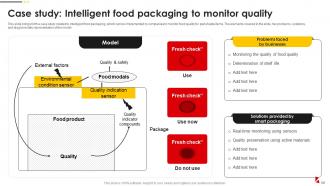
Slide 69: This slide depicts forth a case study related to intelligent food packaging, which can be implemented by companies to monitor food quality for perishable items.
Slide 70: This slide shows all the icons included in the presentation.
Slide 71: This slide is titled Additional Slides for moving forward.
Slide 72: This slide provides a 30-60-90-day plan with text boxes.
Slide 73: This slide depicts a Venn diagram with text boxes.
Slide 74: This slide contains a Puzzle with related icons and text.
Slide 75: This slide shows Post-It Notes. Post your important notes here.
Slide 76: This slide presents a Roadmap with additional text boxes.
Slide 77: This slide is a thank-you slide with address, contact numbers, and email address.
Food Quality And Safety Management Guide Powerpoint Presentation Slides with all 85 slides:
Use our Food Quality And Safety Management Guide Powerpoint Presentation Slides to effectively help you save your valuable time. They are readymade to fit into any presentation structure.










FAQs for Food Quality And Safety Management Guide
So you'll need HACCP first - that's your hazard analysis plan that spots where contamination could happen. Get your basics covered too: sanitation, pest control, supplier checks. Traceability systems are huge. Don't forget employee training, though honestly that's where a lot of places drop the ball. Documentation is annoying but necessary. Regular audits help catch problems early. My advice? Map out your current processes first and see where your biggest contamination risks are. Start there instead of trying to fix everything at once - you'll go crazy otherwise.
So basically, you can get real-time tracking across your whole supply chain now. IoT sensors monitor temp, humidity, contamination - all that stuff from farm to store. Blockchain keeps an unchangeable record of where everything's been. AI spots quality issues way better than humans can (honestly kind of scary how good it's gotten). Your field teams can instantly report problems through mobile apps, upload pics for quick assessment. The trick is making sure all these systems actually talk to each other - then you'll have one dashboard showing everything instead of juggling like 5 different programs.
Look, HACCP is basically like having a game plan instead of just crossing your fingers and hoping nothing goes wrong. You map out your whole process and figure out the danger zones - like where temps could drop or cross-contamination might happen. Then you actually monitor those spots instead of waiting until the end to check everything. Way smarter than the old method, honestly. It stops pathogens before they ever make it to customers, which is obviously the whole point. Start by sketching out your food flow and spotting where things could go sideways - that's your blueprint right there.
Oh man, food regs are all over the place depending where you're selling. The EU is ridiculously strict about everything - pesticides, additives, labeling, you name it. Meanwhile developing countries are way more chill, mostly because they don't have the resources to be picky. US falls somewhere between with FDA rules that aren't terrible but aren't as intense as Europe. Honestly the inspection stuff alone will make your head spin. Each country has different limits on what's allowed, so you'll want to research your target markets before you get too far into planning. Otherwise you might design a whole product that can't even be sold where you want.
Start with hands-on training - handwashing, temps, preventing cross-contamination. Skip the boring PowerPoints, nobody remembers those anyway. Make it ongoing too, not just a one-day thing. Regular refreshers work great, especially after any incidents happen. Get your team ServSafe certified if you can swing it. Document everything so you're covered compliance-wise. Honestly, the biggest thing is creating an environment where people can ask questions or report problems without worrying they'll get fired. That's what actually keeps places safe.
Honestly, you'll want to track everything from farm to fork - create a solid paper trail so you can trace ingredients both ways through your supply chain. Get detailed records from suppliers covering sourcing, processing dates, batch numbers, all that stuff. Then build an internal system connecting your incoming materials to finished products. Your staff needs to actually get it and use it daily, not just when shit hits the fan. I know setting it up is annoying at first, but trust me - when you need to do a recall or investigate contamination, you'll be glad you did. The trick is making traceability routine, not an afterthought.
Honestly, cold chain breaks are your biggest enemy - one busted freezer truck and you're screwed. Temperature swings will destroy your products fast. Cross-contamination is brutal too, especially when they're mixing different foods in the same space. Drivers can be rough with handling, which messes up your packaging. Some of them just don't care about delicate stuff. Plus dirty trucks between loads? Recipe for disaster. Get real-time temp monitoring set up ASAP. Solid packaging helps, but really you need vendor contracts with strict quality rules baked in. Oh, and maybe avoid shipping during heat waves if you can help it.
So basically, microbiological testing is like your safety net for catching nasty stuff before it hits customers. You're looking for the usual suspects - Salmonella, E. coli, Listeria - in both your ingredients and final products. It's honestly pretty crucial for backing up that your HACCP system isn't just paperwork sitting in a binder somewhere. Plus you get solid data to prove your safety claims actually mean something. The trick is figuring out a testing schedule that fits your specific products and risk profile. Don't go overboard, but don't skimp either.
Dude, packaging is basically everything when it comes to keeping food fresh. It blocks out oxygen, moisture, and light - those are what kill your products. I've literally watched shelf life jump from weeks to months just by switching materials, it's wild. Also protects against damage and contamination during shipping, which people forget about. The trick is figuring out what's actually making your food spoil first. Is it going rancid? Getting soggy? Then pick packaging that tackles those specific problems. Don't just grab whatever's cheapest - you'll regret it later when everything's going bad.
Start with handwashing and temp control - sounds boring but most food poisoning comes from stupid simple mistakes. Get your team basic ServSafe training, even if it's just the bare minimum. Document everything - temperatures, cleaning schedules, the works. My buddy's restaurant got hit hard because they couldn't prove their walk-in was working properly. Set up clear procedures for receiving ingredients and storing stuff. Don't overcomplicate it though. Better to nail the basics every single day than create some fancy system nobody follows. Pick one thing first, get it right, then expand.
Track complaints and praise patterns - set up surveys, monitor social media, check customer service logs. Look for recurring themes. Soggy packaging complaints keep coming up? That's your priority. Harsh reviews honestly teach you way more than generic "good product" feedback. Don't ignore the positive stuff though - shows what's already working that you shouldn't change. Monthly trend reviews work well. Turn those insights into actual action items for production. Sometimes I wonder if companies even read their reviews, but you clearly get it!
Honestly, blockchain is a game-changer for food traceability. Every item gets this permanent digital record that follows it from farm to your shelf - no more weeks of investigation when contamination hits. You'll know exactly where the problem started in minutes, not days. The transparency aspect is pretty amazing too. Customers love being able to see the whole journey of their food, and regulators eat that stuff up. Instead of those massive recalls that cost a fortune, you can target just the affected batches. My advice? Start small with whatever product scares you most safety-wise and see how it works.
Yeah so temperature's the big one - heat just destroys everything and bacteria love it. Humidity's brutal too, creates this perfect mold paradise (trust me, lost half my strawberries to this last week). Your dairy and oils? They'll go weird real fast under lights, tastes get funky. Air circulation matters more than people think - bad air lets contamination spread like wildfire. You gotta stay on top of this stuff through your whole process, honestly it's kinda exhausting but worth it. Map out what's happening at each step first, that'll show you where you're vulnerable.
So sensory evaluation is like having people be your taste testers and quality checkers. Trained panels (or just regular consumers) test how food looks, tastes, smells, feels in your mouth - even sounds sometimes. It's wild how our noses can pick up weird off-flavors that fancy machines totally miss. You'll need it for new products, seeing how long stuff stays fresh, checking out what competitors are doing. The trick is keeping everything standardized so your results actually mean something when you're making production calls. Way more reliable than you'd think!
Honestly, you've gotta get serious about separating raw and ready-to-eat stuff - like actually separate areas, not just different counters. Color-coded equipment is your friend here, and make sure everyone's washing hands properly between tasks. That whole "quick rinse" thing people do? Yeah, that's not gonna cut it. Set up your workflow so dirty stuff never flows back through clean zones - I learned that one the hard way. Oh, and if you can swing separate ventilation, do it. Start by walking through your current setup and spotting where things could go wrong.
-
I can say with full confidence that all your business, academic, or professional work requirements will be sufficed with SlideTeam. Their gallery is as rich as 2Million+!!
-
Keep doing the good work guys. Surpass the needs and expectations always!!