


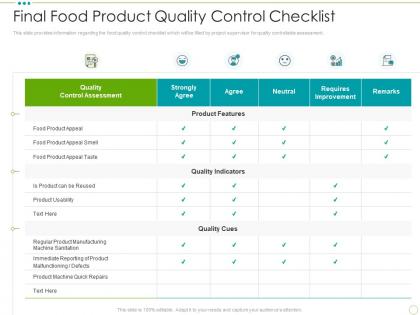
Final food product quality control checklist food safety excellence




Try Before you Buy Download Free Sample Product
 Impress Your
 Audience
 100%
100% Editable
 Save Hours
 of Time


This slide provides information regarding the food quality control checklist which will be filled by project supervisor for quality controllable assessment.
People who downloaded this PowerPoint presentation also viewed the following :
Final food product quality control checklist food safety excellence with all 2 slides:
Use our Final Food Product Quality Control Checklist Food Safety Excellence to effectively help you save your valuable time. They are readymade to fit into any presentation structure.
FAQs for Final food product quality control checklist
So you'll definitely need temp control and hygiene stuff covered first. Handwashing procedures, keeping cold food under 40°F, hot above 140°F - the usual. Cross-contamination is huge though, so separate prep areas for raw vs cooked. Don't use those generic checklists online, they're pretty useless honestly. Your kitchen's different from everyone else's. Track expiration dates religiously because that's where most places screw themselves over. Oh and sanitize surfaces regularly. My cousin's restaurant got dinged hard on that last year. Basically customize everything to how your space actually works.
At minimum, update your food safety checklists once a year. But honestly? That's cutting it close. Regulation changes happen all the time, and you'll need to revise immediately when they do. Same goes for new equipment or menu changes. I've watched restaurants scramble during inspections because their checklists were ancient - totally avoidable mess. Your suppliers might switch up their processes too, which affects your protocols. Set a reminder for every six months instead of waiting the full year. Oh, and definitely document everything when you make changes. Trust me on that one.
Hit the big four: temps, handwashing, cross-contamination, and cleaning schedules. Track hot holding above 140°F and cold stuff below 40°F - different proteins need different cooking temps too. Handwashing is seriously overlooked, drives me nuts how people blow this off. Use separate cutting boards for raw vs cooked. Check expiration dates regularly. Oh, and sanitizing schedules for all your surfaces and equipment. Include spots for signatures so everyone's actually accountable instead of just checking boxes mindlessly.
Honestly, tech makes this stuff so much easier than doing it manually. Apps can bug you with notifications when temp checks are due, and some digital checklists literally won't let you skip steps - which sounds annoying but actually works great. The sensor integration thing is pretty neat too, though maybe overkill depending on your setup. What's really helpful is getting instant data on where your team keeps messing up. Like, you'll finally see patterns instead of just guessing. I'd start with something basic first though - just grab a simple checklist app and see how it goes before you get fancy.
Okay so the main culprits you're dealing with are Salmonella, E. coli, Listeria, and Campylobacter. Poultry and eggs are where you'll find most Salmonella issues. E. coli loves ground beef and leafy greens - which is honestly why I'm paranoid about bagged salad sometimes. Listeria's the tricky one because it actually grows in cold temps, so watch your deli meats and soft cheeses. Campylobacter's another chicken problem. There are definitely more pathogens out there, but these four cover most of what'll get you. Focus on proper cooking temps and don't cross-contaminate stuff. Time and temperature control is huge too.
So regulatory standards are basically your blueprint for food safety checklists. FDA, USDA, local health departments - whatever they require becomes your checklist items. Temperature checks, sanitizing, employee hygiene, allergen stuff - it all stems from those guidelines. Honestly saves you from having to figure out what matters on your own, which would suck. They also tell you how often to check things and what paperwork you need. Oh, and start with local regs first, then add federal ones on top. That way you won't miss any weird local requirements that could bite you later.
Oh man, you're so right to ask about this. Training is everything - seriously, without it your checklist just becomes this pointless paper trail. Walk everyone through what each checkpoint actually means and how to do the checks right. Show them what to do when they spot problems too. Honestly, I've watched places where staff just tick boxes because they have no clue what they're looking for. Cover the reasoning behind each step, not just the mechanics. Practice with real situations and let them mess around with filling it out. Also - and this is huge - schedule those refresher sessions because people forget this stuff surprisingly fast.
Honestly, just hit up the FDA website and your local health department first - they've got free templates that'll save you tons of time. Temperature logs, handwashing, cleaning schedules, storage stuff - nail those basics before getting fancy. I use Google Sheets for tracking everything because those specialized apps are kinda overkill tbh. The trick is customizing whatever template you find to match how your kitchen actually runs, not forcing some cookie-cutter system. Start with daily must-dos. Weekly tasks can wait until your team stops forgetting to log fridge temps every day.
Dude, don't mess around with those food safety checklists. Seriously. You could end up with a foodborne illness outbreak that makes customers sick and destroys your reputation in like 24 hours. The health department will come down hard - we're talking fines, shutdowns, maybe even permanent closure if it's really bad. Then there's the lawsuits when sick people want their medical bills covered. Your staff gets freaked out too when safety goes out the window. I know checklists seem tedious, but they're literally there to save your ass from all this drama.
You know how chaotic cooking gets? That's exactly why I swear by food safety checklists. They stop you from using the same cutting board for raw chicken and then your veggies - gross! When you're rushing around, it's so easy to grab the wrong utensil or forget to wash your hands between tasks. The checklist covers all that stuff: handwashing, keeping raw and cooked foods separate, cleaning between steps. Honestly, I used to think they were overkill until I caught myself almost cross-contaminating everything during a dinner party. Just tape one up where you can see it and actually tick things off as you go.
So basically, different foods need different spots. Raw meat goes on the bottom shelf so it doesn't drip everywhere - learned that the hard way once. Dairy needs to stay at 40°F or below, and produce goes in those crisper drawers (actually use the humidity settings, they matter). For pantry stuff, get some airtight containers for grains and keep canned goods somewhere cool and dry. Oh, and label everything with dates or you'll end up playing the "sniff test" game way too often. Don't try to reorganize everything at once though - pick one area and work from there.
Don't treat allergens as this whole separate thing - just build checkpoints into what you're already doing. Like when you're receiving ingredients, actually read those labels. Clean prep surfaces between allergen stuff and regular items (this is where most places screw up, honestly). Your staff needs to know what allergens are in every dish too. Document your cleaning procedures and training - I know it's annoying but you need that paper trail. Oh, and audit your current checklist first. Flag everywhere allergens could sneak in. Trust me, there's probably way more spots than you think. Cross-contamination is seriously the biggest issue I see everywhere.
Oh man, that's rough but don't panic! First thing - stop whatever food operation is affected and write down exactly what failed. Figure out why it happened (temp issue, contamination, broken equipment, etc.) then fix it before you start back up. Document everything you can think of - what broke, how you fixed it, when you got running again. The inspector's gonna want to see your game plan for handling it. Trust me, this stuff happens way more than restaurants like to admit! Just show them you're on top of it with good records and you'll be fine.
Honestly, fill out your checklists right when you're doing the actual tasks - don't save it all for the end of your shift like I used to do (learned that the hard way). Write legibly and use the same abbreviations every time. Nobody can read messy handwriting during audits. I take photos of temperature logs with my phone as backup - probably overkill but whatever. Keep everything filed by date so you can actually find stuff later. Your manager should be signing off weekly too. Set phone reminders if you have to. The whole thing becomes way easier once it's just habit.
Your team is honestly your secret weapon here. They know when something's totally unrealistic during the dinner rush or if a step is just confusing as hell. Like, they'll tell you "this temp check actually takes forever" or "we forgot to add cleaning the thermometer between different foods." When people help build the checklist, they actually use it - makes sense, right? Nobody wants to follow some random list that doesn't match reality. Set up quick team meetings or just throw out a simple feedback form. Trust me, their input will save you way more headaches later.
-
Informative presentations that are easily editable.
-
Excellent work done on template design and graphics.
-
Thanks for all your great templates they have saved me lots of time and accelerate my presentations. Great product, keep them up!
-
Best Representation of topics, really appreciable.
-
Use of different colors is good. It's simple and attractive.