


Collection Of Quality Control 7 Steps Of Haccp To Ensure Food Safety




Try Before you Buy Download Free Sample Product
 Impress Your
 Audience
 100%
100% Editable
 Save Hours
 of Time


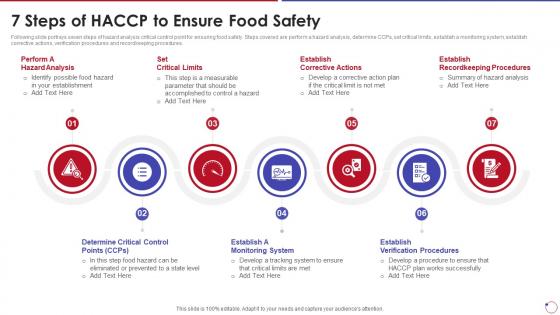
Following slide portrays seven steps of hazard analysis critical control point for ensuring food safety. Steps covered are perform a hazard analysis, determine CCPs, set critical limits, establish a monitoring system, establish corrective actions, verification procedures and recordkeeping procedures.
People who downloaded this PowerPoint presentation also viewed the following :
Collection Of Quality Control 7 Steps Of Haccp To Ensure Food Safety with all 6 slides:
Use our Collection Of Quality Control 7 Steps Of Haccp To Ensure Food Safety to effectively help you save your valuable time. They are readymade to fit into any presentation structure.





FAQs for Collection Of Quality Control 7 Steps Of Haccp To
HACCP's seven principles include conducting hazard analysis, identifying critical control points, establishing critical limits, implementing monitoring procedures, planning corrective actions, verification systems, and comprehensive record-keeping. These principles work together by systematically preventing food safety risks rather than detecting them after occurrence, enabling food manufacturers, restaurants, and processing facilities to deliver consistent product safety, reduce contamination incidents, and maintain regulatory compliance while ultimately protecting consumer health and brand reputation.
Businesses can implement HACCP effectively by conducting thorough hazard analyses, establishing critical control points with monitoring procedures, integrating documentation systems, and training staff comprehensively across all operational levels. This systematic approach enables restaurants, food manufacturers, and processing facilities to seamlessly incorporate HACCP principles into existing protocols, ultimately delivering enhanced food safety compliance, reduced contamination risks, and stronger consumer confidence while maintaining operational efficiency.
Common challenges include inadequate staff training, insufficient documentation systems, resistance to procedural changes, resource allocation constraints, and maintaining consistent monitoring protocols. Organizations often struggle with integrating HACCP across complex supply chains, establishing effective corrective action procedures, and ensuring ongoing compliance, though many food manufacturers and processors find that systematic implementation ultimately delivers enhanced food safety, reduced contamination risks, and stronger regulatory compliance.
HACCP differs from traditional food safety inspection methods by focusing on prevention rather than detection, implementing continuous monitoring throughout production processes, and identifying critical control points before contamination occurs. While traditional inspections examine finished products reactively, HACCP enables food manufacturers, restaurants, and processing facilities to prevent hazards systematically, ultimately delivering safer products and reducing costly recalls.
Hazard analysis in HACCP involves identifying biological, chemical, and physical hazards, assessing their likelihood and severity, determining critical control points, establishing monitoring procedures, and implementing corrective actions. Food manufacturers, restaurants, and processing facilities use this systematic approach to prevent contamination, ensure product safety, and maintain regulatory compliance, ultimately protecting consumer health while reducing liability risks and operational costs.
Effective training enhances HACCP implementation by ensuring personnel understand critical control points, proper monitoring procedures, and corrective actions when deviations occur. Through comprehensive education programs, food processing facilities achieve consistent compliance, reduced contamination risks, and streamlined documentation processes, with many manufacturers finding that well-trained teams deliver faster issue resolution and improved product safety outcomes.
Critical control points serve as essential monitoring stations where food safety hazards can be prevented, eliminated, or reduced to acceptable levels through measurable parameters like temperature, pH, and time. These strategically positioned checkpoints enable food manufacturers, restaurants, and processing facilities to maintain consistent quality control, ensure regulatory compliance, and prevent contamination, ultimately delivering safer products and protecting both consumer health and brand reputation.
HACCP adapts to different food sectors through tailored critical control points, sector-specific hazard assessments, and customized monitoring procedures that address unique operational challenges. While meat processing facilities focus on pathogen control, temperature management, and contamination prevention, catering operations emphasize allergen management, cross-contamination protocols, and service temperature maintenance, with both sectors ultimately delivering enhanced food safety and regulatory compliance.
Regulatory standards from the FDA and USDA significantly shape HACCP implementation by establishing mandatory compliance frameworks, defining critical control points, and requiring comprehensive documentation across food production facilities. These guidelines streamline food safety protocols while ensuring consistent industry standards, with many manufacturers finding that regulatory alignment enhances operational efficiency, reduces liability risks, and ultimately delivers stronger consumer confidence and market access.
Technology enhances HACCP monitoring through digital temperature sensors, automated data logging systems, cloud-based documentation platforms, mobile inspection apps, and real-time alert mechanisms. These tools streamline compliance by eliminating manual record-keeping, providing instant hazard notifications, and enabling seamless audit trails, with food manufacturers finding that automated systems significantly reduce human error while ensuring continuous regulatory adherence.
Small businesses can integrate HACCP principles by starting with simplified risk assessments, focusing on critical control points most relevant to their operations, and leveraging affordable digital tools for monitoring and documentation. Many startups find success by implementing basic temperature controls, supplier verification processes, and employee training programs, which streamline food safety compliance while building scalable foundations for future growth.
Third-party HACCP certification delivers enhanced credibility, regulatory compliance, market access, risk mitigation, and competitive differentiation for food businesses. This independent validation streamlines audit processes, reduces liability exposure, and opens doors to major retailers and international markets, with many food manufacturers finding that certified status ultimately accelerates growth opportunities and consumer trust.
HACCP builds consumer trust by systematically preventing food safety hazards through critical control points, consistent monitoring, and documented compliance with regulatory standards. When food companies implement robust HACCP systems, they demonstrate transparency and accountability, with many brands finding that proactive safety measures enhance customer loyalty, reduce recall risks, and ultimately deliver competitive advantages in increasingly safety-conscious markets.
Successful HACCP implementations include McDonald's global supply chain management, Nestlé's manufacturing standardization, Tyson Foods' meat processing protocols, and Coca-Cola's beverage production systems. These case studies demonstrate how systematic hazard analysis streamlines compliance, reduces contamination risks, and enhances consumer confidence, with many food manufacturers finding that comprehensive HACCP frameworks ultimately deliver operational efficiency and competitive market advantage.
Food businesses can prepare for HACCP audits by maintaining comprehensive documentation, conducting regular internal assessments, training staff on critical control points, and implementing robust monitoring systems. Through systematic record-keeping and preventive measures, restaurants, food manufacturers, and processing facilities streamline compliance verification, minimize operational disruptions during inspections, and ultimately deliver consistent food safety standards while reducing regulatory risks.
-
Great product with highly impressive and engaging designs.
-
Excellent products for quick understanding.