


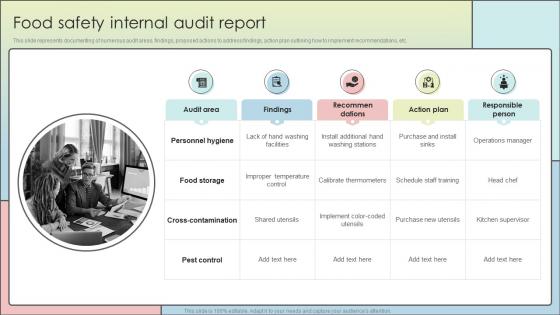
Food Safety Internal Audit Report




Try Before you Buy Download Free Sample Product
 Impress Your
 Audience
 100%
100% Editable
 Save Hours
 of Time


This slide represents documenting of numerous audit areas, findings, proposed actions to address findings, action plan outlining how to implement recommendations, etc.
People who downloaded this PowerPoint presentation also viewed the following :
Food Safety Internal Audit Report with all 9 slides:
Use our Food Safety Internal Audit Report to effectively help you save your valuable time. They are readymade to fit into any presentation structure.








FAQs for Food Safety
Oh yeah, the big four! Clean, Separate, Cook, and Chill. Wash your hands for like 20 seconds before touching anything - I'm terrible at remembering this one honestly. Use different cutting boards for raw meat vs veggies, definitely get a food thermometer if you don't have one already. Cook everything to the right temp and toss leftovers in the fridge within two hours. My mom always drilled this stuff into me but it's crazy how many people just wing it. Most food poisoning comes from skipping these basic steps, so they're actually worth doing!
Ugh, temperature stuff is SO important for food safety. Bacteria goes crazy between 40-140°F - that's the danger zone. Keep your fridge at 40° or under, freezer at 0°, and hot food above 140° when serving. Don't leave perishables sitting out more than 2 hours either. Honestly, get a food thermometer and actually use it - I've seen too many people just guess temps. Cold stuff stays cold, hot stuff stays hot. Where you store things matters too since it affects how well temps hold. Trust me on this one!
Ugh, the usual suspects are Salmonella, E. coli, and Campylobacter - they're behind most food poisoning cases. Salmonella hits you with diarrhea, fever, and cramps for like a week. E. coli's the really scary one though, can cause bloody diarrhea and brutal stomach pain. With Campylobacter, you won't even know you're sick for 2-5 days which is so annoying. Oh and Norovirus spreads crazy fast, makes you puke your guts out. Just cook stuff properly, wash your hands, and don't let raw meat touch everything else in your kitchen.
So basically, cross-contamination is when nasty bacteria jump from one food to another - usually through your cutting board, knife, or hands. Raw meat juice is the worst offender here. Get separate cutting boards for raw meat vs everything else. Yeah, it's one more thing to store but trust me on this. Wash your hands like you're prepping for surgery (okay maybe not that intense). Clean your counters between prepping different foods. Oh, and always put raw meat on the bottom fridge shelf so it can't drip down onto your leftovers or whatever. These little habits will save you from spending a weekend hugging your toilet.
Honestly, you need those certifications if you want to be taken seriously. HACCP, SQF, BRC - yeah they're a pain to get but they're basically your golden ticket. Retailers won't touch you without them, and customers actually care about this stuff now. The paperwork is brutal (I'm not gonna lie), but it forces you to nail down your processes before something goes sideways. Start with HACCP first - everything else builds on that foundation. It's annoying but worth it when you're not dealing with contamination nightmares later.
Start with training your staff on the basics - handwashing, temps, avoiding cross-contamination. I know the paperwork's annoying, but document everything: cleaning schedules, temperature logs, training records. Trust me, you'll thank yourself later if the health inspector shows up. Get some key people certified in food safety. Daily checklists are your best friend here - seriously, stick to them no matter what. Do regular internal inspections so you're always ready. It sounds like a lot, but once you get into the routine it becomes second nature.
Okay so 20 seconds with soap and warm water - before you touch food, after raw meat, bathroom, touching your face, all that. I'm serious about the 20 seconds though, most people rush it. Hand sanitizer's fine if there's no sink around but honestly soap works way better. Don't dry your hands on your apron either, that's gross. Get under your nails and between fingers too. Oh and here's what I learned the hard way - you'll think you're washing them enough but you're probably not. Like, do it way more than feels normal.
Oh dude, biggest thing is keeping raw meat away from everything else - learned that the hard way after some sketchy chicken incidents lol. Get yourself a decent meat thermometer if you don't have one. Ground meat needs to hit 160°F, chicken 165°F, and steaks/pork 145°F. Always thaw stuff in the fridge, never on the counter. Wash your hands like crazy and use separate cutting boards. Also never put cooked meat back on the same plate that had raw meat - that's food poisoning waiting to happen.
Dude, document everything right away - photos, temps, whatever grossness you saw. Call your local health department ASAP, they'll investigate and can shut places down if it's bad enough. Honestly, I've seen restaurants get slapped with fines or temporary closures depending on how nasty things are. Don't feel weird about reporting either - food poisoning spreads crazy fast and people could get really sick. The place has to fix everything before they can reopen anyway. Better safe than sorry, you know?
Look, it's basically about having solid processes so you don't accidentally poison people - which honestly should be motivation enough! Your staff won't be guessing what to do anymore, health inspectors become way less scary, and you'll waste less money on spoiled food. Plus if something does go wrong, you can actually figure out what happened instead of playing detective. The paperwork side helps with regulations too. I'd start simple - temperature logs, cleaning schedules, that kind of thing. You can always add more later once you get the hang of it.
Honestly, just read the damn labels - they're lifesavers. Check expiration dates obviously, but also look for allergen warnings and recall notices. Most people skip the storage instructions which is dumb because proper temps matter. Ingredient lists are clutch if you're avoiding certain stuff or have allergies. I used to just grab things without looking and learned my lesson the hard way with some sketchy leftovers once. Takes literally five seconds to scan the important bits. Way better than dealing with food poisoning later, trust me.
So ServSafe is definitely your best bet - they do online and in-person classes. The FDA website actually has solid free training modules if you're on a budget. Check with your state health department too, though honestly some of their workshops can be pretty boring. What I'd do is mix the online stuff for basics with hands-on training in your actual kitchen using your SOPs. That combo of theory plus real practice usually works way better than just one approach.
Tech is honestly a game-changer for food safety. IoT sensors track temperature and humidity in real-time - super helpful. Blockchain isn't just buzzword nonsense anymore, it actually works for tracing where stuff comes from. AI can spot contamination risks before they blow up into real problems. Even the packaging is getting smart now, like it'll literally tell you when food's going bad. My cousin started with just basic temperature monitoring in their cold storage and it saved them from so many headaches. Connect everything together and you'll see issues coming from miles away. Start small though - don't try to do it all at once.
Dude, recalls absolutely destroy consumer trust - we're talking years to recover. Your brain just marks that brand as "nope, dangerous" and it sticks. Like, if a restaurant gave you food poisoning, you're not going back anytime soon, right? The damage spreads too - people avoid the whole brand, not just that one product. Prevention is everything because honestly? Rebuilding trust costs a fortune and takes forever. Way easier to get safety right from the start than deal with the nightmare aftermath.
Dude, food safety is so tied to culture it's crazy. Korea and Germany? Totally chill with fermented stuff that might freak out other countries. Religious rules play a huge part too - halal and kosher have their own whole thing going on. Japan's raw fish standards are obviously way different than, say, Kansas (lol). Historical prep methods matter a ton. If you're dealing with international food stuff, definitely check what flies locally first. What seems normal to us might be totally sketchy somewhere else. I learned this the hard way once, but that's another story.
-
It saves your time and decrease your efforts in half.
-
SlideTeam is the way to go when you are in a time crunch. Their templates have saved me many times in the past three months.