


Food Quality Assessment And Reporting Dashboard Food Quality And Safety Management Guide




Try Before you Buy Download Free Sample Product
 Impress Your
 Audience
 100%
100% Editable
 Save Hours
 of Time


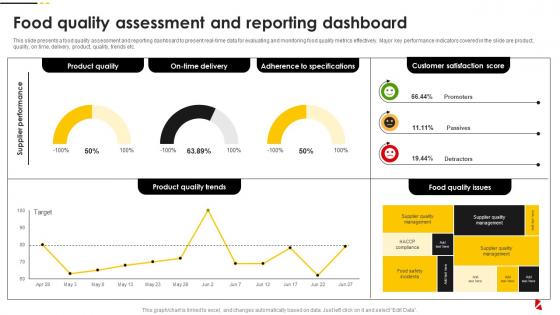
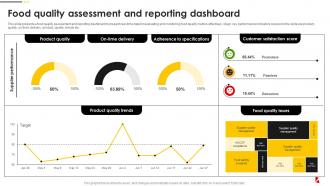
This slide presents a food quality assessment and reporting dashboard to present real-time data for evaluating and monitoring food quality metrics effectively. Major key performance indicators covered in the slide are product, quality, on time, delivery, product, quality, trends etc.
People who downloaded this PowerPoint presentation also viewed the following :
Food Quality Assessment And Reporting Dashboard Food Quality And Safety Management Guide with all 10 slides:
Use our Food Quality Assessment And Reporting Dashboard Food Quality And Safety Management Guide to effectively help you save your valuable time. They are readymade to fit into any presentation structure.








FAQs for Food Quality Assessment And Reporting Dashboard Food Quality And
Primary indicators of food quality include appearance, texture, aroma, expiration dates, and packaging integrity. These assessment methods enable consumers to identify freshness, safety, and nutritional value by evaluating color consistency, firmness, natural scents, and proper storage conditions, ultimately delivering better meal experiences, reduced food waste, and enhanced health outcomes for households.
Food quality assessment varies significantly by category, with fruits evaluated through visual inspection, firmness testing, and sugar content analysis, while dairy products require microbiological testing, fat content measurement, and sensory evaluation for freshness. Meat assessment focuses on marbling, pH levels, color stability, and pathogen detection, with many food manufacturers finding that category-specific protocols streamline operations, ensure regulatory compliance, and ultimately deliver safer products while minimizing waste across supply chains.
Sensory evaluation and taste testing serve as critical quality control measures that assess flavor, texture, aroma, appearance, and overall consumer acceptability through trained panels and standardized protocols. These methodologies enable food manufacturers, restaurants, and processing facilities to validate product consistency, identify formulation improvements, and ensure market readiness, ultimately delivering enhanced customer satisfaction and competitive advantage in an increasingly quality-conscious marketplace.
Food quality assessments help prevent foodborne illnesses by identifying contamination risks, monitoring bacterial levels, evaluating storage conditions, and ensuring compliance with safety standards throughout production chains. Through systematic testing protocols, food manufacturers can detect harmful pathogens like salmonella and E. coli before products reach consumers, ultimately reducing outbreak risks and protecting public health while maintaining brand reputation.
Food packaging significantly impacts perceived quality through visual appeal, material choice, information presentation, brand consistency, and protective functionality. Premium materials like glass or sustainable options enhance quality perception, while clear labeling and attractive design build consumer trust, with many retail brands finding that strategic packaging investments directly correlate with higher purchase intent and customer loyalty.
Blockchain enhances food transparency by creating immutable records of each step in the supply chain, from farm to consumer, enabling real-time tracking of quality metrics, certifications, and handling conditions. This technology allows retailers, restaurants, and food manufacturers to quickly trace contamination sources, verify organic claims, and demonstrate compliance with safety standards, ultimately delivering greater consumer trust and faster response times during food safety incidents.
Subjective food quality assessment relies on human sensory evaluation through taste, smell, texture, and appearance, while objective methods use scientific instruments, chemical analysis, nutritional testing, and standardized measurements. While subjective methods capture consumer preferences and sensory experiences, objective approaches deliver consistent, quantifiable data that food manufacturers increasingly use for quality control, regulatory compliance, and competitive advantage in developing products.
Freshness varies significantly across food types, with produce assessed through firmness and color, proteins through odor and texture, dairy through expiration dates and smell, and grains through moisture content and pest presence. These diverse assessment measures enable retailers, restaurants, and food manufacturers to maintain quality standards, reduce waste, and deliver superior customer experiences, ultimately enhancing brand reputation and competitive advantage.
Food quality regulations include FDA guidelines in the United States, EU Food Safety Authority standards in Europe, Codex Alimentarius international frameworks, HACCP protocols, and national food safety acts across various countries. These regulatory systems streamline compliance through standardized testing procedures, mandatory labeling requirements, and inspection protocols, with many food manufacturers finding that harmonized international standards ultimately deliver operational efficiency and enhanced market access across global supply chains.
Consumer feedback and reviews significantly influence perceived food quality by creating social proof, highlighting specific attributes like taste and freshness, and building brand credibility through authentic experiences. Positive reviews enhance purchase decisions and brand loyalty, while negative feedback can quickly damage reputation, with many food manufacturers finding that actively managing online reviews and responding to concerns ultimately delivers stronger market positioning and consumer trust.
Common challenges include supply chain variability, seasonal ingredient fluctuations, staff training inconsistencies, equipment maintenance issues, and regulatory compliance demands across multiple locations. These operational hurdles can significantly impact brand reputation and customer loyalty, with many food businesses finding that implementing standardized quality protocols, automated monitoring systems, and comprehensive staff development programs ultimately delivers enhanced consistency and competitive advantage.
Environmental factors significantly influence agricultural produce quality through soil nutrient composition, water availability, temperature fluctuations, and seasonal growing conditions. Poor soil health can reduce crop nutritional density, while optimal climate conditions enhance flavor profiles, shelf life, and vitamin content, with many organic farms and precision agriculture operations finding that controlled environmental management delivers superior produce quality and higher market premiums.
Food quality assessments contribute to sustainability by reducing food waste through better shelf-life predictions, optimizing supply chain efficiency, and enabling precision agriculture practices that minimize resource consumption. These comprehensive evaluations help food manufacturers streamline production processes, reduce energy usage, and implement sustainable packaging solutions, while restaurants and retailers leverage quality data to minimize spoilage, ultimately delivering cost reductions and enhanced environmental stewardship across operations.
Companies can effectively communicate food quality standards through transparent labeling, detailed product descriptions, third-party certifications, accessible quality reports, and engaging digital content across multiple channels. Through clear packaging information, certification badges, and interactive websites, food manufacturers build consumer trust while demonstrating commitment to safety and excellence, ultimately enhancing brand credibility and customer loyalty in an increasingly quality-conscious marketplace.
Emerging trends in food quality assessment include AI-powered spectroscopy, blockchain traceability systems, IoT sensor networks, rapid pathogen detection methods, and non-destructive testing technologies. These innovations streamline quality control by enabling real-time monitoring, reducing testing time, and enhancing transparency, with food manufacturers, restaurants, and retailers finding that automated assessment delivers faster compliance verification and significantly improved consumer safety standards.
-
Unique and attractive product design.
-
Nice and innovative design.