


Corrective Action Plan For Construction Company




Try Before you Buy Download Free Sample Product
 Impress Your
 Audience
 100%
100% Editable
 Save Hours
 of Time


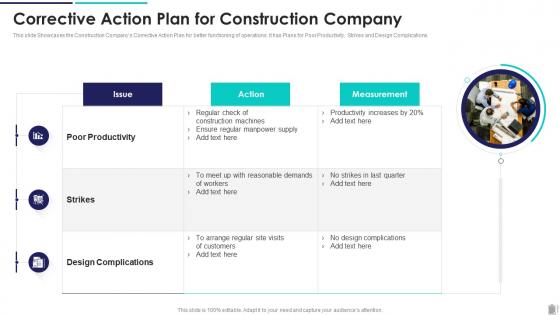
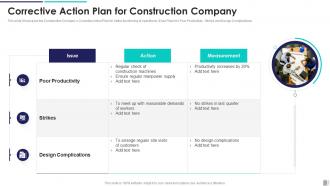
This slide Showcases the Construction Companys Corrective Action Plan for better functioning of operations. It has Plans for Poor Productivity, Strikes and Design Complications.
People who downloaded this PowerPoint presentation also viewed the following :
Corrective Action Plan For Construction Company with all 6 slides:
Use our Corrective Action Plan For Construction Company to effectively help you save your valuable time. They are readymade to fit into any presentation structure.





FAQs for Corrective Action Plan
Effective Corrective Action Plans include problem identification and root cause analysis, specific corrective measures with timelines, assigned responsibilities and accountability, monitoring mechanisms, and verification processes. These components work together by ensuring systematic issue resolution, preventing recurrence through targeted interventions, and maintaining compliance standards, with many organizations finding that structured CAPs significantly reduce operational risks while enhancing overall performance.
Organizations identify root causes through systematic investigation methods including root cause analysis, fishbone diagrams, 5 whys technique, failure mode analysis, and data pattern examination. These analytical approaches enable teams to move beyond surface symptoms by examining process breakdowns, human factors, and systemic weaknesses, ultimately delivering more effective solutions and preventing recurring issues across operational frameworks.
Team collaboration is essential for developing effective corrective action plans, as it brings together diverse perspectives, expertise, and accountability across departments. Through cross-functional input, teams can identify root causes more accurately, develop comprehensive solutions, and ensure seamless implementation, with many organizations finding that collaborative CAPs deliver faster resolution times and sustainable prevention of recurring issues.
Technology streamlines corrective action plan creation and implementation through automated workflow management, real-time tracking systems, centralized documentation platforms, and integrated analytics tools. These solutions enable organizations to accelerate issue identification, standardize response protocols, and monitor progress seamlessly, with manufacturing and healthcare sectors finding that digital CAP systems reduce resolution times while enhancing compliance transparency.
Key metrics for evaluating CAP effectiveness include problem recurrence rates, implementation timeline adherence, cost reduction achieved, customer satisfaction scores, and compliance audit results. These measurements enable organizations to assess whether corrective actions deliver sustainable improvements, with many companies finding that tracking both leading indicators like training completion rates and lagging indicators like defect rates provides comprehensive visibility into operational performance and long-term success.
A CAP should be reviewed monthly during initial implementation, then quarterly once stabilized, with immediate updates triggered by new incidents, regulatory changes, or process modifications. Many organizations find that regular review cycles enable proactive risk management, ensure continuous improvement, and maintain compliance effectiveness, ultimately delivering sustained operational excellence and competitive advantage.
Organizations typically face challenges including insufficient resource allocation, unclear accountability structures, resistance to change, inadequate progress monitoring, and lack of stakeholder buy-in when executing corrective action plans. These implementation barriers can be streamlined through strategic planning, dedicated project management, and robust communication frameworks, with many companies finding that structured oversight and phased approaches ultimately deliver sustainable improvements and enhanced operational efficiency.
CAPs integrate into existing quality management systems through systematic documentation workflows, automated tracking mechanisms, and standardized reporting protocols that align with ISO standards and regulatory requirements. Many organizations enhance their QMS frameworks by embedding CAP modules directly into their quality software platforms, enabling seamless incident management, real-time progress monitoring, and comprehensive audit trails that ultimately strengthen compliance oversight and operational efficiency.
Staff implementing a CAP require training in root cause analysis, problem-solving methodologies, documentation standards, timeline management, and performance monitoring techniques. These competencies enable teams to systematically address issues, track progress effectively, and maintain compliance requirements, with many organizations finding that comprehensive training reduces implementation time, improves solution quality, and enhances overall operational efficiency.
Regulatory requirements significantly shape CAP development by dictating specific timelines, documentation standards, reporting protocols, and remediation approaches across industries. Financial services must comply with banking regulations for risk management, while healthcare follows FDA guidelines for patient safety, and manufacturing adheres to OSHA standards, with each sector finding that regulatory alignment ultimately delivers faster approvals and reduced compliance risks.
**INPUT**: What are the best practices for documenting the steps taken in a CAP? **OUTPUT**: Best practices for documenting CAP steps include maintaining detailed timelines, recording specific actions taken, tracking responsible parties, documenting evidence collected, and noting measurable outcomes achieved. These documentation methods streamline compliance audits, enhance organizational accountability, and enable knowledge transfer, with many companies finding that comprehensive CAP records ultimately deliver improved process reliability and faster future issue resolution. **Word count: 58 words**
Feedback loops enhance CAP processes through regular progress reviews, stakeholder input sessions, performance metric tracking, and continuous improvement assessments. These mechanisms enable organizations to identify implementation gaps, adjust corrective measures in real-time, and strengthen future action plans, with many companies finding that systematic feedback collection ultimately delivers faster issue resolution and prevents recurring problems.
A CAP contributes to continuous improvement by identifying root causes, implementing systemic solutions, establishing monitoring mechanisms, and creating feedback loops for ongoing enhancement. Through structured problem-solving and data-driven analysis, organizations streamline processes, reduce recurring issues, and build proactive quality systems, with many companies finding that effective CAPs ultimately deliver operational excellence and sustainable competitive advantage.
Communication during CAP implementation requires transparent, multi-channel approaches including regular progress updates, stakeholder briefings, documented milestone reports, and feedback mechanisms across all organizational levels. Through structured communication protocols, teams enhance accountability, maintain alignment on corrective measures, and ensure swift issue resolution, while fostering collaborative problem-solving that ultimately delivers improved compliance and operational effectiveness.
Successful CAPs from manufacturing recall responses, healthcare infection control protocols, and financial compliance breaches demonstrate rapid root cause identification, comprehensive stakeholder communication, and measurable prevention strategies. These examples show that organizations implementing systematic corrective frameworks with clear timelines, regular progress monitoring, and cross-departmental coordination achieve faster resolution rates, reduced recurrence, and enhanced operational resilience.
-
Slideteam offers pocket-friendly products. As a college student this is a really necessary thing to look at while paying for something.
-
I was mind-blown by the services that SlideTeam provided me. Thanks a ton!