


Quality assurance plan analysis and management powerpoint presentation slides






Try Before you Buy Download Free Sample Product
 Impress Your
 Audience
 100%
100% Editable
 Save Hours
 of Time


A good quality control strategy ensures that the final product is of the utmost quality. To aid you in this endeavor, we have come up with content-ready quality assurance plan analysis and management PowerPoint presentation slides. This quality management PPT template includes 60 slides which cover topics such as quality control, customer focus, leadership, involvement of people, process approach, system approach to management, continual improvement, decision making, mutually beneficial supplier relations, dimensions of quality, service gap model, and quality determinants. It ensures that the customers are satisfied with the goods and services offered by your company. Other related topics that these illustrations cover are quality assurance program, quality control, and quality assessment. Download quality assurance plan analysis and management presentation designs right now. This will help you increase the efficiency of the business and improve customer satisfaction. Get your ideas together with our Quality Assurance Plan Analysis And Management Powerpoint Presentation Slides. They allow you to put in a concerted effort.
People who downloaded this PowerPoint presentation also viewed the following :
Content of this Powerpoint Presentation
Slide 1: This slide introduces Quality Assurance Plan, Analysis & Management. State your company name here.
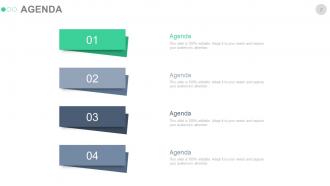
Slide 2: This is an Agenda slide. Use it to showcase your company agendas.
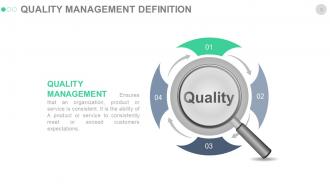
Slide 3: This slide presents Quality Management Definition with magnifying glass imagery.
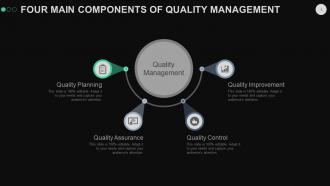
Slide 4: This slide states the Four Main Components Of Quality Management namely- Quality Improvement, Quality Control, Quality Planning, Quality Assurance.
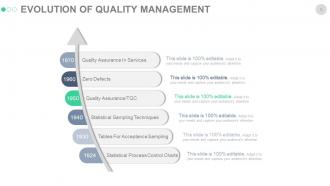
Slide 5: This slide showcases the Evolution Of Quality Management with the following characteristics Quality Assurance In Services, Zero Defects, Quality Assurance/ TQC, Statistical Sampling Techniques, Tables For Acceptance Sampling, Statistical Process Control Charts.
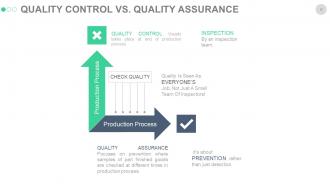
Slide 6: This is Quality Control Vs Quality Assurance slide. State them here.
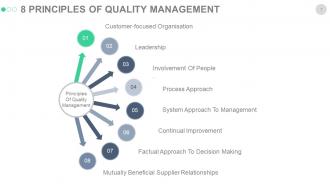
Slide 7: This slide states the 8 Principles Of Quality Management namely- Customer-focused Organisation, Leadership, Involvement Of People, Process Approach, System Approach To Management, Continual Improvement, Factual Approach To Decision Making, Mutually Beneficial Supplier Relationships.
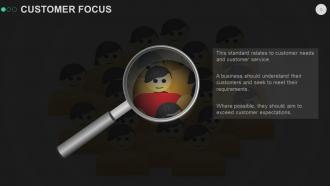
Slide 8: This is a Customer Focus slide with creative magnifying glass imagery.
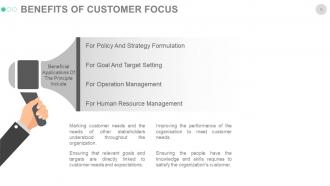
Slide 9: This slide states the Benefits Of Customer Focus which are- Policy And Strategy Formulation, Goal And Target Setting, Operation Management, Human Resource Management.
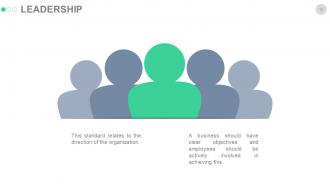
Slide 10: This is Leadership slide in people silhouettes. Use it to state various aspects of leadership.
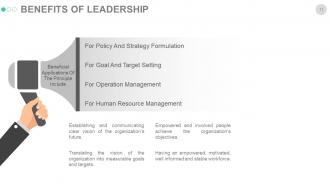
Slide 11: This slide states the Benefits Of Leadership involving the following points- Policy And Strategy Formulation, Goal And Target Setting, Operation Management, Human Resource Management.
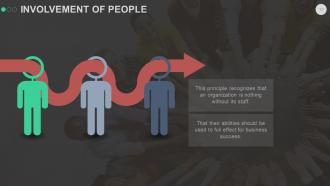
Slide 12: This slide shows the Involvement Of People with creative imagery to go with.
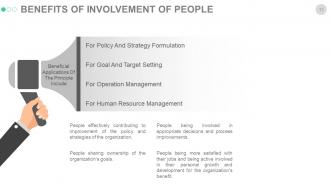
Slide 13: This slide states the Benefits Of Involvement Of People. These include- Policy And Strategy Formulation, Goal And Target Setting, Operation Management, Human Resource Management.
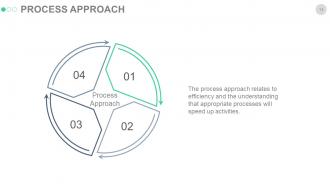
Slide 14: This slide presents Process Approach in a circular form.
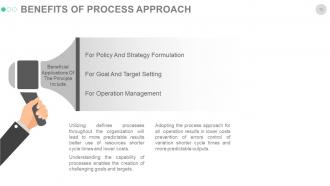
Slide 15: This slide states the Benefits Of Process Approach.
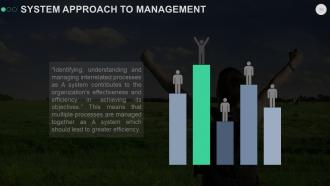
Slide 16: This slide presents System Approach To Management in a creative bar graph/ chart form.
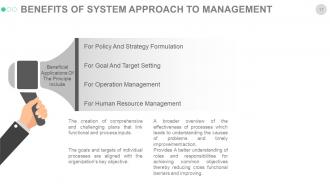
Slide 17: This slide states Benefits Of System Approach To Management with imagery.
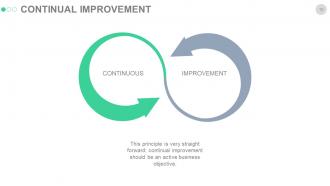
Slide 18: This slide states Continual Improvement with creative arrow imagery.
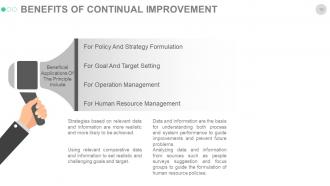
Slide 19: This slide states the Benefits Of Continual Improvement. Beneficial Applications Of The Principle Include- For Policy And Strategy Formulation, For Goal And Target Setting, For Operation Management, For Human Resource Management.
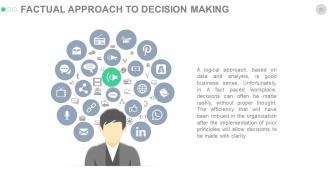
Slide 20: This slide showcases Factual Approach To Decision Making with creative imagery.
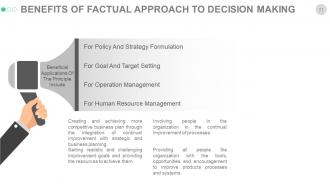
Slide 21: This slide states the Benefits Of Factual Approach To Decision Making. These benefits are- Policy And Strategy Formulation, Goal And Target Setting, Operation Management, Human Resource Management.
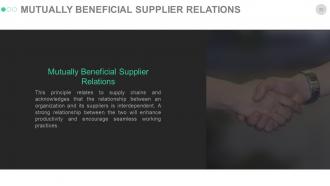
Slide 22: This slide shows Mutually Beneficial Supplier Relations with relevant imagery.
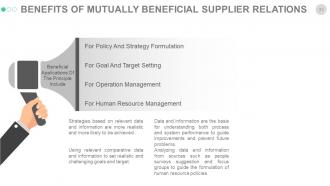
Slide 23: This slide states the Benefits of Mutually Beneficial Supplier Relations such as- Policy And Strategy Formulation, Goal And Target Setting, Operation Management, Human Resource Management.
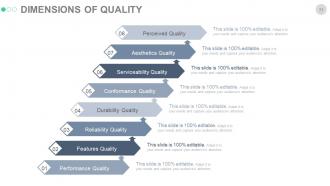
Slide 24: This slide shows the Dimensions Of Quality. These are- Reliability Quality, Durability Quality, Conformance Quality, Aesthetics Quality, Perceived Quality, Features Quality, Performance Quality, Serviceability Quality.
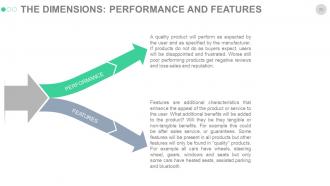
Slide 25: This is The Dimensions: Performance And Features slide to state.
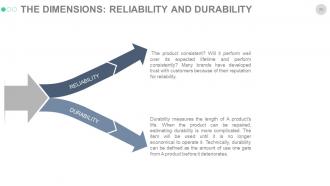
Slide 26: This slide shows The Dimensions: Reliability And Durability. State them here.
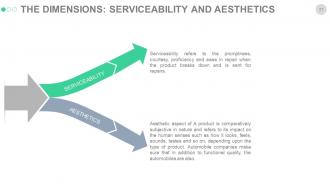
Slide 27: This is The Dimensions with: SERVICEABILITY AND AESTHETICS slide. State them here.
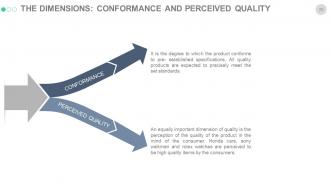
Slide 28: This slide shows The Dimensions: Conformance And Perceived Quality. State them here.
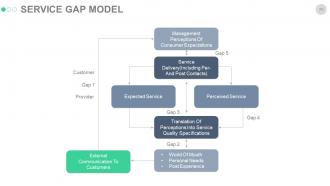
Slide 29: This slide showcases Service Gap Model flowchart. State its various aspects here.
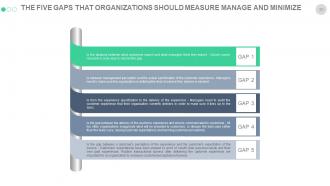
Slide 30: This slide states The Five Gaps That Organizations Should Measure Manage And Minimize.
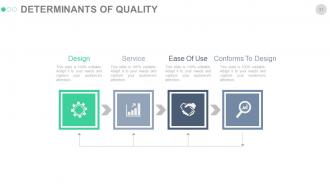
Slide 31: This slide states the Determinants Of Quality namely- Service, Conforms To Design, Ease Of Use, Design.
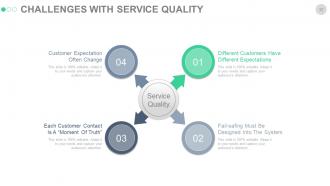
Slide 32: This slide states associated Challenges With Service Quality. These are- Customer Expectation Often Change, Different Customers Have Different Expectations, Each Customer Contact Is A “Moment Of Truth”, Fail-safing Must Be Designed Into The System.
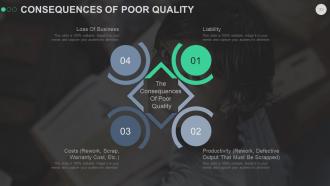
Slide 33: This slide states The Consequences Of Poor Quality such as- Loss Of Business, Liability, Productivity (Rework, Defective Output That Must Be Scrapped), Costs ( Rework, Scrap, Warranty, Cost etc. ).
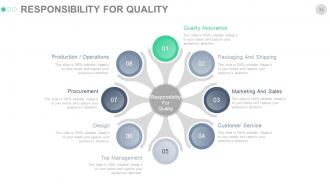
Slide 34: This slide states Responsibility For Quality with the following factors- Top Management, Quality Assurance, Packaging And Shipping, Marketing And Sales, Customer Service, Production/ Operations, Procurement, Design.
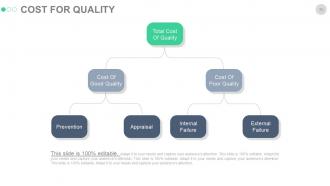
Slide 35: This slide presents Cost For Quality flowchart.
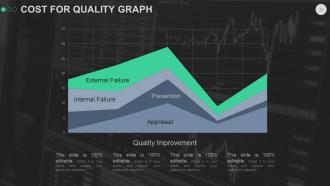
Slide 36: This slide showcases Cost For Quality Graph. Use it for analysis, comparison etc.
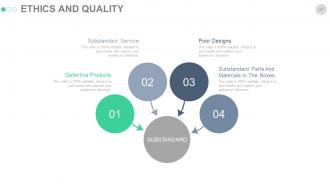
Slide 37: This slide states Ethics And Quality with repect to- Poor Designs, Substandard Service, Substandard Parts And Materials In The Boxes, Defective Products.
Slide 38: This is Our Vision slide with text boxes. State your vision, mission and goals here.
Slide 39: This slide showcases Our Team specifications with name, designation and image boxes.
Slide 40: This is an About Us slide. State team/ company specifications here.
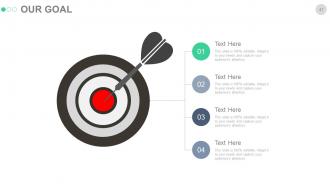
Slide 41: This is Our Goal slide to state company goals, aspirations etc.
Slide 42: This is a Comparison slide to compare two products/ entities etc.
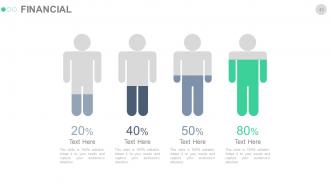
Slide 43: This is a Financial stats slide in people silhouettes. State financial aspects etc. here.
Slide 44: This is a Quotes slide to convey company/ organization message, beliefs etc. You may change the slide content as per need.
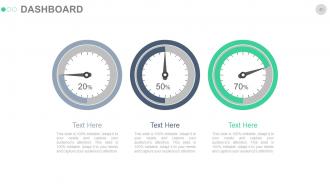
Slide 45: This is a Dashboard slide to show information in percentages etc.
Slide 46: This is a Location slide on a world map image to show global growth, presence etc.
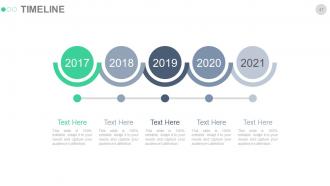
Slide 47: This slide presents a Timeline to show growth, milestones etc.
Slide 48: This is a Post It Notes slide for events, reminders etc. or to add memorabilia.
Slide 49: This is a Puzzle image slide to show information, specifications etc.
Slide 50: This is a Target image slide. State targets etc. here.
Slide 51: This is a Circular image slide to show information etc.
Slide 52: This is a Venn diagram image slide to show information, specifications etc.
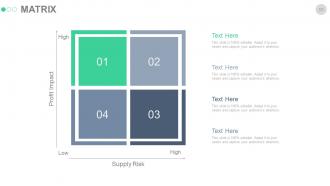
Slide 53: This slide presents a Low High Matrix for representing an information.
Slide 54: This is a Silhouettes slide to show people specific information etc.
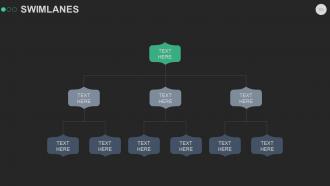
Slide 55: This is a SWIMLANES slide to show information, specifications etc.
Slide 56: This is a Bulb For Idea image slide to state a new idea or highlight specifications/ information etc.
Slide 57: This is a Magnifying Glass image slide with text boxes to show information, specifications etc.
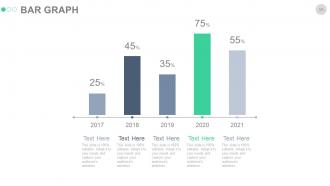
Slide 58: This is a Bar Graph slide to show product/ entity comparison, specifications etc.
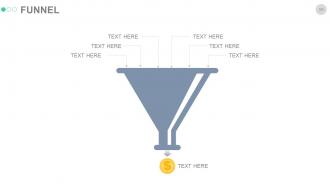
Slide 59: This is a Funnel slide. Showcase the funnel aspect of your team, company, product etc.
Slide 60: This is a Thank You slide with Address# street number, city, state, Contact Numbers, Email Address.
Quality assurance plan analysis and management powerpoint presentation slides with all 60 slides:
Give folks immediate access to information with our Quality Assurance Plan Analysis And Management Powerpoint Presentation Slides.Display it all in a jiffy.






FAQs for Quality assurance plan analysis and management
So you'll need quality objectives first - like what you're actually trying to achieve. Then set up ways to monitor and measure stuff, figure out who's responsible for what, and have procedures for when things go wrong. Resource allocation and training requirements are pretty crucial too. Documentation standards will save you headaches later, trust me. Risk management is huge - I've seen companies get burned when they skip this part. If you work with outside vendors, supplier quality control matters. Regular reviews help you improve over time. Honestly, just map your current processes first, then spot the gaps.
Start by figuring out what "done" actually means for your specific project. What do clients expect? Are there industry rules you have to follow? Map out measurable stuff - performance targets, how many errors you can live with, what users need to accept it. I've watched too many teams wing this part and then scramble later when nothing meets expectations. Be realistic about your team's skills and timeline though. No point setting impossible standards. Write it all down clearly and get everyone to agree upfront. Saves so many headaches down the road when people start having different ideas about quality.
Look, stakeholders are everything for your QA plan. They're literally the only ones who can tell you what "quality" means for your specific project. Get input from customers, users, sponsors, team members - everyone has different ideas about success. I've watched so many QA plans crash because people just guessed what stakeholders wanted instead of asking. Their feedback drives your quality standards and testing priorities. Oh, and don't just talk to them once at the start - check in regularly or you'll drift off course fast.
Track how many bugs you're catching pre-release vs post-release - that's huge. Look at defect detection rates, quality costs, and customer satisfaction scores too. Cycle times matter, but honestly I think trend data over time tells you way more than individual snapshots. Compare everything to your baseline from when you started the plan. The key is setting up regular team reviews where you dig into these numbers together. Oh and don't just collect data - actually adjust your approach based on what it's showing you. Otherwise you're just making pretty charts nobody uses.
Honestly, the worst thing you can do is be super vague with acceptance criteria - I've watched projects crash because nobody knew what "good enough" actually meant. Skip stakeholder input at your own risk. Testing scenarios that sound perfect but are totally unrealistic? Been there, seen that disaster. Copy-pasting from old projects without tweaking anything is lazy and usually backfires. You've got to nail down who's doing what - "the team will figure it out" is basically code for chaos. Oh, and build in review time upfront instead of scrambling later. Get everyone on board before you call it done.
So basically, software QA is all about testing code and making sure apps don't crash or have weird bugs. Manufacturing QA is totally different - you're checking physical stuff like materials and making sure production lines don't mess up. Software teams can fix things super fast with updates, but if you screw up in manufacturing? That's expensive as hell to fix. Both need tons of paperwork (ugh), but manufacturing has way stricter safety rules since people could actually get hurt. Oh, and definitely look up whatever standards apply to your specific industry first.
Start with risk-based testing - FMEA works great for figuring out what to test first. Selenium or Cypress handle your regression stuff pretty well. Jira's solid for tracking bugs and requirements, though honestly? I've watched teams crush it with basic spreadsheets while others crash and burn with fancy enterprise tools. Consistency beats features every time. Static analysis tools help catch code issues early. If you're not doing Agile testing yet, definitely worth looking into. My advice? Pick one or two tools you'll actually stick with rather than going overboard from day one.
So a QA plan is basically your game plan for catching problems before they blow up in your face. Map out your biggest quality risks first - that's where I'd start anyway. Then build specific activities and checkpoints around preventing each one. It works hand-in-hand with risk management, except instead of just identifying what could go wrong, you're actually creating the safeguards and testing procedures to stop those scenarios. Way cheaper than dealing with failures after the fact. Short version: it's proactive problem-solving that'll save your butt later.
Build those feedback loops right into your QA from day one. Pick 2-3 metrics you actually care about and review them monthly - defect patterns, bottlenecks, whatever's bugging your team. Then here's the thing: you've gotta act on what you find. I swear, half the teams I know collect tons of data but never do anything with it. Schedule regular retrospectives and make improvement automatic instead of waiting for disasters. Oh, and don't overthink the metrics part - start simple and add more later if needed.
Track defect density, escape rates, and first-pass yield first - that's your bread and butter for catching issues. Process stuff matters too: inspection times, rework costs, cycle time from detection to fix. Customer satisfaction scores are obviously huge. Oh, and don't sleep on leading indicators like training completion rates and audit findings since they catch problems before they become disasters. Honestly though? Stick to 5-7 metrics max. I've seen teams go overboard with tracking everything and then they're paralyzed by all the data instead of actually fixing things.
Training your people is huge - probably the biggest thing that'll make or break your QA setup. Look, you can write perfect procedures all day, but if your team doesn't get it or can't execute, you're screwed. Good training means they spot problems early and actually understand why quality matters instead of just checking boxes. They'll even pitch ideas for improvements once they see the full picture. I always tell people to spend like 20% of their QA budget on ongoing training. Seems like a lot but honestly? Way cheaper than dealing with defects and having to redo work later.
Keep that QA plan alive - version control and change logs are your friends. Write everything in plain English because nobody has time to decode corporate nonsense when they're rushing through procedures. Update it after big projects, when processes shift, or quarterly at minimum. Actually sit down with your team to review changes instead of just firing off another email they'll ignore. Oh, and always explain WHY you're requiring something, not just what to do. Trust me, when auditors start asking questions six months later, you'll be glad you documented your reasoning. Store it somewhere accessible - seems obvious but you'd be surprised how often this gets screwed up.
Dude, start with your biggest headaches first - what's driving you crazy right now? Automated testing is a game changer for all that repetitive stuff. Real-time dashboards beat the hell out of tracking everything manually (seriously, spreadsheets are the worst). You can set up workflows that catch problems early instead of scrambling later. Quality management systems help keep everyone on the same page too. Honestly? The time you'll save is insane. Just don't try to fix everything at once - pick one pain point and go from there.
First thing - figure out what regulations hit your industry. FDA for pharma stuff, ISO for manufacturing, SOX if you're dealing with financial services. Honestly, it gets confusing fast which is why you really need a good lawyer on speed dial. Your QA plan has to show how you'll hit all these requirements through proper documentation, audit trails, and regular reviews. Oh and GDPR too if you're touching any customer data - that one's a pain. I'd start by mapping everything out first, then build your quality processes around whatever's mandatory.
Look, external audits are basically fresh eyes on your QA plan - someone who isn't buried in your daily chaos checking if you're actually doing what you say you do. Yeah, they're stressful as hell, but honestly? Worth it. These auditors catch gaps and problems your team misses because you're all too close to the work. They'll verify you're hitting compliance requirements and quality goals. I've seen companies discover issues they never would've found internally. Take whatever they find and use it to make your plan stronger. Shows stakeholders you're serious about improvement too.
-
good job
-
Easy to edit slides with easy to understand instructions.
-
Visually stunning presentation, love the content.