


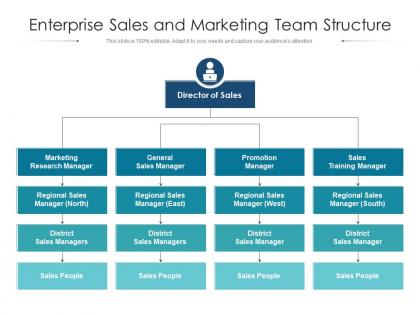
Enterprise sales and marketing team structure




Try Before you Buy Download Free Sample Product
 Impress Your
 Audience
 100%
100% Editable
 Save Hours
 of Time


Our Enterprise Sales And Marketing Team Structure are topically designed to provide an attractive backdrop to any subject. Use them to look like a presentation pro.
People who downloaded this PowerPoint presentation also viewed the following :
Enterprise sales and marketing team structure with all 2 slides:
Use our Enterprise Sales And Marketing Team Structure to effectively help you save your valuable time. They are readymade to fit into any presentation structure.

FAQs for Enterprise sales and
Honestly, start with the basics - get yourself some SDRs to qualify leads and AEs to actually close the deals. Customer Success is huge for keeping people around once they're paying you. Marketing-wise, you'll need demand gen people and someone doing product marketing. Sales engineers are pretty much mandatory for enterprise stuff, trust me on that one. Oh and marketing ops - someone's gotta keep all that data from turning into a complete mess. Build from there as you grow, but those are your must-haves.
Honestly, shared metrics are everything here. Set up KPIs both teams actually care about - like MQL to SQL conversion rates and revenue attribution. Weekly meetings beat quarterly ones by a mile (learned this the hard way). Sales needs to tell marketing which leads suck, and marketing should share what's working content-wise. Oh, and make sure marketing's lead targets actually match realistic sales quotas - sounds obvious but you'd be surprised. Start with one dashboard you both check weekly. The communication piece is huge though - without that, even good metrics fall apart.
Honestly, start with the basics - pipeline velocity, deal size, and conversion rates at each stage. Your CAC to LTV ratio is huge too, especially with enterprise sales dragging on forever (ugh). Track your sales cycle length and win rates against competitors. Revenue expansion per account matters a lot. On the marketing side, watch how your MQLs convert to SQLs and what marketing actually influences closed deals. Maybe I'm overthinking this, but I'd focus on these six first. You can always add more metrics later once you've got the fundamentals down.
Honestly, just get your CRM talking to your marketing automation platform first - that's where you'll see the biggest wins. Both teams can finally track leads together instead of working in silos. Shared dashboards show what campaigns actually work, and everyone updates lead status in real-time. Slack integrations help too (though sometimes people go overboard with notifications lol). The main thing is having one place where marketing sees which leads converted and sales gets the lead quality scores. Once you have that single source of truth, your teams won't be guessing anymore about what the other side is doing.
Oh god, the telephone game thing is SO real - your strategy gets completely mangled by the time it hits different teams. Sales thinks one thing, marketing's doing something else, and don't even get me started on regional offices. Leadership keeps changing direction every few months too which... yeah. Data silos make everything worse since nobody can see what's actually working. Honestly? You need really clear docs and regular check-ins where everyone's looking at the same metrics. Otherwise you'll end up with like five different strategies running at once and wonder why nothing's clicking.
Dude, enterprise deals are a completely different beast. You've got like 8 people who all need to sign off - IT, finance, legal, the actual users, plus some VP who shows up once. Small businesses? One person watches your demo and buys. Enterprises take forever... we're talking months of meetings and "let me run this by my team." Each person cares about totally different stuff too. It gets exhausting honestly. The whole thing becomes about building relationships instead of just showing features. My advice? Figure out who all the players are super early and make content that speaks to what each person actually worries about.
Honestly, ABM is your best bet here since enterprise clients need way more hand-holding. Map out their whole buying committee first - usually like 6-8 people which is a total nightmare but whatever. LinkedIn Sales Navigator is clutch for finding the right contacts. Intent data tools are worth the money too, they'll tell you when prospects are actually looking for solutions. Oh and definitely squeeze your current customers for referrals and case studies. Enterprise people love that social proof stuff way more than smaller companies do. I'd pick one solid ABM campaign and just nail it this quarter instead of spreading yourself thin.
Honestly, start with your CRM data and figure out which channels are actually bringing in real enterprise leads - not just random downloads. Track the whole journey from first contact to closed deal so you know what's working. Most companies just throw money everywhere and hope something sticks, which is insane when you think about it. Focus on connecting your marketing spend to actual revenue instead of those feel-good metrics like webinar signups. Once you set up proper attribution tracking, you'll see patterns in what content and messaging actually moves buyers through each stage.
Dude, content marketing is huge for enterprise sales - it's like your trust-building machine when you can't be there pitching. These deals have crazy long cycles with tons of decision makers, right? So you need whitepapers, case studies, webinars, all that good stuff to keep nurturing relationships. Don't just push features though. Become the resource they actually want to read when they're figuring stuff out. Map your content to different buyer stages and track what's actually closing deals. Honestly, most companies mess this up by being too salesy too early.
Don't make it a big annual thing - that's where most teams screw up. Monthly skill sessions work way better. Get guest speakers in every quarter, and honestly? Your best people teaching the rest of the team is gold. I always tell managers to track what actually gets used afterward, not just who showed up. The training needs to connect to real deals they're working on right now. Otherwise it's just theoretical BS that gets forgotten by next week. Peer learning groups are clutch too.
Honestly, start with regular check-ins between regions - can't tell you how many deals I've watched die because teams weren't talking. What kills companies in Silicon Valley might work great in Tokyo, so ditch the cookie-cutter training approach. Your managers need to actually get local business customs and holidays, not just wing it. Oh and communication styles too - that's huge. The performance gaps between regions will show you exactly where to focus first. I mean, your talent pools are completely different across continents, so why would you treat them the same? Fix the communication silos first, then build out region-specific programs from there.
ABM is like laser-focused targeting for big deals instead of spraying and praying. Pick 10-20 high-value companies you actually want to work with. Then your sales and marketing people team up to figure out who makes decisions there. Marketing creates stuff specifically for those people - like LinkedIn ads just for "VP of Operations at Company X" or whitepapers that nail their exact problems. Way more work up front, honestly. But the conversion rates are usually insane compared to generic campaigns. My buddy's team saw 3x better results once they ditched the broad approach. Start small and see what happens.
Dude, you absolutely need to be collecting feedback from customers - both the ones who bought and the ones who didn't. They'll tell you what's actually working in your pitch and what's making people run away. Honestly, your customers understand your product's value way better than you think you do. Use what they're saying to tweak your sales scripts and marketing stuff. Also maybe this is obvious but track the same objections that keep popping up? That's gold for fixing your messaging. I'd say review everything quarterly and actually make changes based on what you're hearing.
Honestly, I'd do like a 70/30 split - most of your budget on immediate sales stuff, but don't forget the brand building. When you run those quarterly pushes, just make sure they actually connect to your brand message instead of random discounting (I've watched so many companies screw this up lol). Track different metrics for each goal - revenue targets for the quick wins, brand awareness and customer lifetime value for the longer game. Your sales people need to get that they're not just closing deals, they're building relationships too. Oh, and definitely review both sets of numbers monthly so nothing gets forgotten.
Dude, sales teams are going nuts with this stuff now. They're using AI to stalk prospects' tech stacks and social media, then creating custom microsites for each company. Pretty wild honestly. Some even build interactive demos that match the prospect's exact situation. The timing part is crazy too - they hit you up right after you download something like a competitor guide because they can track that intent data. I mean, it works but feels a bit creepy sometimes? Anyway, start by figuring out where your customers hang out online first.
-
Very unique, user-friendly presentation interface.