


Our sales team structure flowchart




Try Before you Buy Download Free Sample Product
 Impress Your
 Audience
 100%
100% Editable
 Save Hours
 of Time


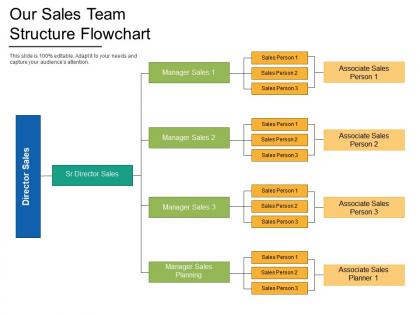
Want to improve your product sales? We have got you covered. Download this predesigned our sales team structure flowchart PowerPoint template slide crafted by the skilled presentation and PowerPoint designers at SlideTeam. This sales group structure PPT template slide consists of a flowchart that depicts five different designation level of the sales team members. With the aid of this sales team management presentation slide design, you will be able to identify the kind of team you need to improve the sales of the product. This editable sales team structure PPT template slide is an excellent tool for achieving the business end goals. You can avail the benefit of this sales members flowchart template slide for designing a presentation on various topics such as sales management, business growth, sales improvement, leads generation, product marketing, business planning, sales operation, promotion and marketing communication, business development, and demand forecasting. As this sale management template slide is customizable, you can alter the look and feel of the design as per needs. Quickly download this our sales team structure flowchart PPT slide. Handle adversity with our Our Sales Team Structure Flowchart. Advise folks on absorbing the fallout.
People who downloaded this PowerPoint presentation also viewed the following :
Our sales team structure flowchart with all 5 slides:
Generate a host of attractive deals with our Our Sales Team Structure Flowchart. It helps build buoyancy.




FAQs for Our sales
So you'll need SDRs to hunt for leads and qualify them first. Then Account Executives close the actual deals. A Sales Manager keeps everyone on track and does the coaching stuff. Customer Success is huge too - seriously, don't skip that role if you want people to stick around and renew. Sales Engineers handle technical demos when your product gets complicated. Oh, and Sales Ops manages all the data and processes behind the scenes. Start with just SDRs and AEs though if you're building from zero. Make sure everyone knows exactly which part of the customer journey they own or it gets messy fast.
B2B sales teams need way more people doing different jobs - you've got your SDRs hunting for leads, account executives closing deals, then account managers babysitting clients afterward. That's because B2B deals are messy with tons of decision-makers involved. B2C is the opposite. One sales rep can handle everything start to finish since customers decide faster and it's less complicated. Sure, B2B teams can get ridiculously bloated with all those handoffs, but honestly each role needs totally different skills. Your B2C team stays lean but moves fast. Just think about how long your sales cycle is - that'll tell you which way to go.
Look at your revenue per rep and conversion rates first - those numbers don't lie. Sales cycle length too. But here's the thing, the soft metrics are just as telling. How happy is your team? Are people actually collaborating or working in silos? New hire ramp time tells you a lot about whether your structure makes sense. Oh, and definitely check what customers are saying about their buying experience - a messy org chart usually means a messy buyer journey. I'd pull these monthly, then do a deeper dive quarterly. Start with maybe 3-4 metrics that match whatever you're trying to fix right now.
Honestly, just look at how your customers actually want to buy from you first. Enterprise clients? You'll need dedicated account managers who can handle those long sales cycles. Going for volume instead? Inside sales teams are way more efficient. Don't just steal your competitor's structure - I see companies do this all the time and it backfires. Match your team's territories and skills to what you're actually trying to achieve revenue-wise. Also, check in every quarter or so because priorities change fast. If something's not working, switch it up. No point sticking with a broken system just because that's how you've always done it.
Honestly, it comes down to team size. Flat structures are great when you're small - people can just walk over to the boss instead of going through three managers. Way faster decisions, better communication. But once you hit maybe 15-20 people? Things get messy fast. Nobody knows who's supposed to handle what, and good luck figuring out career progression. Hierarchical setups work better for bigger teams since you get clearer roles and actual training systems. Sure, it's slower sometimes, but at least someone's accountable when stuff goes wrong. I've seen too many "flat" companies turn into total chaos once they scale.
Honestly, tech has blown up the whole traditional sales setup. Teams are way more specialized now - you've got SDRs doing all the prospecting work, account executives closing, and customer success people handling retention afterward. CRM tools let managers see what's happening in real-time instead of waiting around for those boring monthly pipeline meetings. Remote selling changed everything too - your top performers can literally work from a beach if they want. AI helps with lead scoring and territory stuff, though sometimes I think we overthink that part. I'd start by figuring out where your current tech is creating problems and fix those first.
Pair them with your best performer for the first month - that buddy system thing actually works. Get them meeting key clients and internal people right away instead of hiding them in training forever. Honestly, I've watched too many managers just dump quotas on new people without any real support, which is brutal. Check in with them at weeks 2, 4, and 8 so problems don't blow up later. Let them shadow different team members to see how everyone sells differently. Oh, and set those 30-60-90 day goals that actually build up gradually rather than expecting miracles from day one.
Dude, cross-department stuff is huge for sales teams. I've watched so many companies fall apart because sales just does their own thing while marketing and customer success are off somewhere else. Map out where your teams actually need to talk to each other first - like your SDRs getting solid leads from marketing, account managers staying tight with support, that kind of thing. Your leadership should be meeting with other departments regularly too. Oh and honestly? The companies that nail this collaboration thing just perform way better across the board. Start by figuring out where you're bleeding the most from poor handoffs and fix those gaps when you restructure.
Honestly, you can't really nail your sales structure without solid training first. People need the actual skills to do their jobs well, you know? Once you invest in developing your team, you'll start seeing who's naturally good at what - like some people are killer at prospecting while others shine at closing deals. Way better than just throwing people into random roles and hoping for the best. Plus promoting internally is so much less of a nightmare than constantly hiring new people (trust me on this one). Just audit what skills each role actually needs, then create training that matches up. Makes the whole thing way more strategic.
Honestly, having a solid team structure is a game-changer for keeping everyone on the same page. You'll want designated leads or pods so reps actually know who to go to when shit hits the fan. No more awkward "whose deal is this?" moments in meetings - trust me, those are the worst. Set up your CRM to match however you organize things, otherwise prospect info just disappears into the void. Weekly check-ins become way more productive too. Oh, and map out the reporting chain first - sounds boring but it saves tons of confusion later.
Honestly, the time zone thing will drive you crazy - I swear I've aged years from early morning calls with the West Coast team. Communication becomes this constant puzzle. You can't just pop over to someone's desk anymore when they're struggling with a deal or need quick feedback. Building that team vibe is way harder too when everyone's just a tiny box on Zoom. Performance tracking gets messy since you lose all those little check-ins that actually matter. My advice? Get really good video tools and block out time for regular one-on-ones. Otherwise you'll feel like you're managing ghosts.
Honestly, just match your sales setup to where you're actually at. Founders handle everything at first - prospecting, demos, closing, even some customer stuff. Pretty chaotic but that's startup life. When you start scaling, split things up: get SDRs for prospecting, AEs for closing, maybe a sales manager. Don't go crazy with structure too early though - I've seen companies overthink this and create unnecessary roles. Later on you'll have inside sales, field teams, enterprise specialists, the whole thing. Just don't wait forever to specialize when you're clearly maxed out capacity-wise.
Dude, you gotta specialize your roles first. Don't let everyone do everything - get dedicated prospectors, closers, and account managers. Map out how leads pass between people because that's where things usually fall apart. Your territories need to make sense too, not just random lines on a map based on who lives where. Actually look at market potential. Oh and make sure your managers still remember how to sell - nothing worse than coaches who've forgotten what it's like in the trenches. Consistent processes help, but only if people actually follow them. Start with those handoffs though, that's your biggest pain point probably.
Match people to what they're actually good at - put your number crunchers on the big enterprise stuff, relationship people with key accounts. Your aggressive hunters? New business, obviously. I do tons of one-on-ones because you can't figure out what drives someone without talking to them. Give them challenges that stretch them but won't destroy their confidence (learned that one the hard way). Oh, and celebrate wins beyond just revenue - recognition goes way further than most managers think. It's honestly like coaching - you wouldn't stick your star quarterback on defense, you know?
Honestly, start with time zones - you can't sell to people who are sleeping lol. Then decide if you want local hires who get the culture or just have your current team work weird hours. Different regions have totally different sales styles too. Like some places expect you to wine and dine them for months, others just want the pitch and pricing. Oh and the legal stuff is a nightmare - employment laws, taxes, all that fun paperwork. Language barriers are obvious but buying behaviors aren't always. I'd test one market first instead of going crazy and trying to scale everywhere at once.
No Reviews