


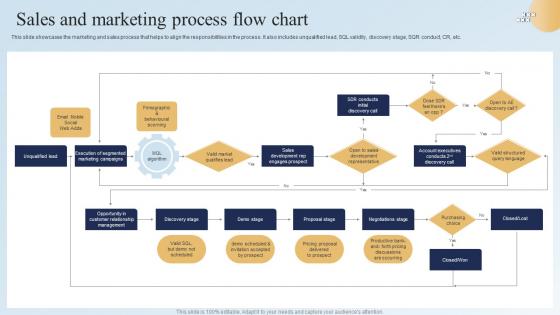
Sales And Marketing Process Flow Chart




Try Before you Buy Download Free Sample Product
 Impress Your
 Audience
 100%
100% Editable
 Save Hours
 of Time


This slide showcases the marketing and sales process that helps to align the responsibilities in the process. It also includes unqualified lead, SQL validity, discovery stage, SQR conduct, CR, etc.
People who downloaded this PowerPoint presentation also viewed the following :
Sales And Marketing Process Flow Chart with all 6 slides:
Use our Sales And Marketing Process Flow Chart to effectively help you save your valuable time. They are readymade to fit into any presentation structure.





FAQs for Sales And Marketing
So the basic stages are lead generation, qualifying prospects, needs assessment, proposal/presentation, handling objections, closing, and follow-up. Most charts use those core phases, though some break it down even more. Honestly, I've watched teams waste weeks perfecting their flowcharts when they should've been selling. What actually matters is moving prospects forward smoothly. Map out where you hand things off between stages and nail down what qualifies someone for the next step. Oh, and start simple! You can always tweak it later once you see what's working.
Dude, flow charts are a game changer for new hires. Instead of dumping massive training manuals on them, you're giving them this visual step-by-step guide they can actually follow. Shows the whole sales process from first contact to closing the deal. Way more effective than those boring PowerPoint marathons - I swear nobody ever remembers those anyway. Best part? They can keep it right on their desk and reference it during real calls when they panic. No more constant interruptions asking "what do I do next?" Just make it simple enough to print out.
Okay so you'll need the basic stages: lead gen, qualification, needs assessment, demo/proposal, negotiation, then closing. Add clear decision points at each step - like "qualified?" with yes/no branches. Honestly, I always include timeframes because deals that sit forever usually just die. Each stage needs specific actions too - call, email, whatever. Define exactly what pushes someone to the next step. Oh and keep it simple! If your team can't follow it without getting lost, what's the point? The whole thing should flow logically but not be overly complicated.
Dude, it's honestly game-changing when everyone follows the same roadmap. No more "wait, who's supposed to call this lead?" confusion. Your team can actually see who handles what and when each step happens. Think of it like GPS for sales - way better than everyone making up their own route, you know? The best part is spotting those weird gaps between marketing and sales that nobody talks about. Just sit down with your team and map out what you're already doing (trust me, you'll find random steps you forgot existed). Short version: it saves so much time and awkward conversations later.
Honestly, the two big ones I see all the time are overcomplicating everything and not talking to your actual team. Like, don't make some crazy spaghetti diagram with 47 steps - just focus on what really moves deals forward. And definitely don't go hide in your office to build this thing alone, because you'll totally miss stuff your sales people run into every day. Oh, and here's the thing - deals are messy. They don't follow neat little boxes, so build in some flexibility from the start. I'd just map out what you're doing now, grab your team's input, then tweak it based on reality.
Yeah, definitely! Map out how your customers actually buy first - that's way more helpful than some cookie-cutter template. B2B software needs those longer demo phases, but retail? Totally different beast, more about quick conversions. Healthcare teams I know throw in "regulatory approval" stages, manufacturing adds sample testing. Really depends on your industry's weird quirks, honestly. Some need compliance checkboxes, others juggle multiple decision-makers who all want their say. The flexibility is the whole point though - your flow chart should match your real customer touchpoints, not force people through generic steps that don't make sense.
Dude, CRM systems are a game changer - they'll track your leads through every stage automatically. Set up email sequences for follow-ups so you're not manually chasing people down (honestly, who has time for that?). Analytics tools show you exactly where prospects are bailing out of your funnel. AI can even predict which leads will actually convert, which is pretty wild. Without this stuff you'd be buried in spreadsheets and Post-it notes everywhere. Just map out what you're doing now first, then you'll see where tech can actually help most.
Honestly, just build feedback checkpoints right into your sales flow - post-demo surveys, follow-up calls, win/loss interviews, that kind of stuff. Make them parallel branches that loop back to earlier stages. The trick is actually making these feedback loops visible so your team doesn't ignore them (which happens more than you'd think). Set up a monthly review where you look for patterns and tweak your process. I'd also add a dedicated analysis step - sounds boring but it's what turns your flow chart into something that actually improves over time instead of just sitting there collecting dust.
Honestly, flowcharts are game-changers for this stuff. You map out your sales steps, then the data tells the whole story. Like if 50 leads are stuck at "proposal review" but only 5 make it to contracts? That's your problem right there. Way better than drowning in spreadsheets - I hate those things. The visual part makes patterns jump out at you instantly. Short sentences make it crystal clear where deals pile up. Once you see the actual bottleneck, you can fix the real issue instead of just dumping more leads into a broken system.
So basically, flow charts give you actual data points instead of just winging it. You can see conversion rates, how long deals sit in each stage, where people bail out - all that stuff. Way better than those awkward Monday meetings where everyone's like "uh, I think this is working?" Short sentences hit different sometimes. Pick 2-3 things you actually want to track at each step, then figure out how to capture it. Honestly saved my butt when I couldn't figure out why deals kept dying in the same spot. You'll spot the bottlenecks fast and can test fixes without guessing.
Honestly, I'd check it monthly if things are moving fast, but quarterly works for most teams. Your reps will be the first to tell you when the chart is total BS compared to what's actually happening - seriously, just ask them. Look for patterns where deals keep dying or new steps that everyone's doing but aren't written down yet. Oh, and anytime you switch tools or change who you're targeting, update it right away. I've seen too many companies with these perfect flowcharts that nobody follows because they're completely outdated. Make reviewing it part of your regular sales huddles so it stays relevant.
So basically, a sales process flow chart is like drawing out your entire pipeline visually. Shows where marketing passes leads to sales and what happens after that. Map out every touchpoint from awareness campaigns to closed deals - both teams can see how everything connects. Super helpful for catching problems too. Maybe marketing's pumping out leads that aren't qualified, or sales is slow to follow up on hot ones. Honestly, just get both teams in a room to build it together. You'll be shocked how fast the weird gaps become obvious. Worth doing even if it feels like extra work at first.
Honestly, there's so much good stuff you can pull from your sales flowchart. Conversion rates between stages are huge - plus average time in each phase and where people bail out. Win rates by stage help too, but the time metrics? Those always surprise me because deals get stuck in weird places you wouldn't expect. Also track lead volume entering each stage and your pipeline velocity. Oh, and don't try to measure everything at once - pick like 3-4 metrics that match your biggest headaches first, then add more later.
Dude, flow charts are honestly a game changer for sales teams. They map out your whole process from first contact to closing the deal, so nobody's confused about what comes next. Think of it like having directions instead of driving around lost. You'll catch where deals keep dying, plus training new people becomes way easier. The best part? You can actually predict your revenue because you know how many leads convert at each stage. Just start by writing down what you're doing now - even if it's kinda chaotic, that's your starting point.
Honestly, I'd go with Lucidchart or Visio first - both have solid templates and make team collaboration pretty painless. Miro's another good one if you like that whole digital whiteboard thing (personally think it's way more fun than the others). There's also Draw.io which is totally free and does the job, though the interface is kinda meh. PowerPoint actually works fine too for basic stuff. I got sidetracked testing all these last month - anyway, try Lucidchart's free trial first. You can probably bang out something decent in half an hour once you upload your process steps.
-
SlideTeam was so customer-centric and quick service-provider that I doubted the amount I was paying and literally re-checked the transaction.
-
Extensive range of templates! Highly impressed with the quality of the designs.