


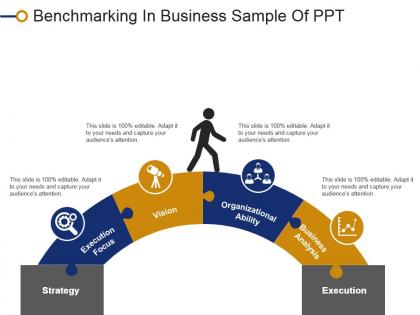
Benchmarking in business sample of ppt




Try Before you Buy Download Free Sample Product
 Impress Your
 Audience
 100%
100% Editable
 Save Hours
 of Time


Encourage joie-de-vivre with our Benchmarking In Business Sample Of Ppt. Insist on being a bit carefree.
People who downloaded this PowerPoint presentation also viewed the following :
Benchmarking in business sample of ppt with all 5 slides:
Our Benchmarking In Business Sample Of Ppt enable you to appear cool and casual. They evoke a feeling of absolute confidence.



FAQs for Benchmarking in business
Honestly, benchmarking is clutch for figuring out where you're actually falling short versus just guessing. You'll find best practices you didn't know existed and see exactly where competitors are beating you (or where you're winning - which feels great). It gives you real data to back up requests for budget or changes too. Keeps your team from getting too comfortable with mediocre results. Oh, and don't go crazy with comparisons at first - pick one metric that matters and find maybe 2-3 solid companies to stack yourself against.
Check out what your competitors are doing first - most of them publish performance data or you can find studies about them. Trade publications have tons of this stuff, and government databases are surprisingly helpful too. Focus on metrics that actually matter to your bottom line though, not just numbers that make pretty charts. I usually go with a mix of financial ratios, operational stuff, and customer satisfaction scores. Oh and here's something that actually works - reach out to companies in similar industries who aren't direct competitors. They'll often share benchmark data if you ask nicely.
Industry reports and public databases are your best bet - tons of competitor data there. Surveys work well if you can team up with trade associations for better responses. Mystery shopping is clutch for customer experience stuff. Oh, and trade conferences? People literally can't help but brag about their numbers when they've had a few drinks. Direct observation helps too. Customer interviews will give you the real story that public data misses completely. Honestly though, stick to maybe 2-3 methods tops or you'll drown in data and never actually use any of it.
Honestly, I'd say every 6 months minimum. Annual feels too slow these days - you'll miss way too much. Tech and retail? Maybe even quarterly for your main competitors. The real trick is staying consistent though. Sporadic checks are pretty much useless since you need that trend data to actually spot shifts. I've watched companies get totally blindsided because they waited a full year between benchmarks. Just pick your top 3-5 competitors and set a calendar reminder. Even a quick review beats nothing. Your industry moves fast, so don't let them pull ahead while you're not looking.
Honestly, tech has completely changed benchmarking. Real-time data collection means you're not working with outdated info from six months ago. AI spots patterns you'd miss completely - that stuff is actually pretty cool now. Cloud platforms let you compare against industry databases instantly instead of waiting forever. Automation handles the boring data collection (seriously, who has time for that manually?). The trick is finding tools that play nice with what you already have. That way you can benchmark continuously rather than making it some annual nightmare project. Way more useful when it's ongoing.
Yeah totally! Pick what the big players do well - like how fast they respond to customers or their pricing. Here's the thing though: you're way more nimble than them. Once you spot what works, you can actually move faster to copy or beat it. I'd focus on maybe 2-3 things where size doesn't really matter that much. Don't go crazy trying to benchmark everything at once - that'll just stress you out. Sometimes being smaller is actually an advantage because you can pivot quickly. Find those sweet spots where you can genuinely compete and use that as your edge.
Honestly, most people screw this up by picking terrible comparison companies or obsessing over metrics that don't actually move the needle. Teams also get stuck in this endless research loop - like they'll spend forever collecting data but never DO anything with it. Pick 2-3 metrics that matter and find companies you can actually compare yourself to. And here's the thing - you can't just benchmark once and walk away. Your competition changes constantly, so check in regularly. The whole point is taking action on what you find, not building a fancy dashboard that nobody looks at.
Here's the thing - qualitative benchmarks tell you WHY stuff is happening, not just what. Like, your sales drop 15% and the numbers are screaming at you, but they won't tell you it's because your checkout process is a total mess and confusing everyone. Customer sentiment, employee vibes, process quality - that's the good stuff metrics miss. Honestly, I think of it like getting the full story instead of just reading headlines. Numbers show the what, but you need the why to actually fix anything. Try pairing each big metric with one qualitative thing.
So internal benchmarking is basically comparing your own departments or locations against each other. External means looking at competitors or industry leaders. I'd start with internal first - way easier to get the data you need, plus you can spot best practices within your company. External is better when you want to see how you stack up competitively or need those big breakthrough ideas. The thing is, getting reliable external data is honestly a pain sometimes. But once you've optimized internally, external benchmarking can show you what's really possible out there.
Oh man, cultural stuff will absolutely wreck your benchmarking if you're not paying attention. Some cultures are super secretive about sharing data, while others are pretty open. And honestly? What counts as "success" varies wildly - like some places care way more about building relationships than hitting quarterly numbers. Communication styles matter too since people won't always be straight with you about their actual performance. Time horizons are another thing - what looks bad short-term might be brilliant long-term thinking. You've really got to adjust your benchmarks based on local norms instead of assuming your metrics work everywhere.
Honestly, most companies focus on the money-making stuff first - ROI, profit margins, EBITDA. Those show if you're actually beating your competition. Current ratio and quick ratio tell you about cash flow, which is super important obviously. Don't sleep on inventory turnover either. Debt-to-equity is probably the one investors care about most though - everyone wants to see how much debt you're carrying compared to other companies in your space. I'd grab like 3-4 industry reports and pick maybe 5-7 metrics max. You don't want to track everything or you'll go crazy. What kind of business is this for again?
Track the KPIs that match what you're actually trying to fix - cost cuts, efficiency gains, whatever gaps you found. Get your baseline numbers first (seriously, so many people forget this step and then have no clue if they improved). Check progress monthly or quarterly. Don't just measure the hard stuff either - see if people are actually using the new processes and if customers notice any difference. Oh, and measure results, not just "we did 5 training sessions." Set up some basic dashboard so you can pivot if things aren't working.
Honestly, benchmarking can actually spark way more innovation than you'd think. Look beyond your direct competitors though - that's where it gets interesting. I've seen tech companies study how restaurants handle complaints and come up with brilliant ideas. You're basically hunting for gaps in your own process while discovering what's actually possible out there. Short sentences work. Then you take those insights and twist them into something that fits your style. The worst thing you can do is just copy everyone else's homework. Use what you find as a jumping-off point instead of the final answer.
Honestly, just ask your team directly - they're dealing with this stuff daily and probably have way better insights than any fancy report. Survey them about what's broken, what competitors are doing better, stuff like that. They've got networks too from old jobs or industry contacts you might not know about. Use their feedback to figure out which metrics actually matter instead of tracking everything under the sun. Once you get your benchmark data, loop back with them - they'll tell you if your implementation ideas are realistic or totally off base. Makes the whole process way more grounded in reality.
Honestly, I'd start with just 2-3 metrics you actually care about - don't go crazy trying to track everything. Set up monthly or quarterly check-ins to see how you're doing against those benchmarks. Dashboards are clutch for spotting performance gaps in real time (once you get hooked on the data, there's no going back lol). Make sure someone owns each improvement project though, otherwise nothing gets done. Oh, and don't forget to check what new competitors are doing every few months - the whole landscape changes fast. Build in feedback loops with your team too. Trust me, this approach actually works way better than overthinking it.
-
Editable templates with innovative design and color combination.
-
Thanks for all your great templates they have saved me lots of time and accelerate my presentations. Great product, keep them up!