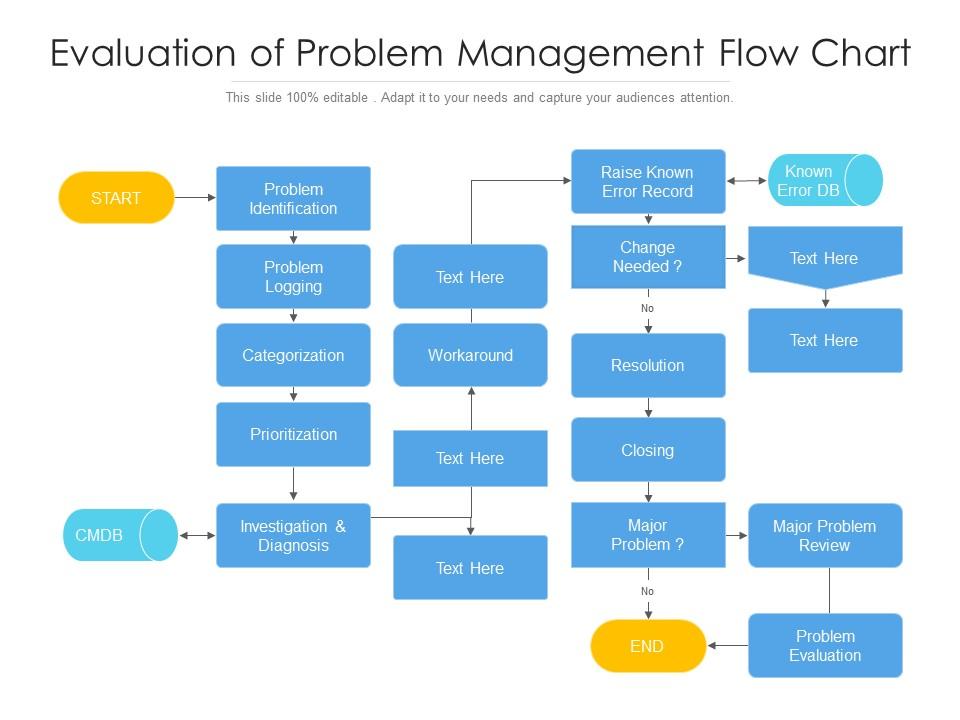
Evaluation of problem management flow chart

Rating:
88%
Evaluation of problem management flow chart
Slide 1 of 2
Favourites Favourites

Try Before you Buy Download Free Sample Product

Audience Impress Your
Audience
Editable 100%
Editable
Time Save Hours
of Time
The Biggest Sale is ending soon in
0
0
:
0
0
:
0
0
Rating:
88%
Presenting our set of slides with name Evaluation Of Problem Management Flow Chart. This exhibits information on one stage of the process. This is an easy-to-edit and innovatively designed PowerPoint template. So download immediately and highlight information on Prioritization, Problem Evaluation, Categorization.

FAQs for Evaluation of problem

So you're basically trying to find what's actually causing incidents and fix those root problems. Track your repeat issues first - that's where you'll see the biggest improvement. Build up a knowledge base so your team can spot patterns instead of just slapping temporary fixes on everything. The whole point is stopping future incidents before they happen and reducing impact when stuff does go wrong. It sounds simple but honestly gets chaotic if you don't stay on top of it. Focus on permanently solving things rather than the quick band-aid approach most teams default to.

So basically, incident management is your "oh crap, fix it NOW" mode - get things working again ASAP. Problem management is totally different though. It's the detective work that happens after, asking why stuff broke in the first place. Here's the thing - you need both working together. When you're handling incidents, flag the weird recurring ones or big disasters for problem management to investigate later. Honestly, most teams skip this step and wonder why they keep dealing with the same issues. The magic happens when your incident docs are actually useful - write down what went wrong so problem management isn't starting from scratch.

Try the "5 Whys" thing - just keep asking why until you get to the real issue. Fishbone diagrams work really well for mapping out different causes by category. Timeline analysis is solid too, where you basically reconstruct what went down before the problem hit. For technical stuff that's complicated, fault tree analysis does the trick. Honestly, don't just stick with one method though. Mix a few together and you'll catch things you might've missed otherwise. I learned this the hard way on a project last year - single approaches leave blind spots.

Look at your mean time to resolution first - that's huge. Are repeat incidents dropping? Because honestly, if you're seeing the same crap over and over, something's broken in your process. Don't get too hung up on perfect numbers right away though. Watch your problem backlog trends and closure rates instead. The magic happens when you catch stuff proactively before it becomes incidents. You'll know it's working when critical issues actually start decreasing because you're fixing root causes, not just slapping band-aids on everything.

Dude, communication literally saves everything when things go sideways. Keep everyone updated on what's broken, what you've already tried, and your next moves. I've watched so many fires get way worse just because nobody was talking! Document what you find and make sure info flows both directions - not just you broadcasting updates. Oh, and be proactive about it. Don't wait for people to hunt you down asking "what's the status?" Set up regular check-ins from day one. Trust me, it's the difference between looking like you've got it handled versus total chaos.

So you've got ServiceNow, Jira Service Management, and Remedy as your big enterprise options - they handle full ITIL workflows pretty well. Smaller teams? Freshservice is solid, or honestly just regular Jira works fine too. I've seen teams overthink this and pick something super fancy that nobody ends up using, which is just painful. Focus on stuff that'll actually integrate with whatever monitoring you're already running. Must-haves are incident linking, root cause tracking, and search that doesn't suck. Oh, and make sure your team will actually want to use it - that's half the battle right there.

Dude, problem management is a game changer. You stop fighting the same stupid issues every week and actually get to work on real projects. Track your repeat incidents first - honestly, you'll spot patterns super fast and kick yourself for not doing it earlier. Most teams see recurring problems drop by 60-80% once they fix root causes instead of just patching symptoms. Your users stop calling constantly, your team isn't stressed 24/7, and you can actually plan stuff instead of running around like crazy. Way better than the endless firefighting mode we all know too well.

Oh man, the classic mistake is rushing to patch things instead of figuring out why they broke in the first place. Don't be those teams that treat every problem like a fire drill. Also, someone needs to actually OWN the process - otherwise it just ping-pongs between departments until everyone forgets about it. Documentation sucks but you gotta update that knowledge base. Creates this weird blame culture where people hide problems because they're terrified of getting thrown under the bus. Honestly? Pick like 3 big issues and nail those first instead of spreading yourself thin across everything.

Analytics can seriously change your problem management game. Instead of guessing what's wrong, you'll actually see patterns in your incident data - like which systems keep breaking or what time of day things go sideways. Honestly, most teams are terrible at tracking whether their fixes actually stick long-term. You can prioritize based on real business impact instead of whoever complains the loudest (we've all been there). Start simple though. Pull reports on your most common incidents first. Look for trends you're probably missing when you're just firefighting all day.

Dude, you can cut your incidents by like 30-50% if you actually hunt down root causes instead of just putting out fires. Last month I started digging into our top 5 recurring problems - honestly should've done this ages ago. It's basically like getting regular oil changes vs waiting for your engine to seize up, you know? Yeah, you'll spend more time upfront doing investigations and proper fixes. But your on-call rotation will actually get some sleep for once. Look at whatever keeps breaking and fix the real problem underneath.

So it really depends on what could destroy your business, you know? Healthcare has crazy strict protocols because people literally die if they mess up. Financial companies are paranoid about security - one breach and they're toast. Manufacturing obsesses over equipment staying online since downtime costs a fortune every minute. Tech teams move fast with agile stuff and quick fixes. Retail freaks out about customer issues during busy seasons (which makes sense). Figure out what matters most to your industry - safety, uptime, compliance, whatever - then build everything around that.

You're gonna need solid detective skills - like really digging into what caused things to break in the first place. Communication matters a ton since you'll be talking to different teams constantly and breaking down complex stuff for people who don't get the technical side. Pattern recognition is huge too. Some problems honestly take forever to solve, so patience helps. Critical thinking's probably the most important though - you're always connecting random incidents that seem totally unrelated. Project management comes in handy when you're juggling big investigations with lots of moving pieces. Oh and document everything! Future you will thank you later.

Honestly, knowledge management is like having a cheat sheet for problems you've already solved. Build up a database with past fixes, workarounds, and what actually caused issues. When something breaks again (and it will), you're not starting from zero. The trick is getting everyone to actually update it after they fix stuff - I know, easier said than done. Even messy notes are better than nothing though. Start with a shared doc where people dump their solutions. You'll spot patterns pretty quick, and your future self will thank you when the same weird error pops up six months later.

Dude, ignoring known errors is like asking for trouble. Your team ends up fighting the same fires constantly instead of building anything new. Users get pissed when the same stuff breaks repeatedly. Stakeholders start wondering if you actually know what you're doing - which, fair point if you keep letting preventable incidents happen. Honestly, the burnout alone makes it not worth it. Your people want to work on interesting projects, not babysit the same broken processes every week. Set up a proper error database and fix things based on what'll hurt the business most if it breaks again.

Look, annually is the absolute minimum for reviewing your problem management stuff. But if you're constantly dealing with the same issues popping up? Go quarterly. I've watched teams cling to broken processes way too long - it's painful to see honestly. Major incidents are huge red flags that something needs fixing. New tech rollouts too. Oh, and when your numbers clearly show things aren't working, that's your cue. Quick tip: just schedule your next review right now and set it to repeat. Future you will thank you for it.

Ratings and Reviews

88% of 100
Review Form
Write a review
Most Relevant Reviews
  1. 80%

    by Byrne Cruz

    Nice and innovative design.
  2. 100%

    by Dominique Vazquez

    Helpful product design for delivering presentation.
  3. 100%

    by Davis Gutierrez

    Out of the box and creative design.
  4. 80%

    by Dewitt Soto

    Great product with highly impressive and engaging designs.
  5. 80%

    by Clark Ruiz

    Thanks for all your great templates they have saved me lots of time and accelerate my presentations. Great product, keep them up!

5 Item(s)

per page: