


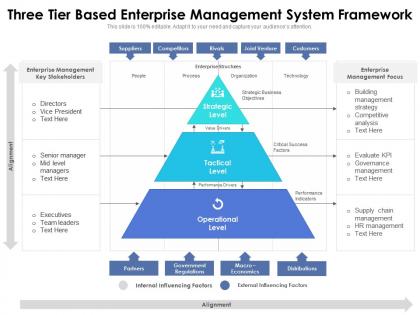
Three tier based enterprise management system framework




Try Before you Buy Download Free Sample Product
 Impress Your
 Audience
 100%
100% Editable
 Save Hours
 of Time


Our Three Tier Based Enterprise Management System Framework are topically designed to provide an attractive backdrop to any subject. Use them to look like a presentation pro.
People who downloaded this PowerPoint presentation also viewed the following :
Three tier based enterprise management system framework with all 2 slides:
Use our Three Tier Based Enterprise Management System Framework to effectively help you save your valuable time. They are readymade to fit into any presentation structure.
FAQs for Three tier based enterprise
So there's three main parts: presentation, application, and data tiers. Presentation handles what users actually see and click on. Application tier is where all your business logic lives - like the brain doing calculations between your UI and database. Data tier manages your database stuff. What's cool is you can work on each piece separately without breaking the others. Way easier to maintain honestly. I'd start by figuring out what parts of your current setup would go where - might take a bit of thinking but it's worth mapping out first.
Dude, three-tier architecture is clutch for scaling because you can upgrade each layer separately. Database hitting a wall? Just pump up that tier while leaving your front-end alone. Way more efficient than upgrading everything at once, which honestly is a waste of money most of the time. You can spread each tier across different servers too - like putting your web stuff on one cluster and your database on beefier hardware somewhere else. Only scale what actually needs it, you know? When you're building your next app, just think about which part's gonna get hammered the most.
Honestly, go three-tier when your app gets complex enough that different parts need different scaling. Your database might be dying while the UI runs fine - with three-tier you just beef up the data layer. Multiple teams can work simultaneously too, which is pretty sweet. Front-end people do their thing while backend devs handle business logic. Also, swapping technologies becomes way less painful. Need a new database? You're not rebuilding everything from scratch. I'd say make the switch when deployments start sucking or when performance requirements get wildly different across components.
Honestly, the biggest win is being able to scale stuff separately - need more web servers but your database is fine? Just add web servers. Your frontend people can work on UI stuff while backend devs mess with business logic at the same time, which speeds everything up. Debugging gets so much easier too since problems stay in their own layer. Oh, and you can swap out tech in one part without breaking the whole thing (learned that the hard way once). Really though, just figure out what logic goes where first - that's like 90% of it.
So basically you're splitting everything into three separate layers - your front-end, business logic, and database. Makes it way harder for hackers to move around if they break in. Like, even if they crack your web server, they still can't touch the database directly because there's that middle layer blocking them. Each part has its own security rules too. Network segmentation between layers is clutch here - honestly wish more companies did this properly. It's not foolproof but you're definitely not making it easy for attackers to wreck everything at once.
Think of middleware as your app's traffic cop - it sits between your front-end and database handling all the messy business logic. Your UI just looks good, your database just stores data, but middleware does the actual thinking. It processes requests, enforces rules, manages transactions, all that fun stuff. Common examples are Tomcat or Node.js backends (honestly Node.js is everywhere these days). The beauty is when you need to change business rules later, you're only tweaking one layer instead of hunting through your entire codebase. Keeps everything way cleaner.
Yeah absolutely, you can totally mix tech stacks across all three tiers! Like your frontend could be React while the backend runs Java Spring, then you've got PostgreSQL handling data. They talk through REST APIs or GraphQL - pretty standard stuff. The cool thing is you're not stuck with one ecosystem. Pick whatever works best for each layer. Though honestly? Make sure your team can actually handle debugging across different stacks because that can be a real pain when things break. The flexibility is worth it though.
Honestly, the biggest pain is just how complicated everything gets - you're juggling three separate pieces that have to work together perfectly. Network latency becomes a real issue with all that communication bouncing around. Debugging? Total nightmare when problems span multiple layers. Infrastructure costs go up since you need more servers to host everything. One tier crashes and it can take down your whole app. Oh, and performance usually suffers from all the back-and-forth chatter. My take: keep it simple at first. Get rock-solid monitoring set up before you even think about scaling - trust me on this one.
Start with rock-solid APIs between your layers - REST or GraphQL work great for front-end to business logic. Database connections need proper pooling and an ORM framework (honestly, raw SQL gets messy fast). Don't let errors fail silently - that'll bite you later when you're debugging at 2am. Log everything at each tier boundary and set up timeouts so nothing hangs forever. Load balancers will distribute your traffic nicely. Oh, and document those API contracts first - sounds boring but you'll thank yourself when stuff breaks.
So for three-tier setups, you've got a few routes to go. Web tier's pretty straightforward - hardware like F5 if you've got budget, or stick with HAProxy/NGINX for software options. They'll spread requests across your web servers no problem. Application layer uses similar stuff - round robin, least connections, weighted algorithms all work. Database balancing though? That's where it gets messy (always does). Most people end up with read replicas and master-slave configs, or go full clustering if they're feeling ambitious. Honestly, the trick is just matching whatever approach to each tier's actual bottlenecks. Don't overthink it.
Oh dude, three-tier architecture is clutch for maintenance! You can mess with one layer without screwing up the others. Database changes? Just hit the data tier - your UI won't even know. Works the opposite way too. Honestly saved my butt so many times with those nightmare legacy systems that somehow still run (barely). Different teams can work on their own tiers simultaneously without chaos. Oh, and pro tip - always sketch out which stuff goes where before you start coding. Trust me on this one.
Dude, three-tier architecture is actually clutch for UX during development. Your frontend people can move fast without sitting around waiting for backend stuff to get done. Everyone stays in their lane - UI folks do interfaces, backend handles business logic, database team optimizes that layer. Honestly makes parallel dev workflows so much smoother. The best part? You can swap components without everything exploding. Like if you need database changes, your presentation layer doesn't even notice. Oh and definitely figure out your team structure around these tiers early on - saves you headaches later when people don't know whose job is whose.
So basically you'd swap out those big monolithic chunks for smaller services that do one thing well. Your presentation layer hits multiple APIs instead of one giant backend. Data gets split up too - each service manages its own database. Pick one feature first though, don't try to rebuild everything (learned that the hard way lol). The messy part is all those API contracts between services, but once you nail that down the scalability is pretty sweet. Just don't overthink it - start small and you'll keep that clean separation while making everything way more flexible.
Honestly, you gotta monitor all three layers or you're flying blind. Start with the basics - response times and page loads at the front end. Your app layer is where things usually go sideways, so watch CPU, memory, and error rates like a hawk. Database stuff is pretty straightforward: query times, connection pools, disk I/O. Don't forget network latency between tiers though - that'll bite you when you least expect it. New Relic or DataDog are solid for connecting the dots across everything. Set up some alerts and you'll actually know about problems before your users start yelling at you.
So three-tier architecture is pretty sweet for deployment flexibility. Each tier can live wherever makes the most sense - maybe your frontend's in the cloud but you keep the database on-premise for compliance stuff. The tiers talk through APIs, so honestly they don't care if they're in different data centers or whatever. I'd start by figuring out your main constraints first - security, speed, budget, that sort of thing. Then you can decide where each piece goes. It's basically like LEGO blocks but for your infrastructure, which sounds nerdy but it's true.
-
Awesome use of colors and designs in product templates.