


Enterprise Scaled Agile Framework Agile Project Management Frameworks




Try Before you Buy Download Free Sample Product
 Impress Your
 Audience
 100%
100% Editable
 Save Hours
 of Time


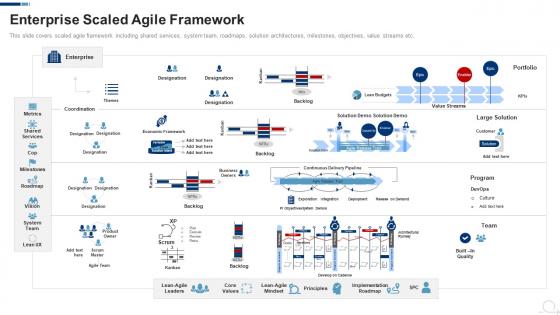
This slide covers scaled agile framework including shared services, system team, roadmaps, solution architectures, milestones, objectives, value streams etc.
People who downloaded this PowerPoint presentation also viewed the following :
Enterprise Scaled Agile Framework Agile Project Management Frameworks with all 6 slides:
Use our Enterprise Scaled Agile Framework Agile Project Management Frameworks to effectively help you save your valuable time. They are readymade to fit into any presentation structure.





FAQs for Enterprise Scaled Agile Framework Agile
So SAFe's got 10 core principles for scaling agile in big orgs. The main ones are taking an economic view on decisions, using systems thinking, and planning for variability. Build stuff incrementally, base your milestones on actual working systems, and make value flow visible. Decentralizing decisions is huge too - though good luck with that in most corporate environments, right? It also covers organizing around value streams and keeping employees motivated. My advice? Pick 2-3 principles that hit your worst scaling problems first. Don't try to do everything at once or you'll just overwhelm everyone.
So SAFe basically gets everyone on the same page through these quarterly planning sessions called PI Planning. Teams come together and hash out objectives and dependencies - first time doing it is kind of overwhelming honestly! The whole thing works because goals flow down from portfolio level all the way to your daily tasks. Program Boards make dependencies super visible, which is clutch. Your day-to-day stuff actually connects back to business goals instead of feeling random. I'd say dive into understanding PI Planning first - that's where teams really sync up and the alignment clicks.
So SAFe breaks roles into three levels - Team (Scrum Master, Product Owner), Program (Release Train Engineer, Product Manager), and Portfolio (Epic Owner, Solution Architect). The magic happens during PI Planning every quarter where everyone gets together to sync up. It's actually pretty chaotic but somehow works. Teams operate in these things called Agile Release Trains - basically multiple teams chasing the same program goals. Communication goes up, down, and sideways instead of just staying in silos. I'd start by figuring out what roles you already have, then spot where people aren't talking to each other.
So SAFe basically has this whole Continuous Delivery Pipeline thing built right in - it walks you through exploration, integration, and deployment steps. The framework really pushes for shorter release cycles and getting dev/ops teams to actually collaborate instead of that old-school "throw it over the fence" mentality. You'll be using automated testing, infrastructure as code, all that good stuff. Honestly, the quality practices they bake in make continuous delivery way more realistic. My advice? Map out your current pipeline first and find your worst bottlenecks - that's where you'll get the biggest wins.
So there's a bunch of SAFe ceremonies but the big ones are PI Planning (quarterly everyone-gets-together sessions), System Demos every couple weeks, and Inspect & Adapt workshops which are basically retros with some innovation thrown in. ART Sync handles coordination stuff, plus there's Scrum of Scrums for dependencies. PI Planning is honestly where all the real work happens - super intense but worth it because suddenly everyone's actually aligned. I mean, these aren't just random meetings. They keep big projects from turning into total disasters. If you're just starting SAFe, definitely begin with PI Planning.
So SAFe is basically this hybrid approach - it grabs the good stuff from Lean and Agile then makes it work for huge companies. Your teams still do sprints and retrospectives like normal, but there's this bigger Lean layer on top handling value streams and budget decisions. The Agile parts are obvious: Scrum teams, PI planning, all that. But then you get Lean principles baked in too - cutting waste, continuous flow, treating people right. I've seen it work pretty well actually. You don't have to throw out what you're already doing, just add the organizational structure above it.
So there's four different SAFe setups. Essential is the basic one - good starting point if you're new to this whole agile scaling thing. When you've got massive, complex products needing multiple release trains, that's Large Solution territory. Portfolio adds the strategic stuff and budgeting for enterprise coordination. Full SAFe throws everything at you, but honestly? Most companies jump to this too fast and regret it later. My advice: start simple with Essential, then build up. Adding layers is doable. Trying to dial back from Full SAFe when you realize it's overkill... yeah, that's a nightmare.
Honestly, don't try to do everything at once - that's a recipe for disaster. Pick one pilot ART first, ideally somewhere that's already doing agile pretty well and has management support. You'll want to throw money at a good SAFe consultant for this first round (trust me, it's worth it). People are gonna be lost initially with all the new roles and ceremonies, so coaching is huge those first few program increments. Get some quick wins under your belt to show it actually works. Once you've got proof it's not just expensive buzzword theater, rolling it out to other teams becomes way easier.
Honestly, I'd start with velocity - story points per iteration - and predictability, like how often teams actually hit their PI objectives. Cycle time and throughput are solid flow metrics too. Business value stuff is probably the most important though - track what features you're shipping and customer satisfaction scores. Employee engagement surveys are clutch since unhappy teams tank everything else. Quality metrics like defect rates matter, but don't go crazy measuring everything upfront. Pick maybe 3-4 to start with. You can always pile on more metrics once you've got SAFe running smoothly.
So SAFe basically works top-down - Portfolio level sets direction, then it flows down to your ARTs. WSJF scoring is your friend here (Weighted Shortest Job First) - it ranks features using business value, time criticality, and risk reduction. Total lifesaver for avoiding the "everything's urgent" nightmare. Product Management teams up with System Architects to keep the Program Backlog organized, while PI Planning gets everyone aligned on what's actually happening next quarter. The trick is helping your team see how their daily work ties back to those big business goals during planning. Makes a huge difference once people get that connection.
Honestly? People hate change, so expect pushback right away. SAFe is crazy complex too - your teams will feel lost with all the new roles and meetings, especially if they've been doing their own thing forever. Don't try rolling it out everywhere at once (learned that the hard way). Pick one Agile Release Train to start with. Get executives bought in early or you're screwed. Training is huge - like, spend way more than you think you need to. Oh, and don't follow SAFe exactly as written. Bend it to fit your company's weirdness. Quick wins help sell people on it.
SAFe actually does customer collaboration pretty well - you'll get demos every iteration, plus bigger System Demos at the end of each Program Increment. Real customers see working software regularly. The inspect and adapt sessions pull in actual user feedback to guide what you build next, which is honestly refreshing compared to some frameworks. Product Owners keep that customer connection alive throughout the whole process too. One thing though - don't just phone it in during those demos. Actually get real users in the room and listen to what they're saying. That's where the magic happens.
Dude, leadership makes or breaks SAFe transformations - I've seen this play out so many times. Your executives can't just write a check and disappear. They need to actually learn the framework and use it themselves. Middle managers will smell BS from a mile away if leadership isn't walking the walk. The good leaders jump in, clear roadblocks for their teams, and make hard calls about what really matters. Without that? You're basically dead in the water. Oh, and they hate hearing this, but being a cheerleader isn't enough - they've got to do the actual work of changing how they operate day-to-day.
Hey! So SAFe actually builds learning into everything you do - it's not just an afterthought. PI Planning has retrospectives, inspect and adapt workshops happen regularly, and communities of practice are where the real knowledge sharing goes down. Each Program Increment sets specific learning goals too. The framework literally forces you to block time for innovation and experimenting (which honestly is refreshing compared to other approaches). Cross-training within Agile Release Trains keeps everyone growing. My advice? Start small - just carve out dedicated learning time in your current sprints and make retrospectives actually meaningful.
Build retrospectives into everything - team level, ART level, portfolio level. Those PI inspect-and-adapt workshops? Pure gold, seriously where all the good stuff happens. Track your actual improvement metrics though, don't just go through the motions because that's pointless. System Demo feedback is huge for this. Flow metrics too. If something's not working, try something else - experimentation beats stubbornness every time. Oh and start small. Pick one thing to improve per PI instead of trying to overhaul everything at once.
-
The service is fast, and I could access any presentation after buying the subscription. I don’t think I’ll ever have to worry about a presentation in my life.
-
Their products can save your time, effort and money. What else you need. All in one package for presentation needs!