


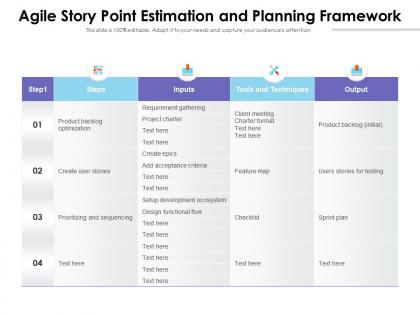
Agile story point estimation and planning framework




Try Before you Buy Download Free Sample Product
 Impress Your
 Audience
 100%
100% Editable
 Save Hours
 of Time


Our Agile Story Point Estimation And Planning Framework are topically designed to provide an attractive backdrop to any subject. Use them to look like a presentation pro.
People who downloaded this PowerPoint presentation also viewed the following :
Agile story point estimation and planning framework with all 2 slides:
Use our Agile Story Point Estimation And Planning Framework to effectively help you save your valuable time. They are readymade to fit into any presentation structure.
FAQs for Agile story point estimation
So story points are basically about comparing complexity between tasks - like "this feature is way harder than that simple login thing." Time estimates? They're a nightmare because it depends on who's coding, what fires pop up, plus we all suck at guessing how long stuff actually takes. Story points work better since your whole team can agree without getting lost in endless "what if this breaks" conversations. Honestly, if you're just starting out, go with story points. They're way more forgiving and you'll develop better habits. Time estimates will just make you hate planning meetings even more.
Honestly, just pick one story point scale and make everyone use it - Fibonacci numbers work well. Build up a database of "reference stories" so teams can compare their work against the same examples. Sounds super tedious, I know, but write down your estimation rules somewhere accessible. Regular calibration meetings help a ton too, where different teams estimate identical stories together. That way you catch when people start getting weird with their numbers. Oh, and rotate your best estimators between projects - they'll spot when teams drift off course and keep things consistent across the board.
Velocity is just tracking how much your team actually gets done each sprint - super helpful for planning ahead. I take the story points we finished over the last 5 sprints and average them out. Like if we did 25, 30, 22, 28, and 25 points, that's 26 per sprint. Pretty straightforward math. Then you've got your baseline for future sprints. Don't go promising stakeholders 40 points when you're consistently hitting 26 - that's just setting everyone up for disappointment. It's honestly one of the most practical metrics in agile once you start using it regularly.
Dude, just start tracking what your team actually gets done each sprint - it's way better than pulling numbers out of thin air. Check how long similar stories took before instead of wild guessing every time. Most teams are terrible at this tbh, they never look back at their old burn-downs or story points. Keep a basic log comparing your estimates to real time spent. Then whip it out during planning poker. Your past velocity shows you what's realistic, not what sounds good in theory. Trust me, this stuff works once you actually do it consistently.
Honestly, I'd give it a shot. The best part is everyone has to explain their reasoning, so you catch weird assumptions early and get way better estimates. Plus nobody just copies the first number someone throws out. Downside is it's slow as hell with big teams. People love to argue about edge cases that'll probably never happen. And yeah, the online tools are kinda janky. But the gamification thing actually works - makes boring estimation meetings less painful. Try it for like 2-3 sprints and see if your estimates get better. If not, ditch it.
Honestly, cross-functional teams are a game changer for estimates. You're getting input from devs, testers, designers - basically everyone who'll actually touch the work. Way better than having one person just wing it, you know? The whole team owns the estimate together, so they're more likely to actually hit it. During planning poker (or whatever you use), make sure the quiet people speak up too - I've seen some brilliant insights come from unexpected places. Oh, and try rotating who runs the session. Some folks just need that extra push to share what they're thinking.
Honestly, when stuff gets murky I just use story point ranges instead of trying to nail down exact numbers. T-shirt sizing is clutch for the really fuzzy stuff - takes all that weird pressure off. Break complex stories into smaller pieces too, way easier to estimate. Three-point estimation helps when you need more accuracy (optimistic/pessimistic/likely scenarios). Sometimes I throw uncertainty buffers into sprints. The whole thing is being upfront about what you don't actually know yet. Your estimates will get better as you learn more anyway - that's just how it works. Start broad, then tighten up as things become clearer.
Definitely map out those external dependencies first and document everything. Estimate them separately though - don't just tack extra buffer time onto your story points because that'll wreck your velocity tracking. Create actual dependency tasks in your backlog so they're visible on the board. I've watched too many teams get completely blindsided by this stuff when they just hope for the best. Stay in touch with those external teams about their timelines and have backup plans ready. Oh, and make sure everyone on your team knows exactly what you're waiting for and when it should arrive. Transparency saves you from nasty surprises later.
So relative estimation is basically comparing stories to each other instead of trying to nail down exact hours. Like "this one's twice as hard as that simple bug fix we did last week." Way better than absolute estimation where you're guessing actual time - we suck at that, let's be honest. With relative estimation you use story points or t-shirt sizes, focusing on complexity rather than hours. It works because your team already has this shared sense of what's easy vs. what's a nightmare. Just pick one story everyone remembers well and use that as your baseline for everything else. Much more realistic approach.
Planning Poker gets everyone involved instead of one person just assigning story points. The cool part is when estimates are wildly different - like Sarah says 2 but Mike says 8. That's when good conversations happen about complexity and different approaches. The game aspect makes sprint planning way less painful too (honestly, traditional estimation is pretty mind-numbing). T-shirt sizing works great as well. Your team will actually stay awake during refinement sessions, which is kind of a miracle. Those discussions where people explain their thinking? That's where you'll catch risks and implementation details you'd totally miss otherwise.
Oh man, don't let your team treat estimates like promises - they're just educated guesses for planning purposes. People love making this way too complicated (sat through a 4-hour planning poker session once, never again). Break down huge tasks first before estimating them. Also watch out for that one loud person who always dominates these conversations - you need everyone's input, not just theirs. Honestly, the whole thing works better when you keep it simple. Just aim for a reasonable sense of effort and move on.
Dude, get your stakeholders in those estimation sessions - they know stuff your dev team just doesn't. Like what the business actually needs and what "done" means to them (spoiler: it's usually different than what you think). They'll catch missing pieces early and help clarify those weird requirements that always mess up sprint planning. Honestly, it's a game changer for avoiding scope creep mid-sprint. Don't just invite them to kickoffs - get them in planning poker too. The immediate feedback is worth dealing with longer meetings, trust me.
Okay so your initial story points are basically educated guesses at best. During sprint planning, you'll break stories into actual tasks and suddenly discover all this hidden complexity - dependencies, technical debt, weird edge cases nobody thought of. Different people on your team will catch stuff you totally missed. That's honestly the best part of the whole process. Just don't let these conversations drag on forever or you'll be there all day analyzing every little detail. I'd say cap it at like 10-15 minutes per story max.
Honestly, start estimating your backlog items with story points or t-shirt sizes - it's a game changer. You'll finally see which tasks are actually quick wins versus total time sinks. Planning poker works great for this (though my team always argues about whether something's a medium or large, but whatever). The estimates help you have real conversations with stakeholders about what's doable. Instead of guessing, you can sequence work based on effort versus value. Try estimating your top 20 items this week - bet you'll be surprised which ones should actually get priority.
Oh nice timing - just wrapped up estimation with my team yesterday! PlanITPoke and Scrum Poker Online work really well for remote sessions. Your team can all vote at once without the awkward revealing-cards-one-by-one thing. If you're already in Jira, their story point feature is solid enough. Miro's surprisingly good for this too, or even a shared Google Doc if you want to keep it simple. Azure DevOps has estimation stuff built in (though the UI's kinda clunky imo). Don't overthink it though - whatever meshes with your current tools is probably your best bet. Adding yet another platform just creates more friction.
-
Innovative and Colorful designs.
-
Excellent products for quick understanding.