


Five events in agile scrum framework




Try Before you Buy Download Free Sample Product
 Impress Your
 Audience
 100%
100% Editable
 Save Hours
 of Time


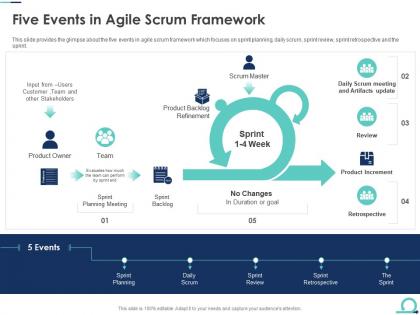
This slide provides the glimpse about the five events in agile scrum framework which focuses on sprint planning, daily scrum, sprint review, sprint retrospective and the sprint.
People who downloaded this PowerPoint presentation also viewed the following :
Five events in agile scrum framework with all 2 slides:
Use our Five Events In Agile Scrum Framework to effectively help you save your valuable time. They are readymade to fit into any presentation structure.
FAQs for Five events in
So Sprint Planning is basically where you figure out what you're gonna tackle in the next 2-4 weeks and how you'll actually pull it off. Your team picks stuff from the product backlog based on what's most important and what you can realistically handle. Break everything down into actual tasks so nobody's confused later. Honestly, half the battle is just getting everyone on the same page about the sprint goal - I've seen too many teams skip this part and then wonder why everything feels scattered. Walk away with a sprint backlog that your team genuinely thinks they can finish, not some wishful thinking nonsense.
Daily Scrums work because everyone has to actually talk about what they're stuck on. When someone mentions a blocker, another team member can jump in with a solution before it becomes this huge mess. Honestly, the best ones I've been in focus less on "here's my status update" and more on "what do I actually need help with today?" That accountability just happens naturally when you're sharing progress with your team every morning. It's basically a quick huddle that keeps everyone on the same page without turning into one of those endless meetings that could've been an email.
Hey! So for Sprint Reviews, I'd track your completed vs planned story points and get stakeholder satisfaction scores after demos. Also super useful - note which user stories got the most pushback since that usually means fuzzy requirements from the start. Oh and definitely track demo fails (we've all had those "worked on my machine" disasters lol). Quality-wise, just count how many features actually worked as shown. Honestly, throw it all in a basic spreadsheet. You'll start seeing patterns after a few sprints and can tweak your planning from there.
Look, psychological safety is huge - if people don't feel safe speaking up, you'll just get generic feedback that doesn't help anyone. I always use structured formats like Start/Stop/Continue because otherwise these things turn into total complaint-fests. Seriously, I've sat through way too many of those. Focus on getting actual action items, not wishy-washy stuff like "let's communicate more." The real game-changer? Follow up on what people said in the next retro. When your team sees their input actually leads to changes, they'll keep giving you the real insights instead of just going through the motions.
Oh man, sprint planning can be brutal! Your biggest headaches will be setting crazy unrealistic goals, dealing with super vague user stories, and completely misjudging what your team can actually handle. Before you even start planning, make sure your backlog items aren't garbage. Look at your actual velocity from past sprints - not what you wish it was, but what it really is. Push your product owner to nail down acceptance criteria upfront. Don't feel bad about pushing back on fuzzy stories either. And honestly? Get everyone involved in estimating since they're doing the heavy lifting anyway.
Daily scrums are actually pretty useful if you don't just treat them like boring check-ins. When someone mentions a blocker, jump on it right away - connect people who can help each other or get management involved to clear the path. If a teammate's drowning in their tasks, pair them up or move work around before your whole sprint falls apart. I've seen too many teams just nod and move on when someone's clearly struggling. Pay attention to patterns too. Same blockers popping up repeatedly? Your process probably needs work. Those daily commitments also help you catch scope creep early.
Sprint Reviews are your best shot at getting real feedback from stakeholders. Demo what you've built and let them actually play with it - don't just talk at them. Their reactions tell you everything, honestly. Walk through completed user stories, but also ask specific questions instead of the generic "thoughts?" Get them to share what's working, what isn't, and what should be prioritized next sprint. Oh, and capture their input while it's fresh. Sometimes they'll completely surprise you with insights you hadn't considered. The key is making it interactive rather than just a presentation.
So the Product Owner is basically the customer's voice in everything. Sprint Planning is where they really shine - presenting backlog items and setting priorities. Sprint Review too, since they're deciding if work gets accepted or not. Daily standups? They mostly just listen unless someone has questions. Honestly, half the POs I know skip dailies anyway and that's totally fine. Retrospectives are different though - they jump in as a regular team member giving process feedback. Oh, and make sure yours actually sticks around to answer questions and make priority calls when your team gets stuck. That's like half their job.
Honestly, grab your top 2-3 issues from the retro and turn them into real tasks for Sprint Planning. Don't let them just float around as "discussion points" – I've watched way too many good ideas die that way. Communication problems? Add a 5-minute daily sync to your backlog. Whatever it is, make it specific and assign ownership. Oh, and actually track this stuff during standups like it's real work. Because it is real work, even though it doesn't feel as exciting as shipping features. The whole point is treating improvements like they deserve actual sprint time.
Honestly, just stick to those three basic questions - yesterday, today, blockers. That's it. Set a timer for 15 minutes and don't let it run over (I know it sounds obvious but people forget). Standing up helps too if you're meeting in person. The second someone dives into technical weeds, cut them off nicely and say "let's chat after." You're coordinating work, not giving status updates to your boss. Oh, and make sure everything ties back to your sprint goal somehow. People love to ramble about random stuff that doesn't matter to anyone else.
Honestly, the regular cadence is what makes Scrum work. Sprint planning, dailies, reviews, retros - it sounds boring but it stops people from disappearing into their own little worlds for weeks. Those time boxes are a lifesaver too. No more meetings that drag on forever! Daily standups make everyone accountable since you can't just hide. Retros let people actually speak up about problems without drama. The trick is being religious about the schedule even when you don't feel like it. That consistency builds momentum over time.
Sprint Planning needs your refined backlog and Definition of Done. Daily standups? Just show up ready to talk about what you did. For Sprint Review, bring your completed work and demo stuff - maybe feedback forms if your team's into that. Retrospectives are weird because sometimes fancy velocity charts help, but honestly the messiest retros with just sticky notes can be the most useful. Oh, and make sure your PO updates acceptance criteria before reviews. Don't overthink the documentation though - too much paperwork just slows everyone down.
Honestly, just get the basics right first - solid video setup with Zoom or Teams, cameras on so it doesn't feel like you're talking to robots. Daily standups are actually easier remote sometimes since people can't go off on tangents as much! Sprint planning gets tricky though, so grab something like Miro where everyone can move sticky notes around at the same time. Ground rules are huge - who mutes when, how long meetings really last, that stuff. Oh and definitely ask your team what's bugging them about your current setup before the next sprint starts.
Oh dude, definitely try the "demo marketplace" thing - basically set up different stations so people can bounce around features however they want. We've also done these "failure parties" where everyone just talks about what bombed (sounds weird but it's actually pretty great). Instead of showing random features, walk through an actual customer's journey from start to finish. Way more engaging that way. If you're remote, breakout rooms work well for getting real feedback instead of just... crickets on the main call. Bottom line - make it interactive or people will zone out hard.
Yeah, Scrum's actually pretty adaptable. Small teams can cut dailies down to like 5-10 minutes and maybe combine some roles. Bigger groups? Split into multiple teams with that Scrum of Scrums thing. Sprint length depends on your project too - quick stuff can be 1-week sprints, complex projects need 3-4 weeks. Honestly, I've seen teams get way too obsessed with following every rule perfectly when they should just focus on the core principles. My advice? Start with basic Scrum then tweak whatever isn't clicking with your team. You'll figure out what works through trial and error anyway.
-
Unique research projects to present in meeting.
-
Top Quality presentations that are easily editable.
-
The Designed Graphic are very professional and classic.
-
Use of icon with content is very relateable, informative and appealing.
-
Great quality product.