


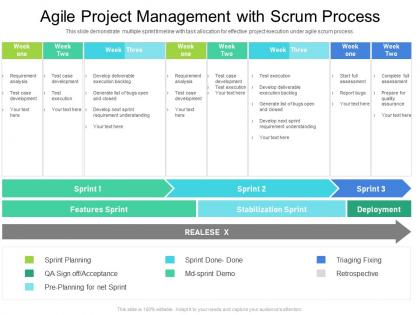
Agile project management with scrum process




Try Before you Buy Download Free Sample Product
 Impress Your
 Audience
 100%
100% Editable
 Save Hours
 of Time


Scrum is an Agile project management style that entails a small team managed by a Scrum master, whose primary responsibility is to remove any impediments to getting work done. Work is completed in short cycles known as sprints, and the team meets daily to review current work and any bottlenecks that need to be cleared. Scrum is a project management style that enables for quick creation and testing, particularly within a small team. SlideTeam’s agile technology PowerPoint templates can help you get up to speed on the scrum process quickly and easily. Our templates are designed to be easy to use, but still provide in-depth information about agile project management. So if you want to learn more about how scrum works or just need a template for your next presentation, download our templates now. And don’t forget to check out our other slide decks for more great content that will help you succeed in your business endeavors.
People who downloaded this PowerPoint presentation also viewed the following :
Agile project management with scrum process with all 2 slides:
Use our Agile Project Management With Scrum Process to effectively help you save your valuable time. They are readymade to fit into any presentation structure.
FAQs for Agile project management
So basically Agile is all about putting people before rigid processes and actually working software over tons of documentation. You'll be doing way more face-to-face conversations and daily check-ins with your team. Honestly, the "fail fast" thing sounds scary but it's actually less stressful - you're not stuck guessing what users want for months. Short sprints mean you can pivot quickly based on real feedback. Customer collaboration becomes huge too, not just following some contract from six months ago. Daily 15-minute stand-ups are a game changer if you want to see results fast.
So basically Scrum breaks work into these short 2-4 week chunks called sprints instead of planning everything upfront like waterfall does. You get actual working software after each sprint rather than waiting forever for the final thing. The cool part? You can pivot based on feedback - waterfall absolutely hates changes once requirements are set (and let's be real, nobody nails requirements perfectly the first try). Teams organize themselves more instead of having some PM breathing down their necks about every little task. Oh, and if you're dealing with stuff that keeps changing or you're not 100% sure what you want, definitely go the sprint route.
Okay so there are three main roles in Scrum. Your Product Owner decides what actually gets built - they handle the backlog and figure out priorities based on what's valuable for the business. Then there's the Scrum Master, who's more like a coach than a boss. They clear roadblocks and keep everyone following Scrum properly. The Development Team does the actual building - usually 3-9 people who are self-organizing and handle everything from design to testing. Honestly, the whole thing only works if these three groups communicate well together. Otherwise you'll just have chaos.
So basically, your Product Backlog becomes the one place where all your work lives - no more chaos from random feature requests flying around. Business value drives what gets prioritized, which honestly makes way more sense than just doing whatever sounds cool. Unlike those old waterfall docs we used to hate, this thing actually evolves when stuff changes (and it always does). Your Product Owner handles all the priority calls, so devs don't get yanked around by every stakeholder with an opinion. Just keep it clean and updated - you'll always know what's next without second-guessing yourself.
So retrospectives are basically when your team hits pause to figure out what's working and what's making everyone miserable. Focus on processes and team stuff, not the actual product. Here's the thing though - they can be amazing or completely pointless depending how you run them. People need to feel safe speaking up about real problems, otherwise you'll just get surface-level feedback. Oh, and don't create some massive to-do list. Pick 1-2 actual things to fix next sprint. Someone's gotta own each action item and you'll want to circle back on progress later.
So we use story points for estimating - Planning Poker is honestly pretty solid for this. Your team votes on complexity using those Fibonacci numbers (1, 2, 3, 5, 8). Don't stress too much, you'll figure it out as you go. Chat with your Product Owner about ranking stories by business value and what depends on what. High-value, low-effort stuff first if you can swing it. When you're planning sprints, just pull stories until you hit your team's usual velocity. Oh, and always leave some wiggle room - there's always some random thing that'll pop up halfway through and derail everything.
Honestly, the biggest pain points are people thinking Scrum Masters are just project managers with a new title (spoiler: they're definitely not) and teams fighting change tooth and nail. You'll probably see pushback on daily standups - people think they're useless - plus terrible estimation skills and panic over sprint review transparency. Here's what actually works: train everyone, not just the bosses. Make sure your Product Owner can make real decisions without waiting for approval chains. Give your Scrum Master space to coach instead of drowning in admin work. Oh, and brace yourself - this transformation thing takes months, sometimes longer than you'd expect.
So basically, a Scrum Master is like your team's bodyguard and problem-solver rolled into one. They'll jump on blockers, run your ceremonies, and keep random people from bugging you while you're trying to code. Here's the thing though - they're not your boss (super important distinction). Instead, they coach everyone on Scrum stuff and squash beef before it gets messy. Good ones will actually make your life easier by cutting meeting BS and keeping things on track. The crappy ones? They just become glorified calendar managers, which honestly makes me want to scream. Find someone who fights for you.
Oh yeah, Scrumban is perfect for this! Basically you keep the good Scrum stuff - standups, retros, all that. But swap out your sprint backlog for a Kanban board with the usual columns. Way more flexible since you can pull work whenever instead of waiting for the next sprint planning session. Honestly, some teams I know just abandoned sprint planning altogether - might be overkill but it works for them. The flow feels more natural than rigid sprints. Just add a Kanban board to what you're already doing and test it out!
Honestly, forget just tracking timelines. Customer satisfaction scores matter way more - are you actually fixing real problems or just cranking out random features? I'd look at business value per sprint too. Quality stuff like bugs and tech debt will bite you later if ignored. Your team's velocity and retro feedback show if people are burning out (which always tanks everything eventually). Stakeholder engagement is huge - plus how much requirements change mid-sprint drives me crazy but it's good to track. Pick maybe 2-3 metrics that actually fit your project and review them each sprint.
Honestly, track your velocity for a few sprints first - that'll show you what your team can actually handle. Don't overcommit in planning even when stakeholders are being pushy (which they always are, ugh). Break stories into smaller pieces and build in time for reviews, testing, all that stuff. Oh and those random "quick sync" meetings that somehow multiply like rabbits. Guard your sprint scope like your life depends on it. Mid-sprint changes are productivity killers. Also make sure people take breaks - burnout sneaks up fast.
Honestly, communication is where most remote Scrum teams totally bomb. Get everyone on video for standups, sprint planning, all of it - makes a huge difference. Time zones suck but find those 2-3 hours where people overlap. Some teams I know rotate meeting times so it's not always the same person staying up late, which is pretty fair. You can't just walk over and ask questions anymore, so overcommunicate everything. Sprint goals, what's blocking you, progress updates. Miro's great for backlog stuff too. Oh and maybe audit where your communication's breaking down first? That'll show you exactly what needs fixing.
Feedback in Scrum is honestly like having a GPS for your project - you're constantly recalibrating instead of driving blind for months. Daily standups catch the small stuff. Sprint reviews let stakeholders see what you've built and say "wait, that's not right" before you waste more time. Retrospectives help the team improve how they work together. The whole point is avoiding those brutal moments where you finish something and everyone's like "um, this isn't what we wanted at all." Just make sure you're actually doing something with the feedback you get - I've seen teams collect it religiously but then totally ignore it.
Honestly, you've got to stop thinking ceremonies = agile and start changing how things actually work. Let people experiment without waiting for approval from a million committees. When stuff fails, treat it like learning instead of pointing fingers - though that's way harder than it sounds. Build an environment where folks will actually speak up about problems early instead of hiding them until it's too late. Get customer feedback fast. Oh, and stop making people escalate every tiny decision up the chain. Pick one annoying process that's slowing everyone down and just try fixing it first.
Sprint reviews every 2-3 weeks are honestly a lifesaver - show them actual working features, not just status updates. Define what "done" means upfront so there's no confusion later. Your product backlog should be their visual guide to what's coming next. Watch out for scope creep though... stakeholders will definitely try to sneak in "quick additions" mid-sprint if you let them. Make sure your Product Owner handles their requests and keeps priorities straight. Oh, and over-communicate everything. Seriously, they'd rather know too much than be left wondering what's happening with their project.
-
Best way of representation of the topic.
-
Topic best represented with attractive design.
-
Awesome use of colors and designs in product templates.
-
Easily Understandable slides.
-
Awesome use of colors and designs in product templates.
-
Great quality slides in rapid time.