


Framework for agile iteration with sprint planning and management




Try Before you Buy Download Free Sample Product
 Impress Your
 Audience
 100%
100% Editable
 Save Hours
 of Time


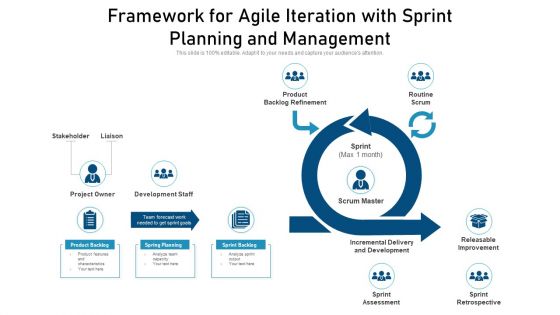
Iteration Planning is a meeting in which all team members decide how much of the Team Backlog they can commit to delivering during the next Iteration. The effort is summarised by the team as a set of committed Iteration Goals. Teams plan by choosing Stories from the Team backlog and committing to completing a set of them in the next Iteration. During Program Increment (PI) Planning, the team's backlog was seeded and partially scheduled. Furthermore, the teams get feedback—not only from previous versions, but also from the System Demo and other teams with whom they are collaborating. In order to help you get started with your own agile iteration framework, we’ve provided a PowerPoint template that covers the basics of sprint planning and management. This template can be used as a starting point for your own organization or team, or it can simply serve as a guide to help you better understand how the agile process works. We’ve also included some helpful resources below that will give you more information about each stage of the agile process. So download our agile technology ppt templates now and start planning your next successful project.
People who downloaded this PowerPoint presentation also viewed the following :
Framework for agile iteration with sprint planning and management with all 2 slides:
Use our Framework For Agile Iteration With Sprint Planning And Management to effectively help you save your valuable time. They are readymade to fit into any presentation structure.
FAQs for Framework for agile iteration with sprint
So you've got four main ceremonies: Sprint Planning to decide what you're building, Daily Standups for quick check-ins, Sprint Review to demo your work, and Retrospectives for figuring out what went wrong (or right). Most teams do 2-week sprints - honestly anything longer and you lose momentum. Oh, and you'll need a Product Backlog for all your ideas and a Sprint Backlog for current work. The standups are supposed to be 15 minutes but let's be real, they always run over. Start simple with these basics then tweak whatever doesn't feel right for your team.
So user stories are what you'll be working on each sprint - they're just features written from the user's point of view. Your team grabs them from the backlog during planning and estimates how much work they'll take. Can't finish a story in one sprint? It's way too big and needs to be split up, trust me on that one. You commit to whatever fits your team's capacity. Each story needs clear acceptance criteria so you actually know when you're done. Then you work through them, demo what you built, and get feedback. Pretty straightforward once you get the hang of it.
Okay so first thing - get your backlog cleaned up before the meeting or you'll waste half the time arguing about requirements. Story points work great for estimating, though some teams like t-shirt sizing better. Get everyone involved since they know the work best. Break stories down into actual tasks and think about capacity - like if someone's on vacation that week. Dependencies always bite you if you ignore them. Oh and timebox it! Otherwise these meetings drag on forever. Biggest thing though? Make sure everyone knows what "done" means for each story before you commit.
So honestly, sprint success comes down to a few things. Did you hit your sprint goal? That's the big one. Velocity matters too - how many story points did you knock out compared to last sprint? Burndown charts are okay but they're kinda overrated if you ask me. Your retrospective feedback tells you a lot about what's actually working. The sprint review is huge - what did stakeholders think? But really, the main thing is whether you shipped working software that users actually care about. Oh, and define "done" upfront or you'll argue about it later.
So the Scrum Master is like your team's coach, not your boss. They run standups, sprint planning, all that stuff - but their main job is clearing roadblocks so you can actually get work done. Mine literally saved our last sprint when stakeholders kept interrupting us with "quick questions" every five minutes. They also help when sprint ceremonies turn into total chaos (which, let's be real, happens way too often). Think facilitator who keeps everyone focused and deals with team drama. Good ones are gold. Bad ones... well, you'll know pretty quickly when nothing runs smoothly.
Honestly, start with standups that don't suck - skip the robotic "yesterday I did X" thing and actually talk about who's blocked. Pair programming helps tons when someone's stuck on something tricky. Sprint goals need to be super clear too, like embarrassingly obvious to everyone. If you're remote, block out real collaboration time. Don't just hope it happens. The best teams I've seen are the ones where people actually jump in to help instead of staying in their own bubbles. Next standup, literally ask "who needs help?" and see what happens. It's awkward at first but works.
Break down your user stories into smaller, actionable tasks first - makes everything way less overwhelming. Daily standups are clutch for catching blockers before they wreck your sprint. Also keep your burn-down charts updated so everyone can actually see what's happening (I swear half the team chaos comes from people not knowing the real status). The visual stuff honestly makes a huge difference for alignment. Oh, and don't try to implement all three at once - pick one and get it solid first. That's what actually worked for my team anyway.
So basically, Sprint keeps scope changes from turning into chaos by locking things down during each sprint. You literally can't add new stuff mid-sprint - which honestly is a lifesaver. But here's the thing: between sprints, you get these natural checkpoints where the Product Owner can totally flip priorities, add stories, whatever. Never more than 2-4 weeks before you can pivot. Those sprint reviews are clutch for talking through changes with stakeholders. Oh, and retrospectives too - don't sleep on those. It's way better than the old days of random scope creep destroying timelines.
Honestly, time-boxing is a game changer. Creates this sense of urgency where your team can't just tinker with stuff forever - there's actually a deadline. Stakeholders get predictable timelines, which keeps them happy. The rhythm prevents scope creep too (thank god). What I really like is the feedback loops. You catch problems in weeks, not months down the road when everything's already broken. Planning becomes way easier since you're working in these consistent chunks. Start with 2-week sprints - most teams I know swear by that length. Short enough to stay focused but not so short you're constantly planning.
Honestly, I'd stick to the classic three buckets: what worked, what sucked, and what you'll actually do differently. Have people jot down thoughts solo first - otherwise the loud ones dominate and you miss good insights. When you discuss as a group, set a timer because these things can turn into endless complaint sessions (learned that the hard way). The real win is getting specific action items instead of just "communicate better" or whatever vague stuff. Someone needs to own each item, and you've got to check in next time. Otherwise you're stuck in this loop where nothing changes and everyone gets cynical about retros.
Jira's probably your best bet - most teams use it and honestly it just works. Handles sprint planning, burndown charts, all that stuff. Azure DevOps and Trello are solid too. For daily standups you'll want Slack or Teams, obviously. Miro's great for retros and planning sessions (way better than trying to do it over Zoom with no visuals). Some teams really like Linear or Monday.com - they're simpler. My advice? Start with whatever your team already knows. Don't overcomplicate it right away. You can always switch to something fancier once you get your rhythm down.
Your "done" definition is basically a quality checkpoint - it decides what ships vs what gets stuck in development hell. Too vague and you'll ship buggy stuff that haunts you later. Make it too strict though, and your team can't finish anything in a sprint. Honestly, the secret sauce is getting everyone on the same page upfront about what counts as done - code reviews, testing, docs, whatever makes sense for your setup. Otherwise sprint review becomes this awkward "is this actually ready to demo?" conversation that nobody wants to have.
Honestly, scope creep will kill you every time. Someone always wants to squeeze in "just one tiny thing" and boom - your whole sprint's a mess. Break down tasks way smaller than you think you need to, trust me on this. Standups turn into these painful status updates where nobody actually helps each other. Such a waste of time. Your retros probably suck too if you're just venting without deciding what to actually fix next time. Oh, and stop letting work spill over into the next sprint - it becomes this never-ending cycle. Protect your sprint boundaries like your life depends on it.
Honestly, time zones will drive you crazy at first - that's the hardest part. Try finding those sweet spot hours where most people can jump on calls, even if someone has to get up early sometimes. Get solid video tools where everyone can actually see your sprint board clearly. Documentation becomes way more critical since you can't just tap someone on the shoulder anymore. Keep your Jira or whatever tool updated constantly. I'd start with shorter sprints while you're figuring out the flow. Your dailies and retros need extra structure too. Oh, and make sure people actually turn their cameras on - it makes such a difference for team connection.
Honestly, just focus on velocity and sprint burndown first - those'll tell you if you're on track. Story points completed is obvious but still worth watching. Mid-sprint, burndown charts are clutch for catching problems early. I'd also track your sprint goal hit rate because scope creep is brutal (learned that the hard way). Team mood matters too - sounds touchy-feely but unhappy teams tank performance fast. Oh, and actually follow up on retro action items instead of just writing them down. Don't go crazy with metrics though. Pick like 2-3 max or you'll spend more time analyzing data than actually getting work done.
-
Appreciate the research and its presentable format.
-
Out of the box and creative design.
-
Unique research projects to present in meeting.
-
Really like the color and design of the presentation.
-
Innovative and attractive designs.
-
Innovative and attractive designs.
-
Excellent template with unique design.
-
The Designed Graphic are very professional and classic.
-
Really like the color and design of the presentation.