


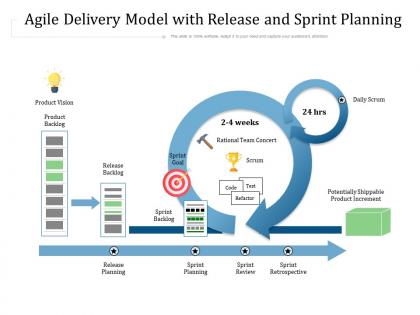
Agile delivery model with release and sprint planning





Try Before you Buy Download Free Sample Product
 Impress Your
 Audience
 100%
100% Editable
 Save Hours
 of Time


Our Agile Delivery Model With Release And Sprint Planning are topically designed to provide an attractive backdrop to any subject. Use them to look like a presentation pro.
People who downloaded this PowerPoint presentation also viewed the following :
Agile delivery model with release and sprint planning with all 2 slides:
Use our Agile Delivery Model With Release And Sprint Planning to effectively help you save your valuable time. They are readymade to fit into any presentation structure.
FAQs for Agile delivery model with release
So basically, Agile is all about people over processes and being flexible instead of stuck on some rigid plan. Deliver working stuff quickly in short sprints, then get feedback and adjust. Your team should be self-organizing - honestly, micromanagement kills productivity anyway. Focus on collaborating with customers rather than fighting over contract details. Ship fast, learn what users actually want, and pivot when things aren't working. Oh, and don't skip the feedback loops - that's where the magic happens. Start small and build from there. Way better than spending months planning something nobody ends up wanting.
So basically, Agile chops your project into bite-sized pieces - you're shipping something every few weeks instead of waiting months to see anything. Traditional methods? You plan everything up front and pray it works out (spoiler: it usually doesn't). The cool part is you can pivot when you get feedback. Stakeholders actually see stuff happening and can tell you if you're heading in the wrong direction early on. Way better than finding out you built the wrong thing after six months. Honestly, just pick one project and try delivering small chunks. You'll get why everyone's obsessed with it.
You'll need three main roles: Product Owner, Scrum Master, and your dev team. The Product Owner decides what gets built and ranks priorities. Your Scrum Master handles blockers and runs meetings (though the really good ones make it look effortless). Dev team's usually 3-9 people who build everything and figure out how to organize themselves. Daily standups, sprint planning, and retros keep everyone connected. Honestly, it only works when people actually trust each other to handle their stuff. Oh, and make sure everyone gets what the other roles do day-to-day - saves so much drama later.
Honestly, don't try to flip the whole company at once - I've seen that blow up spectacularly. Pick one team first and actually invest in teaching them the mindset stuff, not just the daily standups and sprint planning. Your leadership has to be on board too because if they're still micromanaging, it won't work. Oh, and you'll probably need to rethink how you measure success since traditional metrics clash with Agile. Give that pilot team real coaching support, then when they start crushing it, use that momentum to spread it around. Much less painful that way.
You need to get them involved in sprint reviews and demos - way better than those status emails nobody actually reads. Be super upfront about what's doable and what isn't. When they ask for new stuff (which they will), show them exactly how it'll mess with timelines. I'd start scheduling those reviews ASAP. Document everything and flag problems before they blow up on you. Oh, and create a clear process for when they can give feedback - otherwise you'll get random requests at terrible times. Honestly, half the battle is just keeping everyone on the same page.
Track velocity and sprint burndowns, but honestly customer satisfaction matters way more than hitting arbitrary deadlines. Are people actually using what you build? Team morale is huge too - burnout kills productivity faster than anything. I'd grab maybe 3-4 metrics that actually make sense for your situation. Don't overthink it though. Monthly check-ins work fine, and pay attention to what your retrospectives are telling you. Sometimes the soft stuff like team feedback reveals problems before the numbers do.
So for Agile tools, I'd definitely go with Jira or Azure DevOps for tracking your sprints and stuff. Communication-wise, Slack or Teams are pretty much essential. Git's obviously a must for version control. Jenkins or GitHub Actions are solid for CI/CD - basically anything that automates your deployments so you're not doing manual releases like it's 2015. Confluence works well for docs, though honestly Notion's been growing on me lately. Miro's surprisingly good for remote retros too. My advice? Don't overthink it. Pick tools your team will actually use consistently - that's literally half the battle. Start with whatever fixes your biggest headaches first.
Honestly, you'll need way better digital tools and have to be super intentional about talking to people. Miro's great for sprint planning - we use it all the time. Keep standups short but consistent across time zones, and document literally everything since you can't just walk over to someone's desk anymore. Slack becomes your new office chat for quick questions. Over-communicate at first. Add more context to user stories, record decisions, do async updates when meetings won't work. Map out everyone's hours first and schedule ceremonies around overlap times. Trust me, it's a lot but you'll figure it out.
Honestly, you're gonna face three main headaches: people hating change, nobody knowing their actual job, and projects spiraling out of control. Teams get weird about ditching waterfall for collaboration stuff. Start with training - like, real training, not just a lunch-and-learn. Your Product Owner needs to actually show up and make fast decisions (good luck with that one). Don't go full agile overnight though. Introduce things slowly so people don't freak out. Oh, and retrospectives will save your sanity - use them to catch problems early and pivot quickly.
Dude, incremental delivery is seriously a lifesaver. You get feedback super early instead of waiting months to find out you built the wrong thing entirely. Each piece gives stakeholders something real to actually touch and react to. Way better than those awkward "big reveal" meetings where everyone's like... this isn't what we meant. You can pivot fast when priorities change (which, let's be honest, happens constantly). Just make sure each chunk actually adds value - don't just ship random features to hit deadlines. Start small, see what sticks, then build from there.
Honestly, user stories are game-changers because they force you to think like your actual users instead of getting lost in tech details. Breaking big features into smaller pieces makes everything way easier to estimate and prioritize. The whole "As a... I want... So that..." thing might feel weird at first, but it really works. What I've noticed is they get your whole team talking - like someone will ask "but why would anyone actually need this?" and suddenly you're catching assumptions nobody realized they had. Plus everyone can understand them, not just the devs. You'll end up building stuff people will actually use instead of cool features that sit there collecting digital dust.
Honestly, the biggest game-changer is showing customers working stuff every couple weeks instead of making them wait forever. Sprint reviews and quick demos let you catch problems early - way better than finding out you built the wrong thing after months of work. Customers actually feel involved too, which is huge. That whole "fail fast" approach? It's not just buzzspeak, it actually works. Even when features feel half-baked, get them in front of people. Trust me, that rough feedback beats discovering major issues later when it's expensive to fix.
So CI/CD is what actually makes Agile work in real life. Without it, you're stuck doing manual deployments every time you want to push code - and trust me, that gets old fast when you're releasing stuff weekly or daily. The automation handles all your testing and deployment headaches, so you can actually focus on coding instead of worrying about breaking production. Plus automated tests catch the stupid bugs before users see them. Honestly, I'd start with just basic automated tests and slowly build out your pipeline from there. Don't try to do everything at once or you'll hate yourself.
So there's a few ways to handle this - SAFe, LeSS, and Spotify's model are the main ones. They basically help coordinate multiple Scrum teams without losing the Agile vibe. SAFe's super popular but honestly kind of bloated if you ask me. You'll want "Scrum of Scrums" meetings and shared backlogs for bigger features. The trick is keeping teams talking to each other about dependencies. My advice? Don't go crazy at first. Try one framework with just a couple teams, see what actually works for your company's weirdness, then expand from there. Every place is different.
Honestly, Agile is a total game-changer for team dynamics. Daily standups keep everyone on the same page - no more wondering what Sarah's working on or if Mike hit that roadblock. Those sprint retrospectives actually help you fix annoying team problems instead of just venting about them forever. People start helping each other out more since everyone owns the sprint goals together. Problems come up fast instead of festering into disasters later. Oh, and the cross-training that happens naturally? Super helpful when someone's out sick. If you're just starting, try daily standups first - you'll see the transparency boost immediately.
No Reviews