


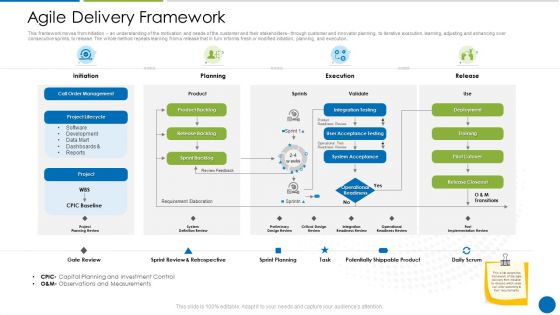
Agile delivery framework disciplined agile delivery




Try Before you Buy Download Free Sample Product
 Impress Your
 Audience
 100%
100% Editable
 Save Hours
 of Time


Our Agile Delivery Framework Disciplined Agile Delivery are topically designed to provide an attractive backdrop to any subject. Use them to look like a presentation pro.
People who downloaded this PowerPoint presentation also viewed the following :
Agile delivery framework disciplined agile delivery with all 2 slides:
Use our Agile Delivery Framework Disciplined Agile Delivery to effectively help you save your valuable time. They are readymade to fit into any presentation structure.
FAQs for Agile delivery framework
Basically, Agile says people matter more than processes, and working code beats endless documentation. You collaborate with customers instead of hiding behind contracts. Change happens - deal with it rather than sticking to some rigid plan you made months ago. Waterfall is like following a recipe exactly, but Agile? You're tasting as you cook and adjusting. Makes way more sense honestly, since you can't predict everything upfront anyway. Just find the smallest thing you can actually ship that adds value, then keep building from there. Way less stressful than the old school approach.
Pick one framework and stick with it - seriously, don't try mixing Scrum and Kanban from day one. Most agile "failures" I've seen? People skip the boring fundamentals. Get your team trained properly first. You'll want consistent standups and retros, plus a product owner who can actually make real decisions (good luck with that one lol). Start small with just one team. Let them get comfortable before you scale up. Leadership will probably try to rush you into rolling it out everywhere, but don't cave. Prove it works first, then expand.
So you've got three main people doing different stuff. Product Owner figures out what to build and ranks everything by importance. Development Team actually codes it all - they're supposed to know multiple areas, which honestly works better than you'd think. Scrum Master runs meetings and deals with whatever's blocking progress. They talk constantly through daily check-ins and planning sessions. Nobody reports to some boss breathing down their necks - they hold each other accountable instead. Just make sure everyone knows their actual role first. When people overlap too much it gets messy quick.
Honestly, Agile's whole thing is those short sprints - like 1-2 weeks max. You're not stuck planning everything months ahead (which is basically impossible anyway). Daily check-ins help catch problems early. Your backlog stays flexible so when stakeholders inevitably change their minds, you just reshuffle what's most important without everything falling apart. Getting feedback constantly means you can pivot fast. I'd start simple though - try switching from monthly planning to every two weeks. That alone makes a huge difference in how quickly you can actually respond to changes.
Track your velocity and cycle time for sure - those show delivery health. Sprint burndowns help too. But don't forget team satisfaction and customer feedback for the bigger picture stuff. Lead time from idea to delivery? That's honestly the one that matters most for real responsiveness. Here's the thing though - it's super easy to get lost in all these numbers (been there, done that). Watch trends instead of getting hung up on exact figures. Use retros to actually understand what's happening. If velocity drops or cycle time goes up, just ask your team what's going on first.
Here's what works - executives only care about ROI and business results, so skip the process stuff with them. Middle managers get weird about Agile because they think it'll make them irrelevant (honestly, some of them aren't wrong). Get them involved in planning the change and show how their jobs shift, not disappear. Teams are easier - just run a small pilot project first. Once they see it actually works, they'll buy in. Oh, and definitely start with whoever's already interested. Success spreads naturally from there. Don't try the same pitch on everyone - totally different concerns.
Honestly, just start with Jira for tracking your sprints and backlog stuff. Confluence is solid for docs too. You'll need Slack or Teams - seriously, like 90% of Agile is just people actually talking to each other lol. GitHub's great for code collaboration, has CI/CD built right in. If your team's remote, Miro's clutch for retrospectives and planning. But here's the thing - don't go crazy picking tools. Start with maybe two that people will actually use instead of complaining about. You can always add more later when you figure out what's missing.
Look, you can't build the right thing without talking to people constantly. Stakeholders give you the feedback that keeps you from going down rabbit holes for months. Sprint reviews help you pivot fast when you're heading in the wrong direction. Regular backlog sessions clarify what actually matters vs what they think sounds cool. When stakeholders feel heard, they'll fight for your project when budgets get tight - trust me on that one. Keep it simple though: short meetings, show working demos instead of PowerPoints, and ask direct questions. Nobody has time for hour-long status updates anyway.
Honestly, async communication becomes your best friend - stuff like Slack threads and shared boards where people can catch up anytime. Find those 2-3 hours where everyone's awake and protect them fiercely for actual meetings. Daily standups are clutch, though you might have to alternate times so it's not always 6am for someone (learned that the hard way). The upside? You're forced to document everything properly since you can't just tap someone on the shoulder. Kick off each sprint with a longer sync to make sure you're all building the same thing. Clear acceptance criteria isn't optional anymore - it's survival.
So Agile breaks everything into short sprints where you can quickly shift resources around based on what's actually happening. Daily standups keep everyone on the same page about priorities. Your product owner manages the backlog so you're always tackling the most important stuff first. Honestly, it feels pretty messy when you're coming from traditional planning - I remember thinking "where's the structure?!" But that flexibility is exactly why it works when business needs change overnight. Short sprints help you get used to the whole rhythm without drowning.
Dude, scope creep will absolutely destroy you - and unclear requirements right behind it. Getting everyone aligned from the start is seriously half the battle. Set those sprint goals super clearly and drag stakeholders into regular reviews, even if they whine about it. Also invest in team training upfront because resistance is real. Communication breakdowns? Project killers. Daily standups and retros aren't optional - they're survival tools. Oh and definitely start with pilot projects first. Build some wins before you try rolling this out everywhere, trust me on that one.
Honestly, retros are where the magic happens - but only if you actually follow through on the action items. I've seen too many teams just complain for an hour then do nothing about it. Pick one thing to fix each sprint, not everything at once. Your people need to feel safe calling out problems without getting thrown under the bus. Maybe dedicate some sprint time to experimenting with new stuff? The whole point is creating that rhythm where improvement just becomes part of what you do. Start small though - big changes usually backfire.
Honestly, agile makes such a difference for quality and keeping customers happy. You're getting feedback way earlier instead of building something for months just to find out it's totally wrong. Bugs get caught faster too since you're testing constantly - beats dealing with a nightmare backlog later! Customers actually feel heard because they see progress every few sprints and can steer things. The trick is genuinely listening to their feedback though, not just doing demo theater. It's kinda wild how much better products turn out when you're course-correcting along the way.
Yeah, totally! Agile works great outside tech - just ditch the jargon and focus on the basics. Break stuff into chunks, get feedback fast, then pivot when needed. I've watched marketing teams run campaigns this way, even construction does it for planning phases. The magic happens when you stop being precious about "the plan" and actually listen to what's working. Figure out what your version of "working software" looks like first - could be rough drafts, prototypes, whatever. Then build quick feedback loops around that. Honestly, it beats the old "plan everything perfectly then pray" approach by miles.
Make them feel safe first - no finger pointing, just solution hunting. I usually cap these at 90 minutes tops or people zone out. Having different folks facilitate keeps it from getting stale. Try "Start/Stop/Continue" or "What worked/What sucked/What's next" to give structure. Always walk away with actual action items assigned to real people, not just "the team will..." But honestly? If you're seeing the same problems every sprint and nothing's changing, your retros are basically expensive venting sessions. You've gotta actually check if last sprint's action items happened.
-
Informative presentations that are easily editable.
-
Wonderful templates design to use in business meetings.
-
Unique design & color.
-
Best way of representation of the topic.
-
Presentation Design is very nice, good work with the content as well.
-
Great experience, I would definitely use your services further.