

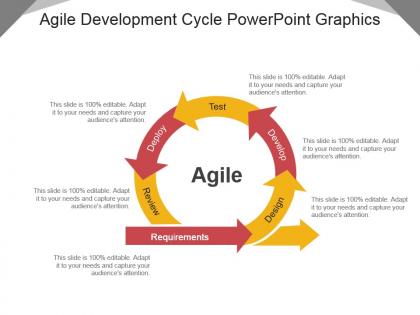
Agile development cycle powerpoint graphics




Try Before you Buy Download Free Sample Product
 Impress Your
 Audience
 100%
100% Editable
 Save Hours
 of Time


Our Agile Development Cycle Powerpoint Graphics are topically designed to provide an attractive backdrop to any subject. Use them to look like a presentation pro.
People who downloaded this PowerPoint presentation also viewed the following :
Agile development cycle powerpoint graphics with all 5 slides:
Use our Agile Development Cycle Powerpoint Graphics to effectively help you save your valuable time. They are readymade to fit into any presentation structure.




FAQs for Agile development
So Agile basically has four phases that keep repeating: planning, development, testing, and review. Planning is where you figure out what to build in the next 1-4 weeks (called a sprint). Development is pretty obvious - your team actually builds the stuff. Testing happens throughout everything, which is way better than the old waterfall approach where you'd test at the very end and discover everything was broken. Then there's review where you show stakeholders what you built and get their feedback. Honestly, most teams skip this part but it's where you actually learn what works. The whole thing just loops over and over, getting better each time.
Oh dude, so Agile basically chops everything into these 2-4 week chunks called sprints instead of mapping out the whole thing upfront. Way more flexible than those old waterfall methods. You get feedback constantly and can actually change direction when your boss inevitably comes back with "totally new ideas" halfway through - which honestly happens like 90% of the time anyway. Traditional approaches pretend you'll know exactly what you want from day one (spoiler: you won't). With Agile you can roll with it. I'd say figure out your bare minimum viable product first, then build from there.
So the Scrum Master basically removes roadblocks and runs all those ceremonies - they're like your process watchdog. Product Owner is different - they handle the backlog and decide what features matter most. Honestly, I've seen teams try to wing it without both roles and it's a disaster. Your sprints just fall apart without someone prioritizing stuff and someone else keeping things moving smoothly. It's kind of like... one person steers the ship while the other makes sure the crew isn't fighting over the sails, you know? If your team's missing either one, definitely bug management to fill those spots.
Three main things to think about: what gives users the most value, how much effort each story takes, and what's blocking what. Business impact should drive your ranking - tackle the high-value stuff first. Story points are clutch for estimating work. Dependencies will bite you if you ignore them. Some tasks literally can't happen until others wrap up, so figure that out early. Your product owner is gold during sprint planning since they actually know the business side. Things shift constantly though, so don't get too attached to your initial plan. Re-evaluate every sprint or you'll end up chasing yesterday's priorities.
Planning poker is honestly a game-changer for getting everyone on the same page about how complex stuff is. Break your user stories down small and don't overcommit - I've watched so many teams do this and it's painful to see them scramble later. Look at your historical velocity to figure out what's actually realistic. Get the whole team involved since they're doing the heavy lifting anyway. Buffer time is crucial because something always goes sideways. Oh, and timebox those planning sessions to like 2 hours max per sprint week or people start zoning out.
Honestly, stand-ups are pretty solid once you get used to them. Everyone shares what they did yesterday, today's plan, and any blockers - takes like 10-15 minutes max. The whole point isn't reporting to your boss (that's annoying), it's actually helping your teammates know what's up. You'll catch overlapping work early and spot when someone's stuck. I thought they were kinda pointless at first, not gonna lie. But they really do stop people from disappearing into their own little work bubbles. Just make sure you actually follow up on those blockers afterward or it's all for nothing.
Start with velocity and burn-down charts - those'll show you story points completed and remaining work. Lead time matters too (how long stuff actually takes start to finish). Sprint completion rates are solid. Honestly, team happiness surveys saved my last project - miserable devs write terrible code. Track defect rates and customer satisfaction if you can swing it. But here's the thing: don't go crazy measuring everything. Pick 3-4 that actually help your specific situation. I learned this the hard way after drowning in spreadsheets for weeks. Focus on what moves the needle.
Look, feedback loops are what make Agile actually work. Daily standups, sprint reviews, retrospectives - they're all designed to keep your team from going off the rails. Think of it like course-correcting constantly instead of waiting until the end to realize you built the wrong thing. You catch problems early, pivot when users tell you something's not working, and honestly? Your team gets better at working together. The trick is actually doing something with all that feedback instead of just nodding along in meetings. Otherwise you're just wasting everyone's time collecting opinions nobody acts on.
So there's a few ways to do this - SAFe, LeSS, or that Spotify model everyone talks about. Basically you keep your teams small (like 7-9 people still) but add coordination stuff on top. Regular sync meetings between teams, shared backlogs, that kind of thing. Sprint cycles need to line up too or it gets messy fast. What works best is when each team owns a clear chunk of the product. The whole trick is not turning into some bureaucratic nightmare while still having enough structure. Oh, and start by figuring out natural team splits around features first - way easier than trying to force it.
Honestly, the hardest part is getting people out of that waterfall headspace - old habits die hard. Training helps but you'll still deal with confused roles and decision-making drama. Oh, and standups? They become boring status meetings real quick instead of actual teamwork. Stakeholders will bug you for those detailed roadmaps when the whole point is staying flexible. Plus there's always some communication breakdown between devs and product folks that slows everything down. My advice? Pick one team to start with, get your Scrum Master properly trained, and work on mindsets first. The process stuff comes easier after that.
So Agile basically forces you to keep improving through those retrospectives after each sprint - your team sits down and honestly talks about what sucked and what didn't. Instead of finding out your project's a disaster at the very end, you're getting feedback constantly from users and stakeholders. Short sprints are clutch because you can pivot fast without throwing away months of work. Daily standups catch problems early too. Honestly, the biggest mistake teams make? They do great retros but never actually implement the changes. Don't let those insights just die in your meeting notes.
Honestly? Jira's what most teams use but it can be such a pain sometimes - super clunky interface. Azure DevOps and Linear are solid too though. If your team's smaller, maybe try Trello or Monday.com first since they're way simpler for basic sprint stuff. Oh, and definitely get Slack or Teams going alongside whatever you pick. The real trick isn't finding the "perfect" tool - it's getting everyone to actually stick with it. I'd grab free trials of like 2-3 options and just see what feels right for how you guys work.
Honestly, start with the basics - get everyone on video for standups and planning sessions. Dave's gonna forget to unmute anyway, but at least you'll see his confused face. Jira or Trello boards help tons for tracking stuff in real time. Here's what works: make retros async so people can dump their thoughts beforehand instead of scrambling on the spot. Remote teams need way more intentional touchpoints than in-person ones. Don't try to fix everything at once though. Pick one meeting to improve this sprint and see what happens.
User stories are how you grab requirements from the user's angle - keeps everyone focused on real value instead of random technical stuff. Format's simple: "As a [user type], I want [goal] so that [benefit]." Product owners usually write them during backlog sessions with the team and stakeholders. Make them small enough for one sprint. Don't forget acceptance criteria so you know when you're actually done. Honestly, just try rewriting your current requirements as user stories - you'll spot tons of gaps you didn't even realize were there. It's kind of eye-opening.
So here's the thing with Agile - it's basically built for scope changes. Those short sprints? They're lifesavers because when requirements change (and they will), you just pivot in your next planning session instead of watching everything burn down. Your product backlog becomes this living document that evolves with feedback. Daily standups keep everyone on the same page when things shift mid-sprint. Sprint reviews are clutch too - you demo what you've got and catch changes early. Honestly, the mindset shift is huge here. Don't treat scope changes like disasters. Document them well so you can see how they affect your timeline, but expect them.
-
Very unique and reliable designs.
-
Top Quality presentations that are easily editable.
-
Unique design & color.
-
Great quality product.
-
Use of different colors is good. It's simple and attractive.
-
Nice and innovative design.