

 0 Comment
 Customer Reviews

Scaled Agile Framework (SAFe) is one of the primary methodologies developed to assist organizations in scaling agile across teams, departments, and business units. This blog highlights how SAFe is based on its principles, which focus on transparency, alignment, and continuous improvement. SAFe provides a structured, multi-layered approach to enterprise agility. By introducing Lean Agile values, Strong teams, Program Increment (PI) Planning, and other methods, SAFe enables cross-functional teams to deliver value consistently and with quality that internal and external customers expect. The emphasis on continuous improvement in SAFe allows you to align strategic objectives with outcomes and project deliverables over time.
SAFe enables you to grow from practicing agile to having an organized, synchronized approach to executing work. An organization will transform at the team level, portfolio level alignment, and work completion to pursue continuous delivery with a strong DevOps. SAFe is a flexible framework aimed at organizations committed to an Agile transformation, those that want to manage an agile portfolio effectively, those who need to change on a grand scale, and/or agile teams that want a structured approach. The focus of the work from SAFe is not only on the concept but also on value-added processes and evidence. Through the templates below, value is seen in evidence of success and delivery of agility, from standardized batch sizes to chosen tools and environments that organizations value the most.
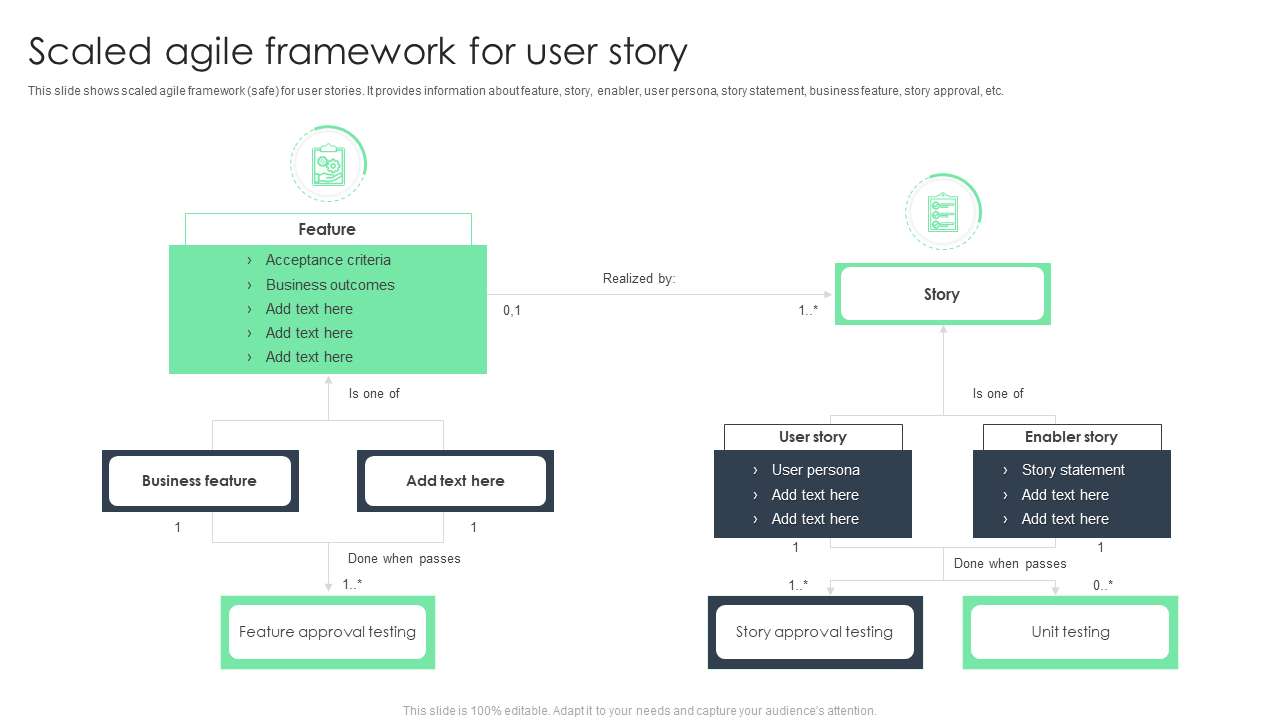
Template 1 - Scaled Agile Framework for User Story Template
This actionable template outlines the connections between features and stories and their variations. Each feature contains its acceptance criteria and business outcomes and is a part of a business feature and leads to testing to approve the feature. A story (the user story or enabler story) describes how the feature will be realized and contains a user persona or a user story statement. Stories are also validated through testing (either story approval testing or unit testing). This deck aligns with the SAFe principles and feeds Lean Agile ways of working; DevOps within SAFe; Agile Release Trains (ARTs); and a scalable way to deliver functionality to the business.
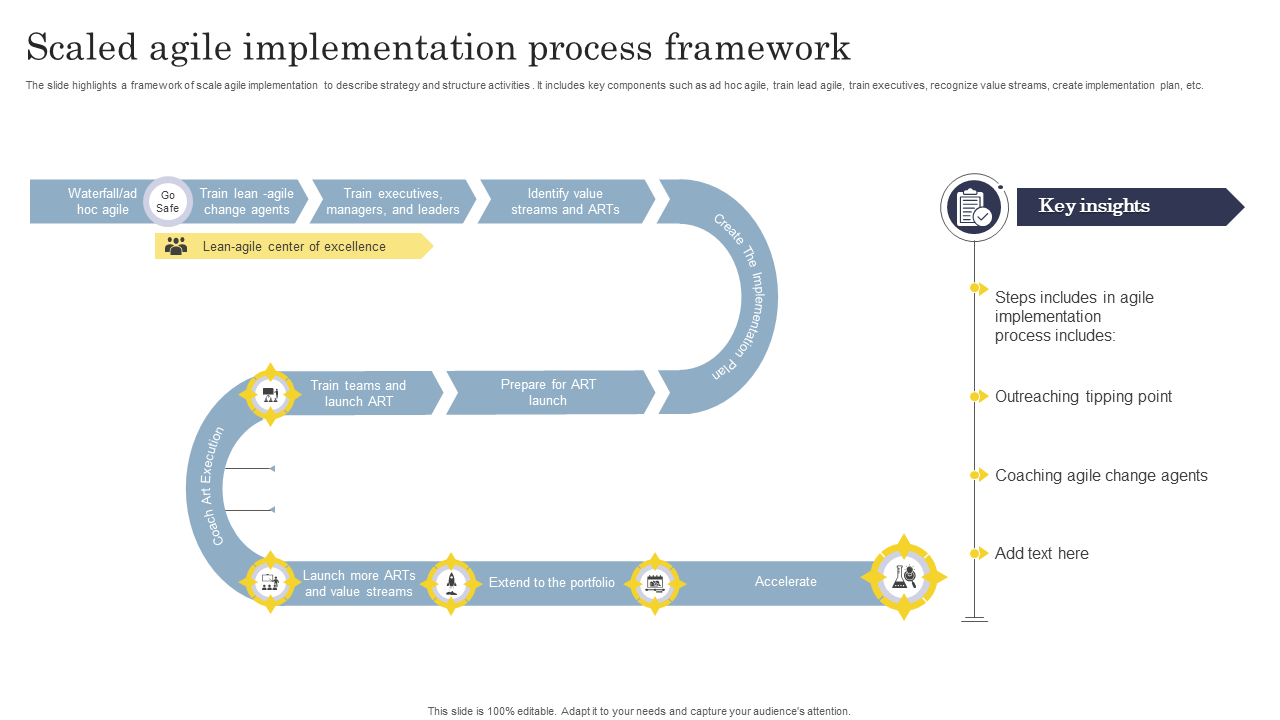
Template 2 - Scaled Agile Implementation Process Framework Template
The Scaled Agile Implementation Process Framework deck is a crucial tool that outlines the stages of a successful SAFe implementation. It begins with transitioning from ad hoc agile to Lean Agile, facilitated by coaching change agents and training executives. The subsequent steps involve identifying value streams and Agile Release Trains (ART) and forming the implementation plan. The process then moves on to planning for ART launch, team training, and value stream extension. A strong emphasis is placed on portfolio extension and acceleration. This Implementation Process Framework, which is rooted in SAFe principles, serves as the foundation for Lean Agile transformation and the enhancement of enterprise agility.
Template 3 - Three-Layered Scaled Agile Architecture Framework Template
The Three-Layered Scaled Agile Architecture Framework template is a comprehensive tool that spans the team, program, and solution levels. It effectively organizes and articulates the team backlog, program backlog, and solution backlog, facilitating a coordinated implementation of SAFe. This slide is particularly beneficial for Lean Agile teams and SAFe for Teams, supporting effective PI Planning, DevOps within SAFe, and agile portfolio management for smaller organizations committed to SAFe principles.

Template 4 - Team And Technical Agility Scaled Agile Framework Agile Project Management Frameworks Template
This Scaled Agile Framework’s Team and Technical Agility template offers an implementation process for agile project management using Lean UX and emergent design. The process in this deck emphasizes intentional architecture and enterprise agility through the SAFe principles. The process is particularly well-suited for teams engaged with Agile Release Train (ART) and DevOps in SAFe or any continuous delivery environment. The model can support SAFe certification processes, PI Planning processes, and Agile transformation processes for organizations implementing SAFe for Teams and SAFe Product Owner responsibilities.

Template 5 - Scaled Agile Framework Implementation 3-Month Roadmap with Multiple Phases Template
This deck provides a roadmap for implementing the Scaled Agile Framework using a structured three-month approach consisting of five core phases: Kick-off, Design, Validate, Launch, and Continuous Improvement. The roadmap will focus on consulting, education, and integration with tasks such as setting agile goals, building a communications plan, validating environments, and launching rollouts. This implementation roadmap is designed to support the implementation of SAFe through the alignment and rollout of standards for Agile Release Trains (ART). The roadmap is designed to support the implementation of Lean Agile practices, governance training, KPI evaluation, and analytics building.

Template 6 - Agile Project Management Frameworks: Scaled Agile Framework Template
This Scaled Agile Framework template presents four levels in SAFe—Team, Program, Large Solution, and Portfolio—to provide a structure for managing a project using Agile practices. Each activity, from stories to strategic themes, is seen through the lens of SAFe Implementation approaches. Teams are accountable for delivering increments of value; Programs are used to manage the Agile Release Trains (ARTs); and Solutions are used to manage capabilities and enablers. Portfolio strategies provide business outcomes leveraging incremental planning.

Template 7 - Requirement Hierarchy for Scaled Agile Framework with Demand Management Template
The Requirement Hierarchy for Scaled Agile Framework with Demand Management template outlines a four-step process (Funnel, Backlog, Analysis, and Implementation) starting with opportunities; this step involves getting more backlogged items, conducting analysis with architects and managers to evaluate viable solutions. WIP and ownership limits are transferred to each stage. Business analysts manage evaluation, while Agile teams manage implementation. This deck supports SAFe principles and aids in ART planning, PI Planning, and SAFe agility in general. The template also promotes Lean Agile decision-making, supports Business Agility in the Enterprise, supports roles like the SAFe Product Owner, and enables agile portfolio management and innovation-driven Agile transformation.

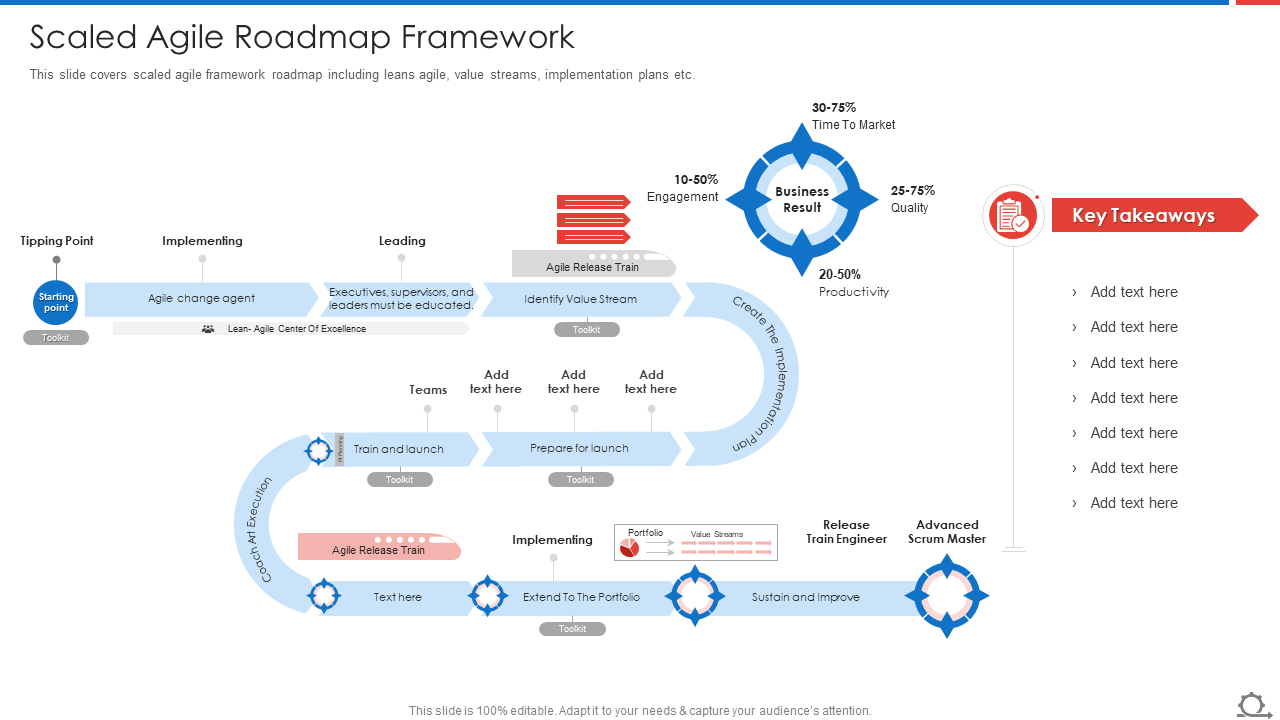
Template 8 - Scaled Agile Roadmap Framework Agile Methodologies and Frameworks Template
The Scaled Agile Roadmap template provides a framework for adopting Lean Agile methodologies from the tipping point to execution. The framework begins with identifying Agile change agents, training leaders, and establishing a Lean-Agile Center of Excellence. The roadmap establishes a process for setting up an Agile Release Train (ART), identifying value streams, training teams, and expanding the portfolio. Select steps provide toolkits to support SAFe roles and responsibilities in the enterprise while enabling Agile transformation and agility.
Template 9 - Cultural Shift Towards Agile Template
The Cultural Shift Towards Agile template highlights four critical values for SAFe implementation. Collaboration supports the close, cross-functional collaboration of teams working together and breaking down silos. Flexibility supports the capacity to adjust as needs change while aligned with Lean Agile and SAFe. Transparency encourages open communication and trust among SAFe roles and responsibilities. Customer focus ensures that output from the Agile Release Train (ART) is value-driven.

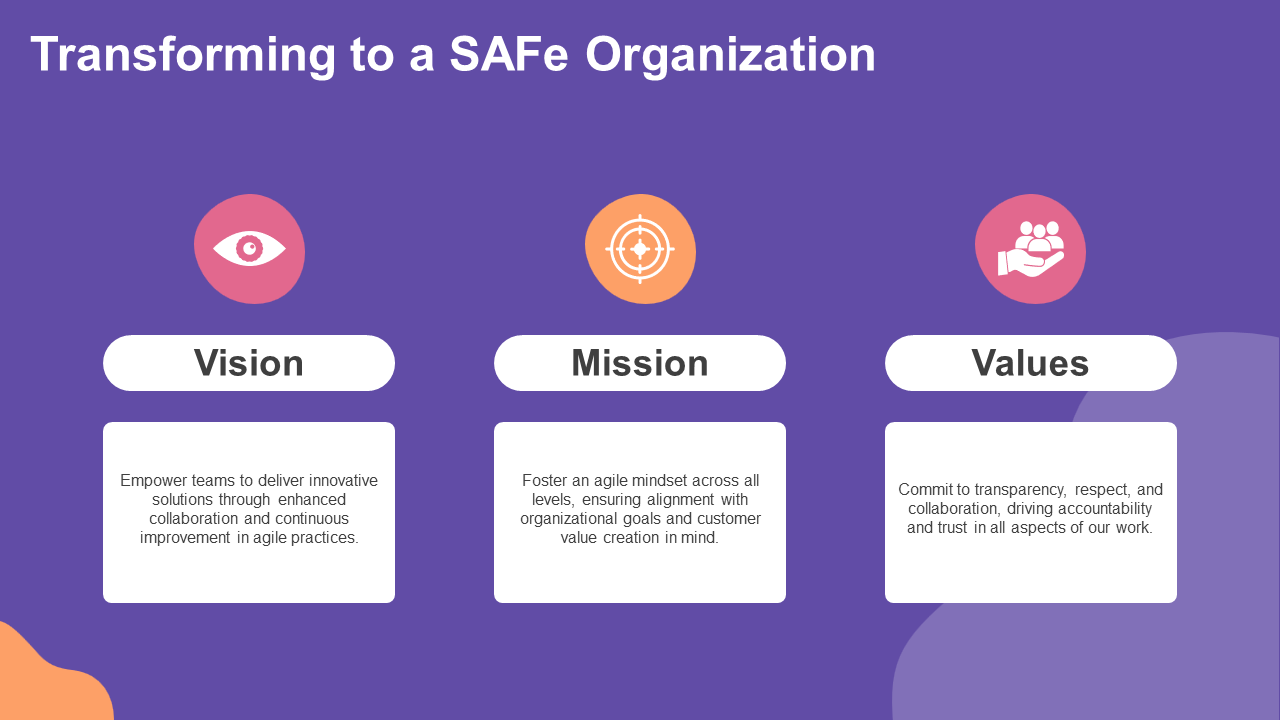
Template 10 - Transforming to a SAFe Organization Template
This Transforming to a SAFe Organization template presents the key components of a SAFe Agile journey. The vision emphasizes the importance of empowering teams to innovate with collaboration and continuous improvement in agile practices. The mission reflects a foundational element of fostering an agile mindset, at all levels that is aligned with business goals and customer value. The values call out transparency, respect, and collaboration which enable building trust and accountability. This supports the implementation strategies of SAFe, Lean Agile practices, Agile Release Train (ART) planning, and enterprise agility. This model also supports SAFe roles and responsibilities, Program Increment (PI) Planning, DevOps in SAFe, and Agile portfolio management.
Conclusion
The Scaled Agile Framework (SAFe) is a detailed framework for promoting enterprise agility, promoting a cultural and operational change at the team, program, and portfolio levels. Based on Lean Agile principles and Agile Release Trains (ARTs), SAFe allows organizations to scale delivery of customer value. Therefore, delve deeper into our templates to drive consistency, visibility, and adaptability at all levels of execution.
FAQs
1. How is SAFe different from regular Agile or Scrum?
The Scaled Agile Framework (SAFe) expands upon the typical Agile or Scrum approach by aligning multiple teams within large enterprises. While traditional Agile is oriented towards a single team, SAFe expands the scope of Lean-Agile principles, with Agile Release Trains (ARTs) and Program Increment (PI) Planning, to bring enterprise agility, coordination, and streamlined delivery to scale.
2. Who should use SAFe in an organization?
Organizations seeking to establish enterprise agility through structured quality management can use SAFe. This framework is especially beneficial for leaders, Agile teams, and stakeholders involved in business process review, performance tracking, and continuous improvement. In addition to operationalizing standards already established by the organization, SAFe designates appropriate roles for coordination, policy compliance, and scalable delivery, which can help mitigate risk.
3. What are the key components of SAFe?
The major components of SAFe (Scaled Agile Framework) consist of Agile Release Train (ART), Program Increment (PI) Planning, Lean-Agile principles, DevOps, SAFe roles and responsibilities, Agile portfolio management, and Scrum of Scrums. These components set teams up for enterprise agility, continuous improvement, and delivery of SAFe at scale in large organizations.