

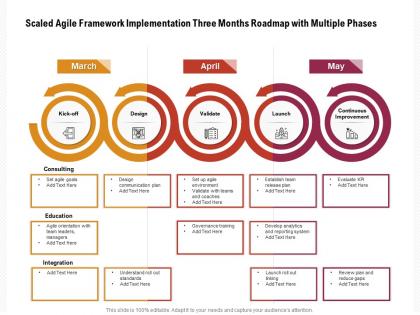
Scaled agile framework implementation three months roadmap with multiple phases




Try Before you Buy Download Free Sample Product
 Impress Your
 Audience
 100%
100% Editable
 Save Hours
 of Time


A well thought out action plan makes execution easier and increases the possibility of success significantly. Ensure hitting all the milestones within the deadlines by introducing our fully customizable Scaled Agile Framework Implementation Three Months Roadmap With Multiple Phases. Streamline the work related information, budget, timeframe, key deliverable, landmarks, and major steps involved, all in one place to give an organized overview of the project by utilizing our PowerPoint theme. Minimize time lag and increase work efficiency by providing insight into the process with our comprehensively researched roadmap PowerPoint layout. Color coding helps in highlighting the process and grabs the attention of the audience. Download our handy Scaled Agile Framework Implementation Three Months Roadmap With Multiple Phases to identify the possible problem areas in a much shorter time and propose solutions. Have a productive brainstorming session with your workforce by utilizing our action plan visualization tool.
People who downloaded this PowerPoint presentation also viewed the following :
Scaled agile framework implementation three months roadmap with multiple phases with all 2 slides:
Use our Scaled Agile Framework Implementation Three Months Roadmap With Multiple Phases to effectively help you save your valuable time. They are readymade to fit into any presentation structure.
FAQs for Scaled agile framework implementation three months roadmap
Key SAFe components include Agile Release Trains, Program Increment planning, Lean Portfolio Management, DevOps practices, and continuous delivery pipelines. These elements work together by aligning teams across organizational levels, establishing predictable delivery rhythms, and enabling strategic investment decisions, with many enterprises finding that this integrated approach streamlines coordination while maintaining agility at scale.
Organizations assess agile maturity through comprehensive evaluations including team collaboration patterns, delivery velocity metrics, cross-functional capabilities, leadership alignment, and existing agile practices across departments. These assessments enable strategic roadmap customization by identifying skill gaps, cultural readiness, and operational bottlenecks, with many enterprises finding that thorough maturity analysis accelerates SAFe adoption and minimizes implementation risks.
SAFe implementation teams require solution architects, release train engineers, product owners, scrum masters, and agile coaches to drive transformation effectively. These roles streamline coordination across multiple teams, enhance delivery predictability, and accelerate value delivery, with many large organizations finding that clearly defined responsibilities ultimately deliver improved alignment and competitive advantage.
SAFe adapts through its flexible four-tier configuration system, allowing organizations to implement Essential, Large Solution, Portfolio, or Full SAFe based on their complexity and scale requirements. Through modular adoption approaches, companies can start with essential practices and gradually expand, with many enterprises finding that this staged implementation reduces risk, enables smoother cultural transitions, and delivers measurable improvements in delivery speed and alignment.
Common challenges include resistance to cultural change, inadequate training, misaligned leadership expectations, poor communication across teams, and difficulty scaling practices effectively. Organizations overcome these by establishing strong executive sponsorship, investing in comprehensive SAFe training programs, creating clear communication channels, and implementing gradual rollouts with dedicated coaching support, ultimately delivering improved alignment and faster value delivery.
Leadership drives SAFe adoption by establishing clear vision, providing necessary resources, championing cultural transformation, and actively participating in training programs. Through consistent communication, removal of organizational impediments, and visible commitment to agile principles, executives enable teams to embrace scaled methodologies, ultimately delivering faster time-to-market, improved collaboration, and enhanced organizational agility.
Organizations should track velocity, predictability, quality metrics, employee engagement scores, and time-to-market improvements to measure SAFe implementation success. These metrics enable teams to assess sprint consistency, defect reduction rates, and delivery acceleration, while many enterprises find that combining quantitative performance data with qualitative team satisfaction surveys ultimately delivers comprehensive insights into transformation effectiveness.
SAFe configurations fundamentally shape roadmap complexity and scope, with Essential SAFe focusing on team-level coordination, Portfolio SAFe adding strategic investment tracking, and Full SAFe encompassing enterprise-wide value stream orchestration. These configurations enable organizations to scale systematically, with many enterprises finding that starting with Essential SAFe and progressing through configurations delivers sustainable transformation while minimizing implementation risks.
Tools facilitating smoother SAFe implementation include Atlassian Jira Align, Microsoft Azure DevOps, Rally Software, VersionOne, and Scaled Agile's own SAFe Studio. These platforms streamline coordination by enabling real-time visibility across program increments, automating dependency tracking, and centralizing backlog management, with many organizations finding that integrated toolchains reduce implementation complexity while accelerating time-to-value delivery.
Continuous improvement practices integrate into SAFe implementation through regular inspect-and-adapt workshops, program increment retrospectives, innovation and planning iterations, and embedded coaching cycles. These practices enable organizations to systematically identify bottlenecks, optimize value streams, and enhance delivery capabilities, with many enterprises finding that structured improvement cycles accelerate transformation outcomes and sustainable agile adoption.
Teams transitioning to SAFe methodologies require comprehensive training including SAFe certification programs, role-specific workshops for Scrum Masters and Product Owners, leadership alignment sessions, and hands-on coaching support. Organizations typically combine formal SAFe training with mentoring resources, digital collaboration tools, and continuous learning platforms, with many enterprises finding that structured onboarding programs and expert-led workshops accelerate adoption while minimizing implementation challenges.
Organizations ensure effective communication across SAFe teams through structured ceremonies like PI planning events, Scrum of Scrums meetings, and regular cross-team retrospectives, combined with shared digital collaboration platforms and standardized reporting frameworks. These approaches streamline coordination by establishing clear communication cadences, aligning dependencies early, and creating transparency around progress, with many enterprises finding that consistent use of SAFe's built-in collaboration rituals ultimately delivers faster delivery cycles and reduced integration conflicts.
The Agile Release Train serves as the primary value delivery vehicle in SAFe, synchronizing multiple agile teams around shared missions, backlogs, and architectural vision through regular Program Increments. This strategic alignment mechanism enables organizations to scale agile practices beyond individual teams, coordinate dependencies across complex product portfolios, and deliver integrated solutions faster, with many enterprises finding that ARTs significantly enhance predictability and reduce time-to-market.
Organizations align existing processes with SAFe principles through systematic assessment, gradual transformation, and strategic integration of current workflows with agile practices. This alignment involves mapping current processes to SAFe configurations, training teams on agile methodologies, and implementing program increment planning, with many enterprises finding that phased adoption delivers improved collaboration, faster delivery cycles, and enhanced organizational agility.
Maintaining stakeholder engagement during SAFe adoption requires transparent communication, regular progress showcases, dedicated change champions, and structured feedback loops throughout each implementation phase. These strategies enhance buy-in by demonstrating tangible value early, addressing concerns proactively, and celebrating incremental wins, with many organizations finding that consistent stakeholder involvement accelerates transformation success and minimizes resistance to change.
-
Use of icon with content is very relateable, informative and appealing.
-
Very well designed and informative templates.