


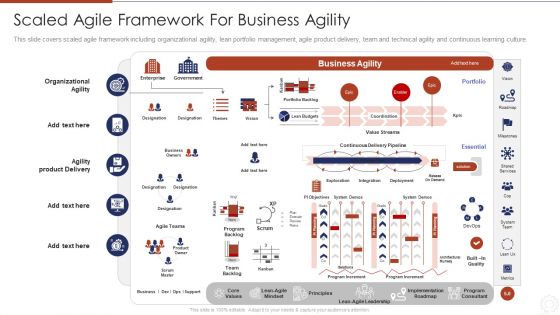
Scaled agile framework agile planning development methodologies and framework it




Try Before you Buy Download Free Sample Product
 Impress Your
 Audience
 100%
100% Editable
 Save Hours
 of Time


Our Scaled Agile Framework Agile Planning Development Methodologies And Framework IT are topically designed to provide an attractive backdrop to any subject. Use them to look like a presentation pro.
People who downloaded this PowerPoint presentation also viewed the following :
Scaled agile framework agile planning development methodologies and framework it with all 2 slides:
Use our Scaled Agile Framework Agile Planning Development Methodologies And Framework IT to effectively help you save your valuable time. They are readymade to fit into any presentation structure.
FAQs for Scaled agile framework agile planning development methodologies
So SAFe has 10 core principles for scaling agile in big companies. The main ones you'll hit are economic thinking for decisions, systems thinking, and planning for variability. Build stuff incrementally, use objective milestones, and make value flow visible (that one's trickier than expected). Decentralized decisions are key, plus organizing around value streams and keeping people motivated. Oh, and cross-domain planning to sync everything up. Honestly? Start with economic view and systems thinking - those two will shift your mindset the most when you're scaling up.
SAFe is basically Lean principles wrapped up in a fancy framework. Value stream mapping and continuous flow are built right in. Teams pull work instead of having stuff pushed at them, which honestly makes way more sense. The whole inspect-and-adapt cycle? That's just Lean thinking with a different name. Program Increments keep batch sizes small and create better flow. Plus you're constantly measuring things to find bottlenecks - though sometimes it feels like you're measuring everything under the sun. Start by mapping your current value streams. You'll spot the Lean opportunities pretty quickly once you see the whole picture laid out.
Look, SAFe basically has three layers of roles. Teams have your usual Scrum Masters and Product Owners doing their thing. Above that, you've got Release Train Engineers (RTEs) - they're like orchestra conductors making sure everyone's in sync during those Program Increments. Product Managers sit there too, translating big strategy into actual features. Portfolio level has Epic Owners and Solution Architects handling the really high-level stuff. The magic happens during quarterly PI Planning sessions where everyone actually aligns (in theory anyway). Pro tip: figure out who's actually filling these roles first - most companies mess this part up and wonder why SAFe isn't working.
So PIs are like SAFe's drumbeat - fixed 8-12 week cycles where all your teams actually work together instead of doing their own thing. You kick off with big planning sessions to get everyone aligned on what they're building, execute for 8-10 weeks, then demo and retrospect. Honestly, the predictability is clutch - stakeholders finally know when stuff's coming. Without it? Total chaos, trust me. Your PI boundaries need to be rock solid or teams just drift apart. It's basically the only way to keep multiple Agile trains from crashing into each other.
So SAFe basically gives big companies a roadmap for scaling agile without totally losing their minds. Three levels - team, program, portfolio - with clear roles and processes at each one. The Agile Release Trains are pretty smart, they sync up multiple teams so nobody's working in silos. PI Planning sessions keep everyone aligned (though honestly they can drag on forever). What's cool is the lean-agile budgeting actually makes sense to the C-suite folks. Don't jump into the deep end though - start with their essential level first. Way less overwhelming.
Honestly, just focus on a handful of metrics at first - maybe 3-4 max. Track PI predictability (are teams actually hitting their commitments?) and how much business value you're delivering each quarter. Those are the ones that actually move the needle. Employee engagement and customer satisfaction matter too, obviously. Velocity trends, defect rates - sure, but don't go overboard initially. I made that mistake once and spent more time measuring than doing actual work lol. Start simple, get those core metrics working, then add more later. Time-to-market is another good one once you're rolling.
So SAFe basically forces everyone to actually talk to each other. Cross-functional teams work together daily, plus there's PI Planning every quarter where dev and business people sit in the same room and hash out priorities. Game changer, honestly - you realize how much miscommunication was happening before. Product Owners become the bridge between worlds, and business folks jump into sprint reviews instead of just getting updates later. They're not just watching demos, they're helping make decisions. Oh, and definitely drag your key business stakeholders to your next sprint demo if you haven't already.
So SAFe actually has this whole Continuous Delivery Pipeline built right in - covers exploration, integration, and deployment. The "release on demand" feature is honestly pretty clever since you can deploy code without actually releasing it to users. Your teams get shared toolchains and automated testing pipelines at the program level. ARTs keep everyone synchronized, which is nice. They also break down the old dev vs ops drama by putting DevOps people directly on development teams. Oh, and infrastructure as code comes standard too. I'd start by looking at your current setup and figuring out what's easiest to automate first.
So SAFe has four configurations you can pick from. **Essential SAFe** is where most people start - just one Agile Release Train, keeps things manageable. **Portfolio SAFe** throws in the strategy piece when you're dealing with multiple value streams. Then there's **Large Solution SAFe** for when multiple teams are building one massive, complicated thing. **Full SAFe** is everything combined - big enterprises with tons of moving parts usually end up here. My take? Don't stress about getting it perfect right away. Essential's your best bet to start with. You'll figure out what you actually need once you get going, and then you can add the other layers. Way better than trying to boil the ocean from day one.
So SAFe uses Solution Trains and those big quarterly PI Planning sessions to sync up multiple ARTs. The PI Planning thing is honestly kind of exhausting but it works - gets everyone aligned on dependencies and priorities. Between those, you've got shared backlogs and regular cross-ART meetings where teams can catch conflicts early. Solution architects and PMs help maintain the bigger picture across teams too. Oh, and make sure whoever represents your ART actually shows up to coordination meetings prepared. I've seen too many teams phone it in and then wonder why alignment falls apart later.
Honestly, coaches are a game-changer for SAFe transitions. Without them, you're basically flying blind into chaos. They'll guide teams through all the new ceremonies and help leadership figure out their shifted roles. Plus they catch those hidden pitfalls nobody sees coming. Think of it this way - they've already made all the mistakes so you don't have to. Super helpful during those "wait, what are we supposed to do here?" moments that happen constantly. Budget for good ones upfront though. I've seen too many companies try to wing it themselves and... yeah, that rarely goes well.
Yeah, SAFe is definitely meant to be customized - honestly, following it word-for-word would be pretty weird. Keep whatever's already working in your current setup. Then just grab the SAFe pieces that actually solve problems you're having. I've worked with teams who totally skip certain meetings or tweak roles to match how they're organized. Works fine. The main thing is sticking to the big ideas like alignment and transparency, but you can mess with the actual mechanics however you want. Oh, and don't go crazy trying to implement everything right away - pick maybe 2-3 things to start with.
Honestly, the toughest part is dealing with people who hate change - and trust me, there's always someone who'll dig their heels in. Teams get totally overwhelmed if you try rolling out everything at once. All those SAFe ceremonies and weird terminology? Yeah, that's gonna confuse the hell out of everyone coming from traditional project management. Here's what actually works: pick just one Agile Release Train to start with. Don't skimp on training and coaching - seriously, spend the money. Make sure leadership is obviously on board, not just paying lip service. Give people breathing room to figure it out. Quick wins early on help tons.
So SAFe is basically your cheat sheet for rolling out agile across a whole company instead of just one team at a time. It comes with all the roles and processes already mapped out - team level, program level, portfolio level, the works. Honestly saves you from reinventing the wheel. They've got implementation guides and ways to track how you're doing too, which is pretty helpful. First thing though - figure out which version fits your company size. Then get your leadership on board with what you're actually trying to achieve before you start deploying it everywhere.
Look, the Lean-Agile mindset is what actually makes SAFe work - skip it and you're just doing fancy ceremonies for no reason. Your teams need to shift from "we follow rules" to "we care about customer outcomes and learning." Psychological safety matters here. So does treating failures as data, not disasters. Focus on flow over keeping people busy (that one's huge). I've watched tons of implementations crash because they rushed to the framework parts. Don't do that. Model the behavior first - question stuff, try small experiments, celebrate when failures teach you something useful.
-
Presentation Design is very nice, good work with the content as well.
-
Good research work and creative work done on every template.
-
Enough space for editing and adding your own content.
-
Perfect template with attractive color combination.
-
Innovative and attractive designs.
-
Great product with effective design. Helped a lot in our corporate presentations. Easy to edit and stunning visuals.
-
Great experience, I would definitely use your services further.
-
Design layout is very impressive.
-
Great designs, Easily Editable.