


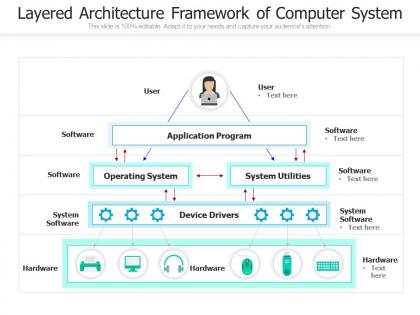
Layered architecture framework of computer system




Try Before you Buy Download Free Sample Product
 Impress Your
 Audience
 100%
100% Editable
 Save Hours
 of Time


Our Layered Architecture Framework Of Computer System are topically designed to provide an attractive backdrop to any subject. Use them to look like a presentation pro.
People who downloaded this PowerPoint presentation also viewed the following :
Layered architecture framework of computer system with all 2 slides:
Use our Layered Architecture Framework Of Computer System to effectively help you save your valuable time. They are readymade to fit into any presentation structure.
FAQs for Layered architecture framework
Layered architecture comprises presentation layers, business logic layers, data access layers, and database layers, each handling distinct responsibilities while maintaining clear separation of concerns. These components interact through well-defined interfaces, with each layer communicating only with adjacent layers, enabling organizations to achieve greater modularity, easier maintenance, and enhanced scalability across their software systems.
Layered architecture improves maintainability by separating concerns into distinct layers, enabling developers to modify individual components without affecting others, reducing system complexity, and facilitating easier debugging. This separation allows development teams to update presentation layers, business logic, or data access independently, ultimately streamlining software updates and minimizing costly system-wide disruptions.
Layered architecture is preferable when building smaller applications with clear hierarchical data flow, tight coupling requirements, or when teams lack distributed systems expertise. Organizations developing enterprise applications, financial systems, or internal tools often find layered approaches streamline development, reduce operational complexity, and deliver faster time-to-market while maintaining clear separation of concerns and easier debugging processes.
The presentation layer serves as the user interface component in layered architecture, handling user interactions, displaying information, formatting data for presentation, and managing input validation. This layer enables seamless user experiences across web applications, mobile interfaces, and desktop systems by translating business logic into accessible formats, while many organizations find that separating presentation concerns enhances maintainability and scalability.
Data flows unidirectionally between layers through well-defined interfaces, with each layer communicating only with its adjacent layers using standardized protocols, APIs, and data contracts. In enterprise applications, the presentation layer passes user requests to business logic, which processes data through service layers before reaching the database tier, ultimately streamlining development cycles and enabling scalable, maintainable systems across organizations.
Implementing layered architecture in large-scale applications presents challenges including performance bottlenecks from cross-layer communication, increased complexity in debugging distributed components, tight coupling between layers, and potential scalability limitations. While these obstacles require careful planning, many organizations find that strategic implementation with proper abstraction and monitoring ultimately delivers better maintainability and system organization.
Effective communication between architectural layers requires well-defined interfaces, standardized APIs, and clear data contracts that govern information exchange. Through service abstraction and dependency injection, organizations can minimize coupling while ensuring seamless data flow, with many enterprises finding that implementing middleware and message queues ultimately delivers greater scalability and maintainable systems.
Layered architecture impacts application performance by introducing processing overhead through multiple abstraction layers, potentially increasing latency, while simultaneously enhancing maintainability, scalability, and resource optimization. Through strategic implementation, organizations in financial services and healthcare streamline complex operations, reduce development costs, and enable faster feature deployment, with many finding that well-designed layered systems ultimately deliver competitive advantage.
Layered architecture facilitates testing and debugging by enabling isolated testing of individual layers, clear separation of concerns, and targeted error identification within specific components. Through modular design, developers can implement unit tests for each layer independently, trace bugs more efficiently through defined interfaces, and maintain comprehensive test coverage, ultimately reducing debugging time and improving software reliability across complex systems.
Layered architecture supports agile development through clear separation of concerns, independent team workflows, modular testing capabilities, and streamlined deployment processes. This structured approach enables development teams to work simultaneously on different layers, implement rapid iterations with minimal cross-dependencies, and deliver incremental features more efficiently, ultimately accelerating time-to-market while maintaining code quality and system stability.
Layered architecture design should follow clear separation of concerns, minimal coupling between layers, consistent interfaces, and well-defined data flow patterns. These practices streamline development by establishing logical boundaries, enabling independent testing, and facilitating maintenance, with many software organizations finding that proper layer abstraction ultimately delivers faster deployment cycles and enhanced system scalability.
Different technologies influence layered architecture design by determining communication protocols, data formats, security requirements, and performance characteristics across presentation, business, and data layers. Technologies like microservices, cloud platforms, and APIs shape how layers interact and scale, with many organizations finding that modern frameworks enable more flexible, distributed architectures while maintaining clear separation of concerns for enhanced maintainability.
Common pitfalls include tight coupling between layers, bypassing layers for performance shortcuts, creating overly granular layers, and unclear layer responsibilities that lead to code duplication. These architectural missteps often result in reduced maintainability, testing difficulties, and performance bottlenecks, with many development teams finding that establishing clear layer contracts and communication protocols ultimately delivers more scalable, efficient systems.
Layered architecture adapts to cloud-native applications through microservices decomposition, containerization of individual layers, and API-first design patterns that enable independent scaling and deployment. Cloud platforms like AWS and Azure facilitate this transformation by providing managed services for each layer, allowing organizations to achieve greater resilience, faster deployment cycles, and cost optimization while maintaining clear separation of concerns.
Tools for building layered architectures include Spring Framework, .NET Core, Django, Express.js, and Angular for presentation layers, alongside Docker for containerization and microservices orchestration. These frameworks streamline development by enforcing separation of concerns, enabling modular design, and facilitating easier testing and maintenance, with many enterprises finding that strategic tool selection significantly accelerates deployment while reducing long-term technical debt.
-
Amazing product with appealing content and design.
-
Easy to edit slides with easy to understand instructions.
-
Very well designed and informative templates.
-
Commendable slides with attractive designs. Extremely pleased with the fact that they are easy to modify. Great work!