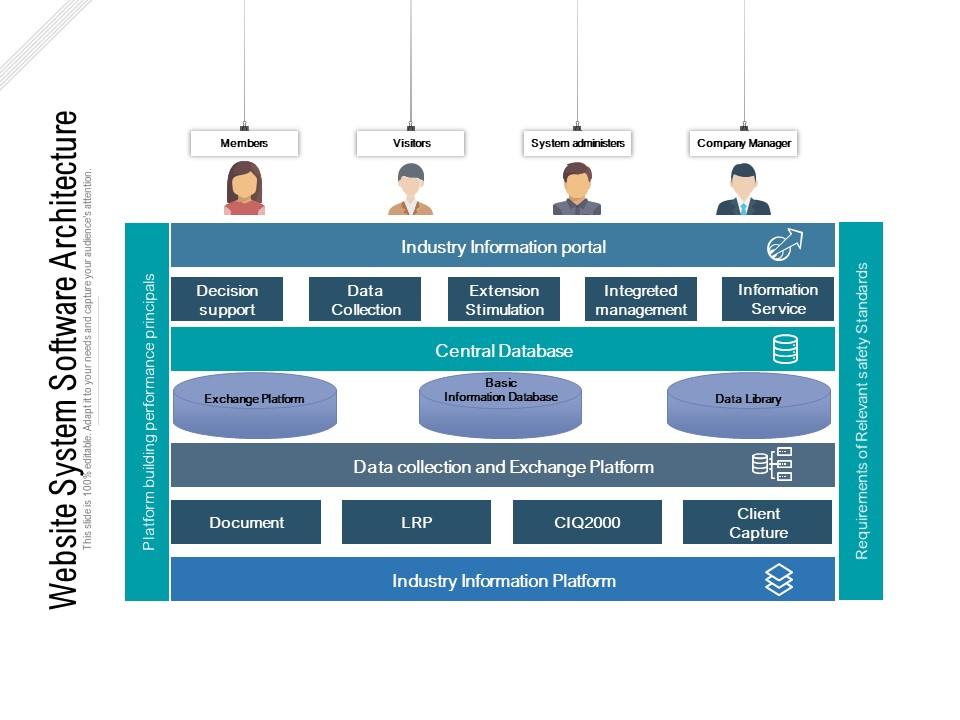
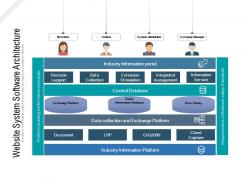
Website system software architecture
Try Before you Buy Download Free Sample Product
Audience
Editable
of Time
Our Website System Software Architecture are topically designed to provide an attractive backdrop to any subject. Use them to look like a presentation pro.
People who downloaded this PowerPoint presentation also viewed the following :
Website system software architecture with all 2 slides:
Use our Website System Software Architecture to effectively help you save your valuable time. They are readymade to fit into any presentation structure.
FAQs for Website
Key software architecture principles include separation of concerns, modularity, abstraction, loose coupling, high cohesion, and scalability considerations. These principles streamline development by reducing complexity, enhancing maintainability, and enabling faster deployment cycles, with many technology organizations finding that adherence ultimately delivers more robust systems and competitive advantage in increasingly dynamic markets.
Microservices offer superior scalability through independent service scaling and enhanced maintainability via isolated codebases, while monolithic architectures provide simpler initial deployment but face scaling bottlenecks. Many organizations in e-commerce, banking, and streaming find that microservices enable faster feature deployment, reduced system-wide failures, and improved team autonomy, ultimately delivering greater operational flexibility and competitive responsiveness.
Documentation serves as the architectural blueprint, ensuring consistency, facilitating knowledge transfer, and enabling informed decision-making as systems evolve. It streamlines onboarding for new developers, reduces maintenance costs, and preserves design rationale, with many organizations finding that comprehensive documentation ultimately accelerates development cycles and minimizes costly architectural drift.
MVC, MVP, and MVVM architectural patterns enhance application structure by separating concerns between data, presentation, and business logic, improving code maintainability, testability, and scalability. These patterns enable development teams to work more efficiently through modular design, facilitate easier debugging and updates, and ultimately deliver more robust applications with reduced development time, with many software organizations finding that structured architectures significantly streamline long-term maintenance costs.
Common software architecture pitfalls include poor scalability planning, inadequate security considerations, over-engineering solutions, insufficient documentation, and misaligned technology choices with business requirements. These architectural missteps often result in cost overruns, delayed deployments, and maintenance challenges, with many organizations finding that early strategic planning and stakeholder alignment significantly reduce project risks and enhance long-term system sustainability.
Determining appropriate architectural style involves analyzing project requirements, scalability needs, team expertise, performance constraints, and integration requirements. These factors guide selection between microservices, monolithic, layered, or event-driven architectures, with many organizations finding that aligning architectural decisions with business objectives, technical complexity, and long-term maintenance capabilities ultimately delivers optimal development velocity and system reliability.
Cloud-native architecture differs from traditional on-premises solutions through microservices-based design, containerization, automated scaling, and distributed data management, while traditional systems rely on monolithic structures and fixed infrastructure. Through cloud platforms, organizations achieve greater flexibility, faster deployment cycles, and reduced operational overhead, with many financial services and retail companies finding that cloud-native approaches ultimately deliver enhanced scalability and competitive responsiveness.
Domain-driven design simplifies complex software architectures by organizing code around business domains, establishing clear boundaries between different functional areas, and creating a shared language between technical and business teams. Through strategic modeling and bounded contexts, organizations streamline development processes, reduce miscommunication, and accelerate feature delivery, with many enterprises finding that domain alignment ultimately enhances maintainability and scalability.
Effective software architecture quality metrics include maintainability index, cyclomatic complexity, coupling coefficients, cohesion measurements, and technical debt ratios. These assessments enable organizations to streamline development cycles, minimize maintenance costs, and enhance system scalability, with many financial services and healthcare institutions finding that comprehensive metric tracking ultimately delivers faster feature deployment and improved operational efficiency.
Programming language choice significantly influences software architecture through performance characteristics, concurrency models, ecosystem compatibility, and scalability requirements. Languages like Java enable enterprise-scale architectures with robust frameworks, while Python facilitates rapid prototyping and data-driven applications, and Go streamlines microservices development, with many organizations finding that language-specific strengths ultimately determine architectural patterns and long-term maintenance strategies.
Model-driven architecture streamlines development by using high-level models to automatically generate code, documentation, and system components, reducing manual coding errors and accelerating delivery timelines. This approach enables organizations to maintain consistency across complex projects, adapt quickly to changing requirements, and ultimately deliver more reliable software solutions while minimizing development costs and resource allocation challenges.
Architectural decisions significantly impact application performance through database design, caching strategies, load balancing, and microservices implementation, while affecting user experience via response times and interface responsiveness. Well-structured architecture enables faster load times, seamless navigation, and scalable user interactions, with many e-commerce and financial platforms finding that strategic architectural choices ultimately deliver competitive advantage and enhanced customer satisfaction.
Technical debt management strategies include regular code refactoring, architectural reviews, automated testing implementation, documentation updates, and prioritized debt reduction sprints. These approaches streamline development workflows by minimizing maintenance overhead, enhancing system scalability, and reducing long-term costs, with many technology companies finding that proactive debt management ultimately delivers faster feature deployment and improved operational efficiency.
AI and blockchain reshape software architectures by introducing distributed computing models, microservices frameworks, and decentralized data management systems. These technologies enable organizations to build more resilient, scalable applications through smart contract integration, machine learning pipelines, and consensus mechanisms, with financial services and healthcare sectors finding enhanced security and automated decision-making capabilities.
Security best practices in software architecture include implementing defense-in-depth strategies, zero-trust principles, secure coding standards, regular vulnerability assessments, and robust authentication mechanisms. These approaches streamline protection by establishing multiple security layers, encrypting sensitive data, and automating threat detection, with many financial services and healthcare organizations finding that proactive security architecture ultimately delivers enhanced customer trust and regulatory compliance.
No Reviews