


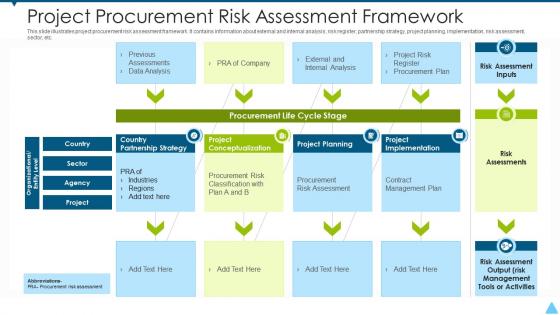
Project procurement risk assessment framework




Try Before you Buy Download Free Sample Product
 Impress Your
 Audience
 100%
100% Editable
 Save Hours
 of Time


Our Project Procurement Risk Assessment Framework are topically designed to provide an attractive backdrop to any subject. Use them to look like a presentation pro.
People who downloaded this PowerPoint presentation also viewed the following :
Project procurement risk assessment framework with all 6 slides:
Use our Project Procurement Risk Assessment Framework to effectively help you save your valuable time. They are readymade to fit into any presentation structure.





FAQs for Project procurement
So you'll want to start with risk identification - basically mapping out everything that could go sideways. Then comes analysis (how likely is it, how bad would it be) and response planning for your mitigation strategies. Don't skip the monitoring piece either. Honestly, stakeholder engagement is huge throughout this whole thing since procurement touches everyone. You need clear governance too - who owns what when stuff hits the fan? Oh, and define your risk appetite upfront so people know your org's tolerance levels. I'd probably begin by documenting current suppliers and contracts, then build out each piece from there.
Start by mapping out your whole supply chain - every supplier and their suppliers too. Look at the big risk areas: money problems, political stuff, whether you're too dependent on one source, that kind of thing. Honestly, if you can swing it, go visit your most critical suppliers in person. You'll pick up on red flags that never made it into their reports. Score each risk based on how likely it is and how badly it'd hurt you. The trick is making this a regular thing, not just checking once and forgetting about it. Set up some kind of early warning system so you're not scrambling when things go south.
Honestly, data analysis is a game-changer for procurement risk stuff. Instead of just winging it, you can actually see which suppliers are always late or going over budget. The best part? You're not just looking at what already happened - you can predict problems before they screw you over. I mean, it does take some time upfront to clean up your data (which is honestly pretty boring), but then you'll spot issues way sooner. Historical trends let you benchmark against industry standards too. My advice? Start simple with something like delivery times and expand from there.
So there's these AI platforms that basically watch your suppliers 24/7 and flag sketchy stuff before it blows up. Financial trouble, compliance red flags, late deliveries - all that. The algorithms crunch way more data than your team ever could... credit reports, news, performance metrics, the whole nine yards. Pretty wild honestly. Some even predict future problems based on market patterns and how suppliers usually behave. Main thing is hooking these up to your current systems so alerts pop right into your workflow. That way you're not playing whack-a-mole when something goes sideways.
Honestly, the biggest headaches are supply chain mess-ups and currency swings that can wreck your budget. Quality control gets tricky when suppliers are thousands of miles away - I learned that one the hard way. Political stuff like Brexit can flip your whole strategy overnight, which is terrifying. Lead times drag on forever, communication gets weird with time zones, and good luck trying to audit someone when you're both awake at different hours. Oh, and if your supplier has sketchy labor practices? That's your reputation on the line too. Map out your critical suppliers first and always have backups ready.
Start by asking for their annual reports, cash flow statements, and credit reports. Look for declining revenues or crazy high debt ratios - those are major red flags. Some suppliers get weird about sharing financials, but honestly? Too bad if it's for critical stuff. Check if they're too dependent on just one or two big clients - that always makes me nervous. Late payments to their own vendors is another bad sign. I'd do quarterly check-ins for your key suppliers, maybe use some kind of scoring system to keep things consistent. Oh, and customer concentration matters more than people think.
First thing - dig deep into your vendors before signing anything. Check their certifications and compliance history. Yeah, I know it's boring, but document everything because audits will happen eventually. Your procurement team needs training on compliance stuff too - they can't catch problems they don't recognize. Set up some kind of alert system for regulatory changes in your space. Honestly, the companies that skip these steps always regret it later. Also throw in regular contract reviews since regulations shift all the time. Having standard processes with compliance checkpoints built in saves major headaches down the road.
Honestly, just grab a simple risk matrix and plot everything out - likelihood vs impact, you know? The high-impact, high-probability stuff is obvious, but those rare catastrophic ones can totally wreck you too if you ignore them. I'd hit the red zone risks first with actual plans, not just wishful thinking. Medium ones you can probably group together to save time. Pick your top 3-5 and actually do something about them instead of just making lists. Oh, and try not to be either doom-and-gloom or ridiculously optimistic when you're rating the chances - we're all guilty of that.
So there's basically three ways people do this stuff. Risk matrices are the simplest - just high/medium/low ratings, though they can get pretty subjective. Quantitative models give you actual numbers and scores, which is way more precise if you have decent data. Most teams I know just mix both approaches because... why not get the best of each? Honestly depends on your bandwidth and what info you're working with. I'd probably start with a basic matrix first - way less overwhelming. You can always level up later once you've got your shit together and better data coming in.
Look, you can't possibly know every single risk that might bite you later. Different people catch different problems - finance spots budget red flags, operations knows what'll break in the field, legal sees compliance issues you'd totally miss. Honestly, the end users are usually the most paranoid about what could go wrong, which is perfect for this. They're motivated since they'll be stuck dealing with the mess if procurement screws up. Getting everyone involved early means they'll actually support your risk plans instead of fighting them later. Just figure out who's affected and loop them in from the start.
Honestly, geopolitical stuff can wreck your supply chain so fast it'll make your head spin. Don't rely on suppliers all clustered in one region - that's just asking for trouble. Trade wars pop up, borders get weird, sanctions happen. You've gotta spread things out geographically and have backup suppliers ready to go. Keep some extra inventory of your critical materials too, because waiting around during a crisis sucks. Oh, and actually pay attention to what's happening politically in your supplier regions - sounds obvious but tons of companies ignore this until it bites them. Buffer zones are your friend here.
First thing - map your whole supply chain, not just the obvious suppliers. Go deeper and find where your critical stuff actually comes from. Then build scenarios for disasters, political mess, suppliers going bankrupt, whatever. COVID proved "rare" events aren't that rare, right? Get backup relationships lined up now while you don't need them. Don't pick suppliers just on price - think about where they're located and if they're financially solid. Oh, and set clear triggers for when to flip the switch on backup plans. Trust me, you don't want to be figuring this out mid-crisis.
Look, start with your cost variance against budgets and supplier performance scores - those'll tell you the most. Supply chain disruptions are probably your biggest headache though, I've seen that tank entire quarters. Track how fast you bounce back from issues too. Oh, and make sure you know what percentage of your suppliers have current risk assessments. Having backup suppliers lined up is clutch. Honestly? Pick maybe 3-4 of these that actually matter for your situation and check them monthly. Don't overthink it - you can always layer on more metrics later once you've got the basics down.
Add procurement risks straight into your main enterprise risk register - don't silo them off. Your leadership needs to see how supplier failures ripple through everything. Like when your software vendor crashes, sales dies too, not just IT. Get procurement people in those quarterly risk reviews using the same scoring system as everyone else. Honestly, most companies are terrible at mapping these dependencies. Start simple: pick your 5 most critical suppliers and game out what breaks if they disappear tomorrow. The cascading effects will surprise you.
Honestly, the worst issues are supply chain transparency gaps and greenwashing from your suppliers. Plus compliance failures with labor standards - that stuff bites hard. Tracing materials through multiple supplier tiers? It's detective work but way more boring. Carbon reporting errors are getting companies in serious trouble lately too. If a supplier screws up ethically, you'll take the reputational hit along with regulatory penalties. ESG requirements aren't getting any looser either. Map out your critical suppliers first and make them get third-party certifications. Trust me, it's worth the upfront hassle.
-
Use of icon with content is very relateable, informative and appealing.
-
Commendable slides with attractive designs. Extremely pleased with the fact that they are easy to modify. Great work!