


It Software Risk Assessment Report





Try Before you Buy Download Free Sample Product
 Impress Your
 Audience
 100%
100% Editable
 Save Hours
 of Time


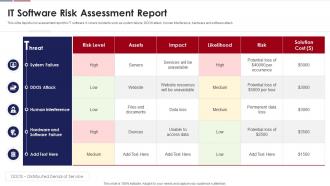
This slide depicts risk assessment report for IT software. It covers incidents such as system failure, DDOS attack, human interference, hardware and software attack.
People who downloaded this PowerPoint presentation also viewed the following :
It Software Risk Assessment Report with all 6 slides:
Use our It Software Risk Assessment Report to effectively help you save your valuable time. They are readymade to fit into any presentation structure.





FAQs for It Software
So you're basically hunting for what could go wrong with your software and figuring out how screwed you'd be if it actually happens. Think of it like... idk, checking if your car doors are locked in a sketchy neighborhood. First, scope out your biggest threats and rank them by damage potential. Some stuff needs fixing yesterday, other things can wait. The whole point is avoiding that "oh crap" moment when something breaks. Start with whatever would hurt most if hackers got in. Way better than playing cleanup after the fact.
Honestly, you've gotta attack this from a few different directions. Check your tech stack first - is anything overly complicated or untested? Then look at timelines realistically (not just what leadership wants to hear). Team stuff is huge too - what happens if Sarah from DevOps suddenly quits? I've seen that torpedo entire projects. External crap matters just as much. Requirements change, vendors flake out, regulations shift. Run quick brainstorming sessions with your team every couple sprints and keep that risk doc updated. Most people create it once then forget it exists.
So FAIR is basically the go-to if you want quantitative stuff - really solid but can be overwhelming at first. OCTAVE's more qualitative and honestly easier to sell to management. Tool-wise, don't overthink it. Excel risk matrices work fine to start, though RiskLens and ServiceNow GRC are nice if you've got budget. NIST frameworks are dry as hell but they cover everything you need. Here's the thing though - pick whatever your team will actually stick with. I've seen too many companies go for the shiniest solution then abandon it after three months. Start basic, document as you go, then upgrade later when you know what you really need.
You're gonna miss so many risks if you just stay in your tech bubble. Users know which workflows absolutely can't break. Business people understand the financial hit if things go sideways. Ops teams spot infrastructure weak points that we developers totally overlook - honestly, they've saved my butt more times than I can count. Getting everyone involved early means they'll actually follow through on whatever mitigation plan you come up with later. Map out your stakeholder groups first, then do quick focused sessions to collect their concerns. Way better than trying to guess what matters to them.
Looking back at your incident logs and bug reports is like having a roadmap for what's gonna break next. Past failures show you patterns - if that auth module crapped out three times this year, it's probably not done with you yet. I'd dig through the last year or so of post-mortems and defect data to see what keeps happening. Way better than just crossing your fingers and hoping for the best. You can actually focus your testing and fixes on the stuff that historically causes problems instead of shooting in the dark.
Okay so regulatory requirements basically control everything about your risk assessment approach. You can't just wing it - there are mandatory standards like ISO 14971 or FDA guidelines that spell out exactly what risks to check, how to document stuff, and what proof you need. Healthcare, finance, aviation - they all have different rules. Here's the thing though: figure out which regulations hit your software right at the start. Trust me on this one. Trying to add compliance later? Total nightmare and costs way more. Yeah it's rigid, but there's actually good reasons for all that structure.
So there's a few ways to tackle this. Risk scoring is probably the easiest - just multiply how likely something is by how bad it'd be. Gets you a number to work with. I'm a big fan of risk matrices too, where you plot likelihood vs severity on a grid. Super visual and stakeholders actually get it. MoSCoW works well if you need buy-in from higher-ups (Must/Should/Could/Won't). There's also the Delphi method where everyone votes anonymously - prevents the loudest person from dominating, which honestly happens more than it should. Just pick whatever clicks with your team first. You can tweak it later once you see what works.
So with agile, you're basically doing mini risk checks all the time instead of one huge analysis upfront. During sprint planning, you spot potential issues. Daily standups let you track what's going wrong. Then retrospectives help you figure out what to do differently next time. Way better than those old-school methods that feel super rigid, honestly. The cool thing is you're shipping working software constantly, so problems get caught early when they don't cost a fortune to fix. Oh and you don't need some fancy separate process - just weave risk talks into meetings you're already having.
Don't just focus on the technical stuff - business and compliance risks will bite you too. The biggest mistake? Not talking to actual people. Skip the docs and chat with your devs, ops team, users. They know where things really break. Also, this isn't some one-and-done thing you can check off (learned that the hard way). Your software changes, risks change with it. Actually put numbers on the impact and likelihood - vague "high/medium/low" rankings are pretty useless. Set up regular check-ins so you're not scrambling when something goes sideways.
Honestly, dashboards are a game changer for this stuff - I'd start there to track your defect rates, incident frequency, and recovery times. Before rolling out any changes, define what success looks like so you've got solid baselines to compare against. The annoying part? It's super hard to prove your efforts directly caused improvements vs. other random factors. I usually reassess risk scores quarterly to see if they're actually dropping. Quick tip: don't forget to check if you're staying within your risk tolerance thresholds. Running regular reassessments helps spot trends, but man, correlating cause and effect can be tricky.
Honestly, you've gotta keep checking on risks throughout your project - they're always changing. New problems show up while old ones get worse or just vanish. I've seen way too many teams do one risk assessment at kickoff and think they're covered (spoiler: they're not). Your whole setup changes as you build - requirements shift, team dynamics evolve, tech stack gets messy. Catching stuff early beats scrambling later when everything's on fire. Just throw a quick risk check into your weekly standups or sprint planning. Takes like five minutes but saves you so much stress down the road.
Honestly, risk assessment is like doing reconnaissance before a battle. You spot the sketchy parts early - that third-party API that might blow up, the database migration nobody wants to touch. Then you can actually plan for it. Budget extra time, put your best people on the nightmare modules instead of the new hire. I learned this the hard way on a project where we didn't do this upfront. Way better than panicking when deadlines hit and half your code's broken. Run the assessment first, build your timeline around real problems.
Yeah, team experience totally changes how well you spot risks. Seasoned devs who've done this before? They'll catch stuff like integration nightmares or scaling issues that junior teams don't even think about. I've watched newer teams be ridiculously optimistic about timelines - it's almost painful sometimes. But experienced folks can swing too far the other way and overthink everything. Mix both types on your team. Have the veterans walk through risk reviews with newer people. You'll get way better coverage that way without being overly cautious or naive.
Honestly, just talk money and business stuff - skip all the techy details. Your stakeholders only care about lost revenue, angry customers, or missing deadlines. Show them simple charts instead of those massive technical reports (nobody reads those anyway). I always frame it like "here's what breaks if we don't fix this" then give them 2-3 clear options with timelines. They want to make decisions without drowning in implementation details. Practice translating tech speak now because you'll use this skill constantly. Make them feel smart, not overwhelmed.
Honestly, AI-powered risk analysis is where everything's heading right now. You'll want tools that plug straight into your CI/CD pipeline for continuous assessment. Supply chain security is blowing up too - third-party dependencies are finally getting the attention they deserve after all those nasty breaches. Container and serverless security are moving crazy fast in the cloud-native space. Behavioral analytics got way better at spotting weird code patterns. The whole "shift-left" thing means catching problems during development instead of scrambling after deployment. Look into automated SAST/DAST tools that won't mess with your current setup. Actually, start there - they're game changers.
-
I discovered this website through a google search, the services matched my needs perfectly and the pricing was very reasonable. I was thrilled with the product and the customer service. I will definitely use their slides again for my presentations and recommend them to other colleagues.
-
I had them make a presentation for an office retirement party. They were very helpful in understanding what we wanted and delivered the perfect presentation. Highly recommended!