Software Evaluation Program Assessment Checklist
Try Before you Buy Download Free Sample Product
Audience
Editable
of Time
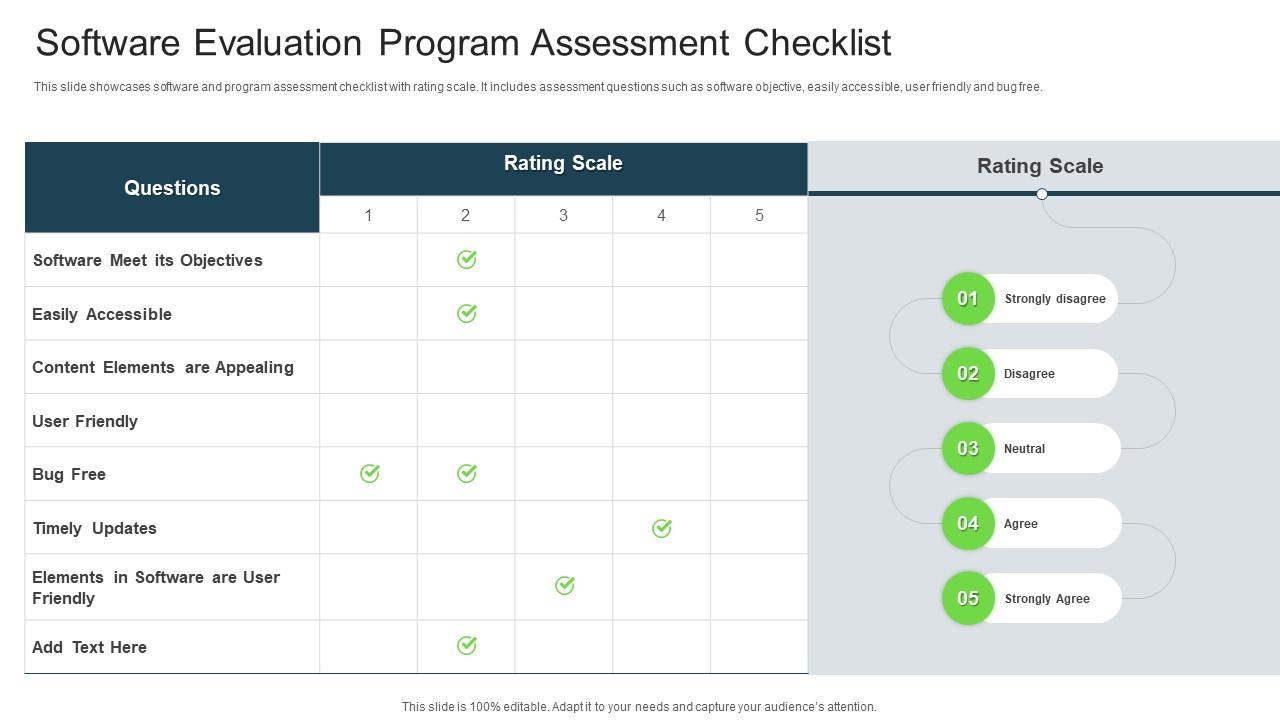
This slide showcases software and program assessment checklist with rating scale. It includes assessment questions such as software objective, easily accessible, user friendly and bug free.
People who downloaded this PowerPoint presentation also viewed the following :
Software Evaluation Program Assessment Checklist with all 6 slides:
Use our Software Evaluation Program Assessment Checklist to effectively help you save your valuable time. They are readymade to fit into any presentation structure.
FAQs for Software Evaluation
Small businesses should prioritize cost-effectiveness, ease of use, scalability potential, and minimal IT support requirements, while large enterprises focus on integration capabilities, security compliance, customization options, and robust support infrastructure. These different priorities reflect varying resource constraints and operational complexity, with small businesses seeking streamlined solutions that grow with them, and enterprises requiring comprehensive systems that seamlessly integrate across departments, ultimately delivering efficiency gains tailored to organizational scale.
User experience testing significantly influences software evaluation checklists by prioritizing usability metrics, accessibility standards, interface design quality, performance benchmarks, and user satisfaction scores. Through comprehensive UX testing, organizations can identify critical pain points, streamline navigation workflows, and enhance overall functionality, with many enterprises finding that user-centered evaluation criteria ultimately deliver higher adoption rates and improved operational efficiency.
Integration capabilities are fundamental in software evaluation, determining seamless data flow, operational continuity, reduced implementation costs, and minimized workflow disruption. Organizations across sectors like healthcare, finance, and retail find that robust integration features enable faster deployment, preserve existing investments, and deliver enhanced operational efficiency, ultimately providing significant competitive advantage in increasingly complex technological environments.
Assessing software scalability involves evaluating performance benchmarks, infrastructure requirements, user capacity limits, database optimization capabilities, and integration flexibility with existing systems. Through load testing and architecture reviews, organizations can determine how solutions handle increased data volumes, concurrent users, and transaction processing demands, while examining licensing models and upgrade paths to ensure long-term viability and cost-effectiveness.
When reviewing software for sensitive data handling, essential security measures include end-to-end encryption, multi-factor authentication, role-based access controls, regular security audits, and compliance with industry standards like GDPR or HIPAA. These safeguards work together by protecting data at rest and in transit, controlling user permissions, and ensuring regulatory compliance, with many financial services and healthcare organizations finding that comprehensive security frameworks ultimately deliver enhanced customer trust and reduced breach risks.
Customer support and training resources significantly influence software evaluation outcomes by determining implementation success, user adoption rates, and long-term operational efficiency. Organizations with robust vendor support experience faster deployment timelines, reduced internal training costs, and higher user satisfaction scores, while comprehensive documentation and responsive technical assistance minimize downtime risks, ultimately delivering stronger ROI and competitive advantage.
User feedback and testimonials provide crucial real-world insights into software performance, usability, and reliability that technical specifications alone cannot reveal. These authentic perspectives help organizations identify potential implementation challenges, understand actual user experiences across different workflows, and validate vendor claims, ultimately reducing deployment risks and ensuring the selected solution delivers measurable business value.
Licensing models and costs should be evaluated through total cost of ownership analysis, including initial fees, ongoing subscriptions, user-based pricing, maintenance costs, and potential scaling expenses. Organizations must assess how different licensing structures align with their growth projections and budget constraints, with many enterprises finding that flexible, usage-based models ultimately deliver better cost predictability and operational efficiency.
Organizations should track user adoption rates, system uptime and performance metrics, task completion times, error frequencies, and customer satisfaction scores to assess software effectiveness. These KPIs enable businesses to measure operational efficiency improvements, identify areas requiring optimization, and validate ROI, with many organizations finding that comprehensive tracking ultimately delivers enhanced productivity and competitive advantage.
Trial versions and demos inform software evaluation checklists by enabling hands-on assessment of usability, performance, integration capabilities, and feature functionality before purchase decisions. Through direct testing, organizations can validate vendor claims, identify potential workflow disruptions, and assess user adoption challenges, with many companies finding that demo experiences reveal critical compatibility issues and training requirements not apparent in standard product documentation, ultimately reducing implementation risks.
**INPUT**: What differences should be taken into account when evaluating software for different industries (e.g., healthcare vs. finance)? **OUTPUT**: Industry-specific software evaluation requires considering regulatory compliance requirements, data security protocols, integration capabilities, and operational workflows unique to each sector. Healthcare organizations prioritize HIPAA compliance and patient data protection, while financial institutions focus on fraud detection and real-time transaction processing, ultimately enabling organizations to streamline operations while meeting industry-specific standards.
Compliance requirements fundamentally shape software evaluation criteria by mandating specific security protocols, data protection measures, audit capabilities, and regulatory reporting features. Organizations in healthcare, finance, and manufacturing increasingly prioritize solutions that streamline compliance management, automate documentation processes, and ensure seamless adherence to industry standards, ultimately delivering reduced risk and operational efficiency.
Vendor reputation and stability serve as critical risk mitigation factors, influencing long-term software viability, ongoing support quality, and business continuity assurance. Organizations evaluate financial health, market presence, customer testimonials, and update consistency, with many enterprises finding that established vendors deliver more reliable partnerships, faster issue resolution, and strategic roadmap alignment for sustained competitive advantage.
A software's development roadmap influences evaluation by revealing planned features, technology updates, security enhancements, and long-term viability considerations. Organizations can assess whether future capabilities align with their strategic goals, scalability requirements, and industry trends, with many enterprises finding that robust roadmaps indicate vendor commitment and minimize risks of platform obsolescence.
Common pitfalls include insufficient stakeholder involvement, inadequate security assessment, overlooking scalability requirements, rushed evaluation timelines, and neglecting total cost of ownership calculations. These oversights often lead to poor adoption rates, integration challenges, and budget overruns, with many organizations finding that thorough upfront evaluation prevents costly post-implementation issues and ensures long-term strategic alignment.
-
The team is highly dedicated and professional. They deliver their work on time and with perfection.
-
Innovative and attractive designs.