


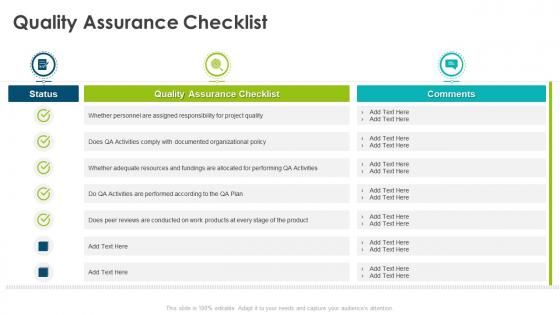
Project quality management bundle quality assurance checklist




Try Before you Buy Download Free Sample Product
 Impress Your
 Audience
 100%
100% Editable
 Save Hours
 of Time


Our Project Quality Management Bundle Quality Assurance Checklist are topically designed to provide an attractive backdrop to any subject. Use them to look like a presentation pro.
People who downloaded this PowerPoint presentation also viewed the following :
Project quality management bundle quality assurance checklist with all 6 slides:
Use our Project Quality Management Bundle Quality Assurance Checklist to effectively help you save your valuable time. They are readymade to fit into any presentation structure.





FAQs for Project quality management bundle
So there's three main parts: Quality Planning, Quality Assurance, and Quality Control. Planning is where you figure out what "good" actually looks like for your project - set those standards early. QA is the ongoing stuff, making sure everyone's following the right steps (this is honestly where most teams slack off). Quality Control is when you actually test everything and catch the screw-ups. Think of it like plan, prevent, check. Oh and definitely nail down your quality criteria at the beginning. Trust me, it'll save you so much pain later when things start going sideways.
So quality planning is basically figuring out your standards and metrics before you even start - like, what does "done well" actually mean for your project? Then QA happens while you're working and it's all about sticking to those processes so you don't mess things up. QC is different though - you're testing stuff after it's built to catch problems. Honestly, it's like cooking. Planning = your recipe prep, QA = using proper technique while cooking, QC = tasting at the end. Most teams just skip straight to testing and then wonder why everything feels so messy. Trust me, nail the planning part first and you'll save yourself tons of headaches later.
Okay so for quality planning, flowcharts and checklists are your best friends - seriously, they catch so many issues early. Cause-and-effect diagrams work great too. You'll definitely need quality metrics and benchmarking so you have actual numbers to hit. Management's gonna want cost-benefit analysis (they're obsessed with ROI). There's fancier stuff like design of experiments if your process is really complex, but honestly? Start with the basics. I probably sound like a broken record, but flowcharts and checklists will save you from expensive disasters later. Way better than scrambling to fix things mid-project.
Okay so you've gotta nail down your quality metrics right from the start - defect rates, customer satisfaction, all that stuff. Build in checkpoints too: peer reviews, testing phases, feedback sessions spread throughout your timeline. Most PMs I know totally blow this off early on (huge mistake) then scramble when everything goes sideways. Don't be that person. Track your numbers consistently and create some basic dashboard to spot trends before they bite you. Also make quality a regular thing in team meetings so problems actually surface instead of hiding until the worst possible moment.
Think of stakeholders as your quality safety net. They actually know what "good" looks like - we're honestly just winging it half the time. Get them involved early and you'll catch problems before they cost you big. Regular feedback sessions are clutch here, but make them structured, not random coffee chats. Set up formal review points where they can actually look at your work and tell you if you're on track. It's way better than finding out at the end that you built the wrong thing perfectly.
So instead of scrambling to fix quality problems at the end (trust me, been there), you build quality standards right into your project from the start. Figure out what "good" looks like before anyone touches the work. Then set up checkpoints and reviews throughout your timeline - not just at the end. Your team needs to know the standards upfront too. Way cheaper than the alternative! Catching problems early saves you so much headache and money. Next project, start by asking "what does quality actually mean here?" and plan around that answer.
Look, a quality management plan is basically your blueprint for making sure the project actually meets what everyone expects. Define your standards upfront and document who does what testing. I can't tell you how many times I've watched projects crash because people had totally different ideas of what "done" looks like. You'll save yourself so much headache later. Map out your review checkpoints from start to finish. Short version - figure out what quality means for YOUR specific project first, then build your testing approach around that. Trust me, flying blind on this stuff always bites you later.
Track your defect rates and customer satisfaction scores first - those are non-negotiable. Rework percentages will show you where things are breaking down. Cost of quality matters big time, especially comparing what you spend preventing issues vs fixing them later (prevention is always cheaper btw). First-pass yield rates are clutch because redoing work is soul-crushing. Cycle times for quality reviews, audit pass/fail rates, customer complaints - all solid indicators. Honestly though? Don't go crazy tracking everything. Pick 3-4 metrics that actually matter for your specific situation and focus there. You can always add more later.
So ISO 9001 is basically this framework that keeps your quality processes consistent throughout a project. Yeah, it makes you document literally everything - kinda annoying at first but it actually works. You'll end up doing way more systematic risk checks and regular audits. Plus there's all these feedback loops with stakeholders. Management has to commit resources too, which is honestly half the battle. I'd say start with just their process approach and documentation stuff. Don't go crazy trying to implement everything at once - your team will hate you. Build up from there once everyone's used to it.
Honestly, the biggest pain is always people fighting change. Teams treat quality like something they'll worry about later instead of baking it in from the start. Time pressure makes everything worse - suddenly everyone's cutting corners when deadlines hit. Your stakeholders will say they want quality but then complain about the actual work needed (so annoying). Different teams not talking to each other screws up consistency too. Oh, and budget constraints obviously don't help. Get leadership on board first though - that's huge. Then set your quality metrics early and keep them visible so nobody can pretend they don't exist.
Honestly, risk management is like having a crystal ball for your project quality. You spot problems before they blow up into expensive disasters. Early identification means you can actually build in those quality checkpoints instead of scrambling later - and trust me, scrambled work always looks terrible. Having backup plans ready saves you from that panic mode where everything goes to hell. Think through what could go wrong upfront, then design your processes around avoiding those failures. It's way smarter than playing defense the whole time. Maybe start by listing your top quality risks for next sprint?
Honestly? Good training is like having quality control baked right into your team. People catch problems way earlier when they actually know what they're doing. Your biggest wins come from fewer mistakes and way less rework - which saves everyone's sanity, trust me. Focus on the skills that directly hit your pain points first. Don't make it a one-and-done workshop thing though. Teams that get ongoing training communicate better about risks too. I've seen it make a huge difference. Start small, maybe pick your worst quality headache and train around that specific gap.
Think of customer feedback as your reality check - it tells you if your project actually works for real people. Don't wait until the end to ask though, that's rookie mistake territory. Set up multiple points where you can gather input throughout the process. Here's the thing - collecting feedback is only half the battle. You need to spot patterns in what people are saying, then actually DO something about it. Otherwise you're just hoarding complaints, which helps nobody. Always circle back to show customers how their suggestions led to real changes. That's how you build trust.
Honestly, tech can save your sanity here. Start with automating your most annoying repetitive checks - that alone will free up so much time. Real-time dashboards show you quality metrics instantly, and digital checklists mean no more paperwork disasters. Set up alerts when things go wrong so you're not playing catch-up later. AI can even spot defect patterns you'd miss (pretty cool actually). The best part? Everything's in one place where you can actually see what's happening and fix issues before they become major problems. Your team can log stuff immediately instead of waiting for those meetings half the people don't show up to anyway.
Definitely dig through your old retrospectives and post-mortems - both the wins and disasters. I keep a running doc of what worked vs what bombed because honestly, we're creatures of habit and repeat dumb mistakes otherwise. Check for patterns like scope creep killing quality or which testing methods actually caught bugs early. My last few projects? Same issues kept popping up. Pull lessons from your most recent 3-5 projects first. Then update your checklists and review processes based on what you find. Trust me, the patterns become super obvious once you start looking.
-
Content of slide is easy to understand and edit.
-
Great experience, I would definitely use your services further.