

Tools For Project Quality Management Plan




Try Before you Buy Download Free Sample Product
 Impress Your
 Audience
 100%
100% Editable
 Save Hours
 of Time


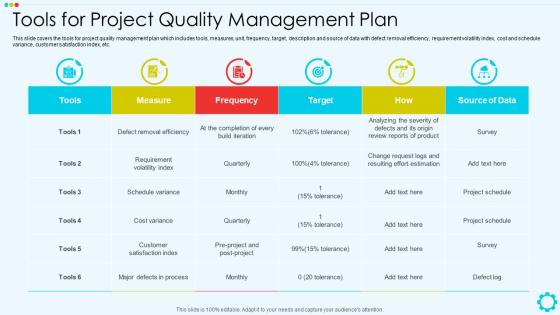
This slide covers the tools for project quality management plan which includes tools, measures, unit, frequency, target, description and source of data with defect removal efficiency, requirement volatility index, cost and schedule variance, customer satisfaction index, etc.
People who downloaded this PowerPoint presentation also viewed the following :
Tools For Project Quality Management Plan with all 6 slides:
Use our Tools For Project Quality Management Plan to effectively help you save your valuable time. They are readymade to fit into any presentation structure.





FAQs for Tools For Project
So there's three main parts: Quality Planning, Quality Assurance, and Quality Control. Basically plan, prevent, and fix. Planning is where you set your standards upfront and map out how you'll actually hit them. QA means sticking to your processes religiously - honestly, this is where most teams completely fall apart because it's boring. Then QC is the inspection part where you're hunting down defects. Oh and don't just dump all your quality checks at the end. That's when fixes cost a fortune. You want to weave all three throughout the whole project.
Dude, quality management tools are like having a smoke detector for your project - they catch problems before everything goes to hell. Control charts, audits, checklists... boring stuff but it works. I learned this the hard way after watching a friend's team scramble for weeks because nobody was tracking their deliverables properly. Such a mess. Start with simple checklists to compare what you're delivering against what you planned. You'll spot issues way faster than just crossing your fingers and hoping things turn out okay. Trust me, "winging it" never ends well.
So Six Sigma is basically this data-driven approach for finding and fixing defects in your processes. Uses the DMAIC method - Define, Measure, Analyze, Improve, Control. Honestly sounds boring but it actually works pretty well. You'll track everything with control charts, process maps, root cause analysis, that kind of thing. The whole point is making decisions based on real numbers instead of just winging it. I'd say start with one small process first and work through those DMAIC steps. Way less overwhelming than trying to fix everything at once.
Jira's probably your best bet for tracking bugs and issues. Monday.com or Asana work well for the bigger picture project stuff. If you're doing software testing, TestRail is decent too. Honestly? Don't overthink it. Pick one and actually use it instead of switching tools every few weeks like my last team did (total nightmare). Azure DevOps is pretty solid if you're already using Microsoft stuff anyway. The trick is finding something your team won't hate using - some of these tools are way too complicated for no reason. Just grab free trials of like 2-3 options and see what clicks.
So basically control charts track your quality stuff over time - you plot data points between upper and lower limits. Defect rates, cycle times, customer satisfaction scores, whatever metrics actually matter to your team. When points fall outside those limits or you see weird trends, that's your signal something's off with the process. It's like having an early warning system before things go to hell. I'd honestly just start simple - pick 2 or 3 key metrics your project really affects and chart them weekly. Way better than scrambling to fix problems after they've already blown up.
Here's the thing - stakeholder feedback is like your quality safety net throughout the whole project. Collect it during reviews, testing, sign-offs, all that stuff. What you think looks "good enough" probably isn't what they had in mind (learned this the hard way). Build their input right into your quality metrics and use it to tweak acceptance criteria as you go. Don't wait until the end to ask - that's when fixes get expensive and everyone gets cranky. Regular feedback loops are your friend here. Trust me on this one.
So basically it's your game plan for not delivering crap work - defines what "good enough" looks like and how you'll actually check that boxes are getting ticked. You'll outline quality standards, who does what, measurement processes, all that stuff. Honestly, most people write these things and then never look at them again, which is dumb. Create it early but actually use it! Your team needs to know where it lives and what they're responsible for. Without one, you're just crossing your fingers that everything turns out okay. Think of it as your "let's not embarrass ourselves" blueprint.
So basically, track all your quality problems first - I know it's tedious but trust me on this. Then figure out which 20% are causing most of your headaches. Make a Pareto chart if you can; seeing those massive bars on the left is wild. Those tall ones? That's where you dump your energy. Don't spread yourself thin trying to fix every little thing. Go after the big troublemakers first and you'll see way better results. It's crazy how much time people waste on tiny issues when there's usually just a few major problems driving everything.
Honestly? Resource limits will kill you, and your team's gonna hate the extra work. I've seen people dig in their heels when you throw new processes at them - they're already swamped. Tool selection is another headache since there's like a million options out there. Good luck getting the budget approved too. Oh, and don't even get me started on making everything play nice with your current systems. Start tiny though - pick one tool, show some quick wins so people actually see it's worth it. Once they're convinced, you can slowly add more stuff to your quality toolkit.
Look, I get why you'd want to just slap a band-aid on bugs and call it done. But here's the thing - root cause analysis actually saves you time in the long run. Instead of the same annoying issues popping up every sprint, you fix the real problem once and you're done. Try the "5 Whys" method or those fishbone diagrams (honestly took me forever to remember what those were called). Start tracking patterns in your defects too. You'll notice the same underlying causes keep screwing things up, whether it's unclear requirements or rushed testing phases.
So honestly, I'd focus on three main things: AI analytics that can spot quality problems before they blow up, real-time collaboration platforms, and dashboards that actually pull everything together instead of making you jump between apps. The machine learning stuff is getting scary good at predictions - like, weirdly accurate. Cloud tools are huge right now since your whole team can update metrics at the same time, plus you can check issues from your phone or whatever. But here's the thing - don't pick something that creates yet another system to manage. Start by figuring out what quality data you're tracking manually now, then find tools to automate that stuff first.
So with Agile, you're basically flipping the whole quality thing on its head. No more waiting until the end to test everything - that was always a nightmare anyway. Build your quality checks right into each sprint instead. Continuous testing becomes your best friend, plus you get feedback from stakeholders constantly. Way less panic mode than waterfall! Everyone works together daily now too - developers, testers, product owners aren't stuck in separate bubbles anymore. Those short feedback loops are clutch. My advice? Start by adding automated testing to your "done" criteria for each user story. Makes everything smoother.
So I'd focus on defect density first - how many bugs per chunk of work you're doing. Customer satisfaction scores are huge too. Then track your defect detection rate, which is basically catching problems before customers see them. Budget and schedule variance will tell you a lot since quality issues usually mean delays and money problems. Rework percentage is honestly one of the best early warning signs for process problems. Test coverage and pass rates give you the technical side of things. But here's the thing - don't try measuring everything right away. Pick maybe 3-4 that actually match what your project needs to accomplish.
So basically, risk management tools are super helpful for catching quality issues before they blow up into expensive disasters. You can use risk registers to spot stuff like sketchy suppliers or process problems way earlier. Honestly, I think of it like having a heads-up system but with boring spreadsheets instead of magic. The trick is building your risk checks right into quality planning from the start. That way you're not just scrambling when things go sideways - you've already got backup plans baked in. Oh, and definitely add a "quality impact" column to your risk register next time you update it.
Pick something that fits your project size - no need for crazy enterprise stuff if you've got a small team. Check what plays nice with your current systems first because switching between platforms is honestly such a pain. Your team actually has to want to use it, otherwise you're just burning money on features nobody touches. Budget's obviously a thing, but don't forget about training costs too. Oh, and definitely try a pilot run or free trial before you commit. I learned that one the hard way - what looks great in demos doesn't always work with real workflows.
-
Great product with highly impressive and engaging designs.
-
Topic best represented with attractive design.